
CIPS Global Commercial Strategy - L6M2 Exam Practice Test
SIMULATION
Describe 5 strategic decisions a company can make and how these decisions could impact upon competitive advantage.
Describe 5 strategic decisions a company can make and how these decisions could impact upon competitive advantage.
Correct Answer:
Five Strategic Decisions a Company Can Make and Their Impact on Competitive Advantage Strategic decisions shape a company's direction and influence its long-term success. Below are five key strategic decisions and their impact on competitive advantage:
1. Market Entry Strategy
Decision: A company decides how to enter new markets (e.g., direct investment, joint ventures, exporting, franchising).
Impact on Competitive Advantage:
✅ Global Reach: Expanding into new markets increases revenue streams and reduces dependency on a single market.
✅ Risk Mitigation: Entering via joint ventures or alliances can reduce risks related to market unfamiliarity.
✅ Brand Positioning: Choosing premium vs. cost-leadership entry strategies can establish market dominance.
❌ Potential Risk: Poor market research can lead to financial loss and reputational damage.
Example: Tesla entering China through direct investment in Gigafactories to strengthen its supply chain and reduce production costs.
2. Supply Chain Strategy
Decision: Whether to adopt a globalized, localized, or hybrid supply chain model.
Impact on Competitive Advantage:
✅ Cost Reduction: Strategic sourcing from low-cost countries lowers production expenses.
✅ Resilience: A diverse supplier base reduces risks of disruptions (e.g., geopolitical risks, pandemics).
✅ Speed to Market: Nearshoring strategies improve lead times and response to demand fluctuations.
❌ Potential Risk: Over-reliance on global suppliers can lead to disruptions (e.g., semiconductor shortages).
Example: Apple's dual sourcing strategy for chip manufacturing (Taiwan's TSMC + US-based suppliers) improves resilience.
3. Innovation and R&D Investment
Decision: How much to invest in research and development (R&D) to drive product innovation.
Impact on Competitive Advantage:
✅ Differentiation: Unique and high-quality products create strong brand loyalty (e.g., iPhones, Tesla).
✅ First-Mover Advantage: Innovators set industry trends, making it difficult for competitors to catch up.
✅ Revenue Growth: New technologies create additional revenue streams (e.g., SaaS models in tech).
❌ Potential Risk: High R&D costs with no guaranteed success (e.g., Google Glass failure).
Example: Pfizer and BioNTech's rapid COVID-19 vaccine development, giving them first-mover advantage.
4. Pricing Strategy
Decision: Whether to compete on cost leadership, differentiation, or premium pricing.
Impact on Competitive Advantage:
✅ Market Penetration: Low-cost pricing attracts price-sensitive customers (e.g., Walmart, Ryanair).
✅ Brand Exclusivity: Premium pricing enhances brand perception and profitability (e.g., Rolex, Louis Vuitton).
✅ Value-Based Pricing: Aligning price with perceived value increases customer retention.
❌ Potential Risk: A race to the bottom in pricing wars can erode profit margins (e.g., budget airlines struggle with profitability).
Example: Apple uses a premium pricing strategy while Xiaomi competes via cost leadership in smartphones.
5. Digital Transformation Strategy
Decision: Investment in automation, AI, and digital platforms to improve efficiency and customer engagement.
Impact on Competitive Advantage:
✅ Operational Efficiency: Automation reduces costs and increases productivity (e.g., Amazon's AI-driven warehouses).
✅ Customer Experience: AI-driven personalization improves engagement (e.g., Netflix's recommendation algorithms).
✅ Scalability: Digital platforms enable rapid global expansion (e.g., Shopify helping SMEs go digital).
❌ Potential Risk: High initial investment with slow ROI; risk of cyber threats.
Example: Starbucks using AI-powered personalization and mobile ordering to increase sales and customer loyalty.
Conclusion
Each strategic decision influences a company's competitive positioning. The most successful companies align market expansion, supply chain strategies, innovation, pricing, and digital transformation to create a sustainable competitive advantage.
1. Market Entry Strategy
Decision: A company decides how to enter new markets (e.g., direct investment, joint ventures, exporting, franchising).
Impact on Competitive Advantage:
✅ Global Reach: Expanding into new markets increases revenue streams and reduces dependency on a single market.
✅ Risk Mitigation: Entering via joint ventures or alliances can reduce risks related to market unfamiliarity.
✅ Brand Positioning: Choosing premium vs. cost-leadership entry strategies can establish market dominance.
❌ Potential Risk: Poor market research can lead to financial loss and reputational damage.
Example: Tesla entering China through direct investment in Gigafactories to strengthen its supply chain and reduce production costs.
2. Supply Chain Strategy
Decision: Whether to adopt a globalized, localized, or hybrid supply chain model.
Impact on Competitive Advantage:
✅ Cost Reduction: Strategic sourcing from low-cost countries lowers production expenses.
✅ Resilience: A diverse supplier base reduces risks of disruptions (e.g., geopolitical risks, pandemics).
✅ Speed to Market: Nearshoring strategies improve lead times and response to demand fluctuations.
❌ Potential Risk: Over-reliance on global suppliers can lead to disruptions (e.g., semiconductor shortages).
Example: Apple's dual sourcing strategy for chip manufacturing (Taiwan's TSMC + US-based suppliers) improves resilience.
3. Innovation and R&D Investment
Decision: How much to invest in research and development (R&D) to drive product innovation.
Impact on Competitive Advantage:
✅ Differentiation: Unique and high-quality products create strong brand loyalty (e.g., iPhones, Tesla).
✅ First-Mover Advantage: Innovators set industry trends, making it difficult for competitors to catch up.
✅ Revenue Growth: New technologies create additional revenue streams (e.g., SaaS models in tech).
❌ Potential Risk: High R&D costs with no guaranteed success (e.g., Google Glass failure).
Example: Pfizer and BioNTech's rapid COVID-19 vaccine development, giving them first-mover advantage.
4. Pricing Strategy
Decision: Whether to compete on cost leadership, differentiation, or premium pricing.
Impact on Competitive Advantage:
✅ Market Penetration: Low-cost pricing attracts price-sensitive customers (e.g., Walmart, Ryanair).
✅ Brand Exclusivity: Premium pricing enhances brand perception and profitability (e.g., Rolex, Louis Vuitton).
✅ Value-Based Pricing: Aligning price with perceived value increases customer retention.
❌ Potential Risk: A race to the bottom in pricing wars can erode profit margins (e.g., budget airlines struggle with profitability).
Example: Apple uses a premium pricing strategy while Xiaomi competes via cost leadership in smartphones.
5. Digital Transformation Strategy
Decision: Investment in automation, AI, and digital platforms to improve efficiency and customer engagement.
Impact on Competitive Advantage:
✅ Operational Efficiency: Automation reduces costs and increases productivity (e.g., Amazon's AI-driven warehouses).
✅ Customer Experience: AI-driven personalization improves engagement (e.g., Netflix's recommendation algorithms).
✅ Scalability: Digital platforms enable rapid global expansion (e.g., Shopify helping SMEs go digital).
❌ Potential Risk: High initial investment with slow ROI; risk of cyber threats.
Example: Starbucks using AI-powered personalization and mobile ordering to increase sales and customer loyalty.
Conclusion
Each strategic decision influences a company's competitive positioning. The most successful companies align market expansion, supply chain strategies, innovation, pricing, and digital transformation to create a sustainable competitive advantage.
SIMULATION
Discuss the role and influence of industry regulators and international bodies in the business environment.
Discuss the role and influence of industry regulators and international bodies in the business environment.
Correct Answer:
The Role and Influence of Industry Regulators and International Bodies in the Business Environment Introduction Industry regulators and international bodies play a critical role in shaping the business environment by enforcing regulations, setting industry standards, and ensuring fair competition. These organizations influence how businesses operate, impacting areas such as trade, finance, environmental sustainability, labor practices, and consumer protection.
Companies must comply with regulations set by both domestic industry regulators and global institutions to maintain legal and ethical business operations.
1. Role of Industry Regulators
Industry regulators are government-appointed or independent organizations that oversee specific sectors to ensure compliance with laws and standards. Their key functions include:
✅ Enforcing Compliance - Ensuring companies adhere to legal requirements (e.g., financial reporting, safety regulations).
✅ Promoting Fair Competition - Preventing monopolies and anti-competitive practices.
✅ Consumer Protection - Safeguarding consumer rights and ensuring product/service quality.
✅ Regulating Market Entry and Operations - Setting standards for licensing, pricing, and ethical conduct.
Example of Industry Regulators
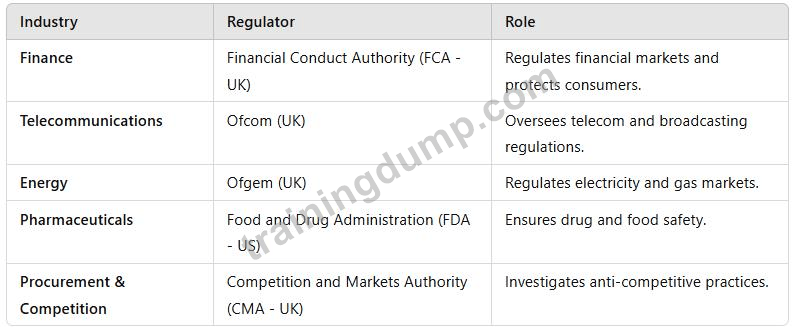
Case Example: The UK's Competition and Markets Authority (CMA) blocked Microsoft's acquisition of Activision Blizzard due to concerns over market dominance in cloud gaming.
2. Role of International Bodies
International bodies set global regulations, trade policies, and ethical standards that influence businesses operating across borders.
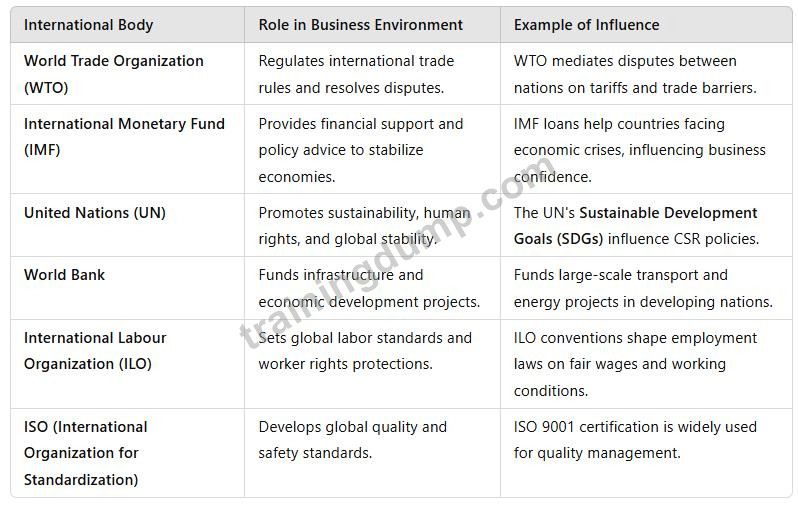
Case Example: The WTO's intervention in Brexit trade negotiations affected tariffs and supply chain costs for UK-based companies.
3. Influence of Industry Regulators and International Bodies on Business Strategy Businesses must align their strategies with regulatory and international frameworks to ensure compliance and avoid financial or reputational risks.
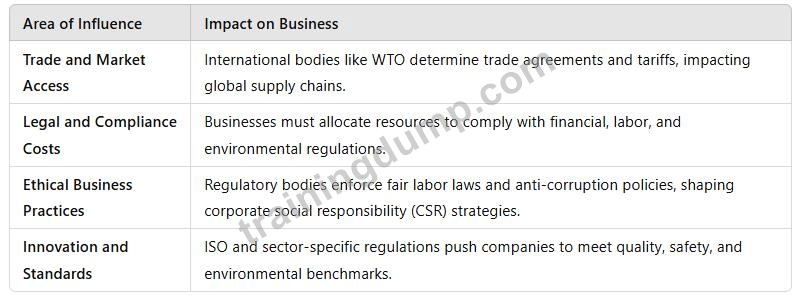
Example: The EU's General Data Protection Regulation (GDPR) forced global companies to enhance data protection policies or face heavy fines.
4. Advantages and Disadvantages of Regulatory and International Influence
✅ Advantages
Promotes Stability & Fair Competition - Reduces market manipulation and corruption.
Protects Consumers & Employees - Ensures safety, fair wages, and ethical standards.
Encourages Innovation & Sustainability - Businesses invest in R&D to meet regulatory requirements.
Facilitates Global Trade - International trade agreements create business opportunities.
❌ Disadvantages
Regulatory Burdens & Compliance Costs - Strict laws increase operational costs.
Trade Barriers & Bureaucracy - Lengthy regulatory approval processes slow down market entry.
Risk of Overregulation - Too many rules can stifle competition and innovation.
Example: The EU Emissions Trading System (EU ETS) requires manufacturers to pay for carbon emissions, increasing operational costs.
Conclusion
Industry regulators and international bodies shape the business environment by enforcing laws, ensuring ethical practices, and facilitating global trade. Companies must proactively monitor regulatory changes, integrate compliance into strategic planning, and adapt to international standards to maintain market competitiveness and sustainability.
Companies must comply with regulations set by both domestic industry regulators and global institutions to maintain legal and ethical business operations.
1. Role of Industry Regulators
Industry regulators are government-appointed or independent organizations that oversee specific sectors to ensure compliance with laws and standards. Their key functions include:
✅ Enforcing Compliance - Ensuring companies adhere to legal requirements (e.g., financial reporting, safety regulations).
✅ Promoting Fair Competition - Preventing monopolies and anti-competitive practices.
✅ Consumer Protection - Safeguarding consumer rights and ensuring product/service quality.
✅ Regulating Market Entry and Operations - Setting standards for licensing, pricing, and ethical conduct.
Example of Industry Regulators
Case Example: The UK's Competition and Markets Authority (CMA) blocked Microsoft's acquisition of Activision Blizzard due to concerns over market dominance in cloud gaming.
2. Role of International Bodies
International bodies set global regulations, trade policies, and ethical standards that influence businesses operating across borders.
Case Example: The WTO's intervention in Brexit trade negotiations affected tariffs and supply chain costs for UK-based companies.
3. Influence of Industry Regulators and International Bodies on Business Strategy Businesses must align their strategies with regulatory and international frameworks to ensure compliance and avoid financial or reputational risks.
Example: The EU's General Data Protection Regulation (GDPR) forced global companies to enhance data protection policies or face heavy fines.
4. Advantages and Disadvantages of Regulatory and International Influence
✅ Advantages
Promotes Stability & Fair Competition - Reduces market manipulation and corruption.
Protects Consumers & Employees - Ensures safety, fair wages, and ethical standards.
Encourages Innovation & Sustainability - Businesses invest in R&D to meet regulatory requirements.
Facilitates Global Trade - International trade agreements create business opportunities.
❌ Disadvantages
Regulatory Burdens & Compliance Costs - Strict laws increase operational costs.
Trade Barriers & Bureaucracy - Lengthy regulatory approval processes slow down market entry.
Risk of Overregulation - Too many rules can stifle competition and innovation.
Example: The EU Emissions Trading System (EU ETS) requires manufacturers to pay for carbon emissions, increasing operational costs.
Conclusion
Industry regulators and international bodies shape the business environment by enforcing laws, ensuring ethical practices, and facilitating global trade. Companies must proactively monitor regulatory changes, integrate compliance into strategic planning, and adapt to international standards to maintain market competitiveness and sustainability.
SIMULATION
Currency Options and Currency Swaps are instruments used in foreign exchange. Explain the advantages of using these derivatives compared to the use of spot transactions
Currency Options and Currency Swaps are instruments used in foreign exchange. Explain the advantages of using these derivatives compared to the use of spot transactions
Correct Answer:
Comparison of Currency Options, Currency Swaps, and Spot Transactions in Foreign Exchange Introduction In international trade and finance, companies dealing with foreign currencies use various financial instruments to manage exchange rate risks. The three main instruments are:
Currency Options - Provide the right (but not obligation) to exchange currency at a fixed rate in the future.
Currency Swaps - A contract to exchange currency flows over a set period.
Spot Transactions - A simple immediate currency exchange based on the current market rate.
While spot transactions offer simplicity, currency options and swaps provide better risk management and flexibility.
1. Currency Options (Flexible Risk Management Tool)
Definition
A currency option gives the holder the right, but not the obligation, to exchange a currency at a predetermined rate on or before a specific date.
✅ Types of Options:
Call Option - Right to buy a currency at a fixed rate.
Put Option - Right to sell a currency at a fixed rate.
Example: A UK importer buying goods from the US purchases a GBP/USD call option to protect against an increase in the exchange rate.
Advantages of Currency Options Over Spot Transactions
✔ Risk Protection - Protects against adverse currency movements while maintaining upside potential.
✔ Flexibility - No obligation to execute the transaction if the exchange rate is favorable.
✔ Ideal for Hedging Future Payments - Useful for businesses with uncertain future cash flows in foreign currencies.
❌ Disadvantages
✖ Premium Costs - Buying options requires upfront payment.
✖ Complexity - More sophisticated than spot transactions.
Best for: Businesses managing currency risk with unpredictable payment schedules.
2. Currency Swaps (Long-Term Hedging Solution)
Definition
A currency swap is a contract between two parties to exchange currency flows over a set period at a predetermined rate.
✅ How It Works:
Companies exchange principal and interest payments in different currencies.
Used to secure long-term financing in foreign markets.
Example: A UK company with a loan in USD enters a GBP/USD swap with a US firm to exchange interest payments, reducing exchange rate risk.
Advantages of Currency Swaps Over Spot Transactions
✔ Long-Term Stability - Protects businesses from long-term exchange rate fluctuations.
✔ Cost Efficiency - Often cheaper than converting currency via spot transactions repeatedly.
✔ Reduces Interest Rate Risk - Useful for companies with foreign currency debt obligations.
❌ Disadvantages
✖ Less Flexible Than Options - The swap contract must be followed as agreed.
✖ Counterparty Risk - Dependent on the financial stability of the other party.
Best for: Companies with long-term foreign currency liabilities (e.g., loans, international contracts).
3. Spot Transactions (Immediate Currency Exchange, No Hedging)
Definition
A spot transaction is a straightforward exchange of currency at the current market rate for immediate settlement (usually within two days).
Example: A European exporter receiving USD payment converts it immediately into EUR using a spot transaction.
Limitations Compared to Derivatives (Options & Swaps)
❌ No Risk Protection - Subject to daily exchange rate volatility.
❌ Not Suitable for Future Obligations - Cannot hedge against expected payments or receipts.
❌ Higher Costs for Frequent Transactions - Repeated spot trades incur forex fees and spread costs.
Best for: Small businesses or one-time transactions with no currency risk concerns.
4. Comparison Table: Currency Options, Swaps, and Spot Transactions
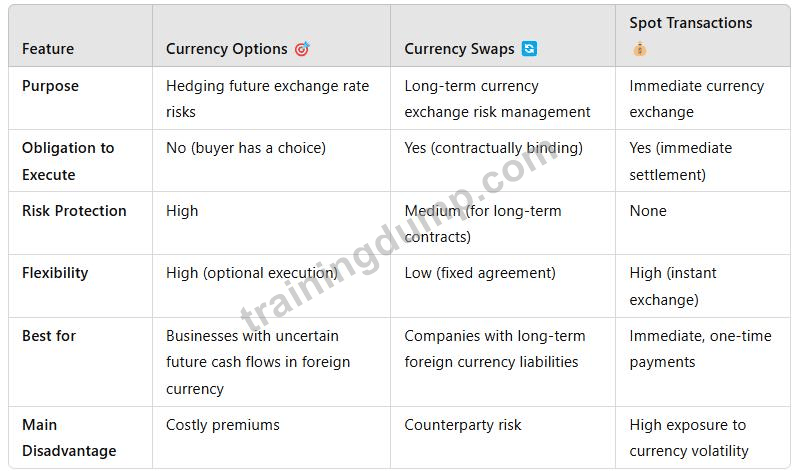
Key Takeaway:
Currency options offer flexibility and protection but come at a cost.
Currency swaps provide long-term stability for large corporations.
Spot transactions are simple but expose businesses to market fluctuations.
5. Conclusion & Best Recommendation
For businesses engaged in international trade, investments, or loans, using currency options and swaps is superior to spot transactions, as they provide:
✅ Protection from exchange rate volatility.
✅ Cost efficiency for large or recurring transactions.
✅ Better financial planning and risk management.
Best Choice Based on Business Needs:
For short-term flexibility → Currency Options
For long-term contracts or loans → Currency Swaps
For one-time currency exchange → Spot Transactions
By selecting the right derivative instrument, businesses can reduce foreign exchange risk and improve financial stability.
Currency Options - Provide the right (but not obligation) to exchange currency at a fixed rate in the future.
Currency Swaps - A contract to exchange currency flows over a set period.
Spot Transactions - A simple immediate currency exchange based on the current market rate.
While spot transactions offer simplicity, currency options and swaps provide better risk management and flexibility.
1. Currency Options (Flexible Risk Management Tool)
Definition
A currency option gives the holder the right, but not the obligation, to exchange a currency at a predetermined rate on or before a specific date.
✅ Types of Options:
Call Option - Right to buy a currency at a fixed rate.
Put Option - Right to sell a currency at a fixed rate.
Example: A UK importer buying goods from the US purchases a GBP/USD call option to protect against an increase in the exchange rate.
Advantages of Currency Options Over Spot Transactions
✔ Risk Protection - Protects against adverse currency movements while maintaining upside potential.
✔ Flexibility - No obligation to execute the transaction if the exchange rate is favorable.
✔ Ideal for Hedging Future Payments - Useful for businesses with uncertain future cash flows in foreign currencies.
❌ Disadvantages
✖ Premium Costs - Buying options requires upfront payment.
✖ Complexity - More sophisticated than spot transactions.
Best for: Businesses managing currency risk with unpredictable payment schedules.
2. Currency Swaps (Long-Term Hedging Solution)
Definition
A currency swap is a contract between two parties to exchange currency flows over a set period at a predetermined rate.
✅ How It Works:
Companies exchange principal and interest payments in different currencies.
Used to secure long-term financing in foreign markets.
Example: A UK company with a loan in USD enters a GBP/USD swap with a US firm to exchange interest payments, reducing exchange rate risk.
Advantages of Currency Swaps Over Spot Transactions
✔ Long-Term Stability - Protects businesses from long-term exchange rate fluctuations.
✔ Cost Efficiency - Often cheaper than converting currency via spot transactions repeatedly.
✔ Reduces Interest Rate Risk - Useful for companies with foreign currency debt obligations.
❌ Disadvantages
✖ Less Flexible Than Options - The swap contract must be followed as agreed.
✖ Counterparty Risk - Dependent on the financial stability of the other party.
Best for: Companies with long-term foreign currency liabilities (e.g., loans, international contracts).
3. Spot Transactions (Immediate Currency Exchange, No Hedging)
Definition
A spot transaction is a straightforward exchange of currency at the current market rate for immediate settlement (usually within two days).
Example: A European exporter receiving USD payment converts it immediately into EUR using a spot transaction.
Limitations Compared to Derivatives (Options & Swaps)
❌ No Risk Protection - Subject to daily exchange rate volatility.
❌ Not Suitable for Future Obligations - Cannot hedge against expected payments or receipts.
❌ Higher Costs for Frequent Transactions - Repeated spot trades incur forex fees and spread costs.
Best for: Small businesses or one-time transactions with no currency risk concerns.
4. Comparison Table: Currency Options, Swaps, and Spot Transactions
Key Takeaway:
Currency options offer flexibility and protection but come at a cost.
Currency swaps provide long-term stability for large corporations.
Spot transactions are simple but expose businesses to market fluctuations.
5. Conclusion & Best Recommendation
For businesses engaged in international trade, investments, or loans, using currency options and swaps is superior to spot transactions, as they provide:
✅ Protection from exchange rate volatility.
✅ Cost efficiency for large or recurring transactions.
✅ Better financial planning and risk management.
Best Choice Based on Business Needs:
For short-term flexibility → Currency Options
For long-term contracts or loans → Currency Swaps
For one-time currency exchange → Spot Transactions
By selecting the right derivative instrument, businesses can reduce foreign exchange risk and improve financial stability.
SIMULATION
Describe four drivers of internationalisation
Describe four drivers of internationalisation
Correct Answer:
Four Key Drivers of Internationalisation
Introduction
Internationalisation refers to the process of expanding business operations into international markets. Companies expand globally to increase market share, access resources, reduce costs, and enhance competitiveness.
Several factors drive internationalisation, but the four key drivers are:
Market Drivers - Demand from global consumers.
Cost Drivers - Reducing production costs.
Competitive Drivers - Gaining an edge over rivals.
Government & Regulatory Drivers - Trade policies and incentives.
These factors influence business strategy, supply chain management, and operational efficiency in international markets.
1. Market Drivers(Demand and Market Expansion)
Definition
Market drivers relate to consumer demand, global branding opportunities, and standardization of products across different markets.
✅ Why It Drives Internationalisation?
Companies seek new customers and revenue streams beyond domestic markets.
Global branding creates strong market presence and customer loyalty.
Similar customer preferences allow for product standardization and scalability.
Example: McDonald's expands globally by offering consistent branding and adapted menus to match local tastes.
Key Takeaway: Businesses expand internationally to tap into new markets, increase sales, and leverage brand recognition.
2. Cost Drivers (Reducing Production and Operational Costs)
Definition
Cost drivers involve reducing manufacturing, labor, and supply chain costs by operating in lower-cost regions.
✅ Why It Drives Internationalisation?
Labor cost savings - Companies move production to low-cost countries (e.g., China, Vietnam, Mexico).
Economies of scale - Expanding operations globally lowers per-unit costs.
Access to cheaper raw materials - Firms relocate to resource-rich countries for lower procurement costs.
Example: Apple manufactures iPhones in China due to lower labor costs and supplier proximity.
Key Takeaway: Companies internationalise to optimize costs, increase profit margins, and improve supply chain efficiency.
3. Competitive Drivers (Gaining Market Advantage)
Definition
Competitive drivers push firms to expand internationally to stay ahead of rivals, access new technologies, and strengthen market positioning.
✅ Why It Drives Internationalisation?
Competing with global players forces firms to expand or risk losing market share.
First-mover advantage - Entering new markets early builds brand dominance.
Access to innovation - Expanding to regions with advanced R&D and skilled talent enhances competitiveness.
Example: Tesla expanded into China to compete with local EV manufacturers and dominate the world's largest electric vehicle market.
Key Takeaway: Businesses internationalise to outperform competitors, access innovation, and capture strategic markets.
4. Government & Regulatory Drivers(Trade Policies & Incentives)
Definition
Government policies, trade agreements, and financial incentives influence how and where businesses expand internationally.
✅ Why It Drives Internationalisation?
Free Trade Agreements (FTAs) reduce tariffs, making exports/imports more attractive.
Government incentives (e.g., tax breaks, subsidies) encourage foreign investments.
Favorable regulations allow easier market entry and operations.
Example: Car manufacturers set up plants in Mexico due to NAFTA trade benefits and lower import tariffs into North America.
Key Takeaway: Businesses internationalise when government policies support market entry, trade facilitation, and investment incentives.
Conclusion
Internationalisation is driven by market demand, cost efficiencies, competitive pressures, and regulatory factors. Companies expand globally to:
✅ Access new customers and increase revenue.
✅ Reduce costs through cheaper production and labor.
✅ Stay competitive and gain market leadership.
✅ Leverage government trade policies for easier market entry.
Understanding these drivers helps businesses make informed global expansion decisions while managing risks effectively.
Introduction
Internationalisation refers to the process of expanding business operations into international markets. Companies expand globally to increase market share, access resources, reduce costs, and enhance competitiveness.
Several factors drive internationalisation, but the four key drivers are:
Market Drivers - Demand from global consumers.
Cost Drivers - Reducing production costs.
Competitive Drivers - Gaining an edge over rivals.
Government & Regulatory Drivers - Trade policies and incentives.
These factors influence business strategy, supply chain management, and operational efficiency in international markets.
1. Market Drivers(Demand and Market Expansion)
Definition
Market drivers relate to consumer demand, global branding opportunities, and standardization of products across different markets.
✅ Why It Drives Internationalisation?
Companies seek new customers and revenue streams beyond domestic markets.
Global branding creates strong market presence and customer loyalty.
Similar customer preferences allow for product standardization and scalability.
Example: McDonald's expands globally by offering consistent branding and adapted menus to match local tastes.
Key Takeaway: Businesses expand internationally to tap into new markets, increase sales, and leverage brand recognition.
2. Cost Drivers (Reducing Production and Operational Costs)
Definition
Cost drivers involve reducing manufacturing, labor, and supply chain costs by operating in lower-cost regions.
✅ Why It Drives Internationalisation?
Labor cost savings - Companies move production to low-cost countries (e.g., China, Vietnam, Mexico).
Economies of scale - Expanding operations globally lowers per-unit costs.
Access to cheaper raw materials - Firms relocate to resource-rich countries for lower procurement costs.
Example: Apple manufactures iPhones in China due to lower labor costs and supplier proximity.
Key Takeaway: Companies internationalise to optimize costs, increase profit margins, and improve supply chain efficiency.
3. Competitive Drivers (Gaining Market Advantage)
Definition
Competitive drivers push firms to expand internationally to stay ahead of rivals, access new technologies, and strengthen market positioning.
✅ Why It Drives Internationalisation?
Competing with global players forces firms to expand or risk losing market share.
First-mover advantage - Entering new markets early builds brand dominance.
Access to innovation - Expanding to regions with advanced R&D and skilled talent enhances competitiveness.
Example: Tesla expanded into China to compete with local EV manufacturers and dominate the world's largest electric vehicle market.
Key Takeaway: Businesses internationalise to outperform competitors, access innovation, and capture strategic markets.
4. Government & Regulatory Drivers(Trade Policies & Incentives)
Definition
Government policies, trade agreements, and financial incentives influence how and where businesses expand internationally.
✅ Why It Drives Internationalisation?
Free Trade Agreements (FTAs) reduce tariffs, making exports/imports more attractive.
Government incentives (e.g., tax breaks, subsidies) encourage foreign investments.
Favorable regulations allow easier market entry and operations.
Example: Car manufacturers set up plants in Mexico due to NAFTA trade benefits and lower import tariffs into North America.
Key Takeaway: Businesses internationalise when government policies support market entry, trade facilitation, and investment incentives.
Conclusion
Internationalisation is driven by market demand, cost efficiencies, competitive pressures, and regulatory factors. Companies expand globally to:
✅ Access new customers and increase revenue.
✅ Reduce costs through cheaper production and labor.
✅ Stay competitive and gain market leadership.
✅ Leverage government trade policies for easier market entry.
Understanding these drivers helps businesses make informed global expansion decisions while managing risks effectively.