

100% PASS RATE JNCIS-ENT JN0-349 Certified Exam DUMP with 112 Questions
Updates For the Latest JN0-349 Free Exam Study Guide!
Juniper JN0-349 Exam Topics:
| Section | Objectives |
|---|---|
| OSPF | Describe the concepts, operation or functionality of OSPF
Demonstrate knowledge how to configure, monitor or troubleshoot OSPF
|
| High Availability | Identify the concepts, benefits, applications or requirements for high availability in a Junos OS environment
Demonstrate knowledge of how to configure, monitor, or troubleshoot high availability components
|
| Protocol Independent Routing | Identify the concepts, operation or functionality of various protocol-independent routing components
Demonstrate knowledge how to configure, monitor, or troubleshoot various protocol-independent routing components
|
| IS-IS | Describe the concepts, operation or functionality of IS-IS
Demonstrate knowledge of how to configure, monitor or troubleshoot IS-IS
|
| Spanning Tree | Describe the concepts, benefits, operation, or functionality of the Spanning Tree Protocol
Demonstrate knowledge how to configure, monitor, or troubleshoot Spanning Tree
|
Juniper JN0-349 Exam Certification Details:
| Exam Code | JN0-349 JNCIS-ENT |
| Exam Name | Enterprise Routing and Switching Specialist |
| Exam Price | $300 USD |
| Exam Registration | PEARSON VUE |
| Sample Questions | Juniper JN0-349 Sample Questions |
| Duration | 90 minutes |
NEW QUESTION 46
Which two statements are true about high availability on Junos devices? (Choose two.)
- A. BFD is faster at detecting failures than default GRE or OSPF timers.
- B. BFD is slower at detecting failures than default GRE or OSPF timers.
- C. NSR is independent of helper routers to assist the routing platform in restoring routing protocol information.
- D. NSR is dependent on helper routers to assist the routing platform in restoring routing protocol information.
Answer: A,C
Explanation:
Explanation
https://www.juniper.net/documentation/en_US/junos/topics/concept/nsr-overview.html
NEW QUESTION 47
Based on the traceoptions output shown in the exhibit, what is the problem with the adjacency?
- A. connectivity
- B. area mismatch
- C. MTU mismatch
- D. authentication mismatch
Answer: B
NEW QUESTION 48
Click the Exhibit button.
Why is the route shown in the exhibit hidden?
- A. The route is being rejected through an export policy.
- B. The router is being rejected through an import policy.
- C. The router cannot reach the protocol next hop.
- D. An MPLS LSP is unavailable.
Answer: B
NEW QUESTION 49
What are two benefits of 802.3ad link aggregation? (Choose two)
- A. It increases bandwidth
- B. It creates physical layer redundancy.
- C. It simplifies interface configuration.
- D. It ensures symmetrical paths
Answer: A,B
Explanation:
Aggregating multiple links between physical interfaces creates a single logical point-to-point trunk
link or a LAG. The LAG balances traffic across the member links within an aggregated Ethernet
bundle and effectively increases the uplink bandwidth. Another advantage of link aggregation is
increased availability, because the LAG is composed of multiple member links. If one member
link fails, the LAG continues to carry traffic over the remaining links.
https://www.juniper.net/documentation/us/en/software/junos/interfaces-ethernet-
switches/topics/topic-map/switches-interface-aggregated.html
NEW QUESTION 50
You want to advertise only a default route into a new area, which will be called area7.
In this scenario, which configuration statement would solve this problem?
- A. User@host t# set protocols ospf area 0.0.0.7 nssa default-lsa default-metric 10
- B. user@host # set protocols ospf area 0.0.0.7 stub default-metric 10
- C. User@host # set protocols ospf area 0.0.0.7 stub no-summaries
- D. user@host # set protocols ospf area 0.0.0.7 stub
Answer: B
NEW QUESTION 51
Which two statements are correct regarding the root bridge election process when using STP?
(Choose two )
- A. A higher system MAC address is preferred
- B. A higher bridge priority is preferred
- C. A lower bridge priority is preferred
- D. A lower system MAC address is preferred
Answer: C,D
NEW QUESTION 52
Your network connect to the Internet Through two different ISPs using EBGP.
You must ensure that ISP1 is the primary path used for all traffic entering your network while
using ISP2 as a backup path.
In this scenario, which statement is correct?
- A. You should use a lower MED value on routes sent to ISP1.
- B. You should change the next hop for all routes sent to ISP2.
- C. You should your local AS number three times on routes that you are sending to ISP2.
- D. You should assign a higher local preference on routers that you are sending to ISP1.
Answer: C
NEW QUESTION 53
In which two STP states is a port active and a MAC address learned? (Choose two.)
- A. blocking
- B. learning
- C. forwarding
- D. disabled
Answer: B,C
NEW QUESTION 54
What are the three possible port states when using RSTP? (Choose two.)
- A. Listening
- B. Tagging
- C. Discarding
- D. Learning
- E. Forwarding
Answer: C,D,E
NEW QUESTION 55
Exhibit.
In the exhibit, each IP subnet in the network is associated with a unique VLAN ID.
Which action will ensure that Host C will communicate with Host A and Host B?
- A. Configure an IRB interface for each VLAN and associate It with its corresponding VLAN.
- B. Configure all switch ports connecting to the host devices as trunk ports associated with all VLANs
- C. Configure all switch ports connecting to the host devices as access ports associated with a common VLAN.
- D. Configure a port-based ACL that permits inter-VLAN routing for all configured VLANs.
Answer: C
NEW QUESTION 56
Which two situations would cause dynamic ARP inspection to drop traffic? (Choose two.)
- A. if no IP-to-MAC address entry exists in the DHCP snooping database
- B. if the IP address in the ARP packet is deemed invalid
- C. if the ARP packet comes from a port that has been configured as trusted
- D. if the requested MAC address exceeds the configured limit on the port
Answer: A,B
NEW QUESTION 57
You are adding a new EX4300 member switch to your existing EX4300 Virtual Chassis. However,
the new member is not running the same Junos version as the other members.
By default, what is the expected behavior in this scenario?
- A. The new switch is not recognized by the virtual Chassis.
- B. The virtual Chassis will transition into a brain situation between the existing master Routing
Engine and the switch running the different version. - C. The new switch will be assigned a member ID and then placed in an inactive state.
- D. The new switch will be assigned a member ID and then placed in an inactive state.
Answer: C
Explanation:
https://www.juniper.net/documentation/en_US/junos/topics/concept/virtual-chassis-ex4200-
software-automatic-update.html
NEW QUESTION 58
Click the Exhibit button.
Which statement is true about the configuration shown in the exhibit?
- A. The preference for the 172.30.25.1 next hop is 5.
- B. 172.30.25.1 is the preferred next hop.
- C. The preferred next hop is 172.30.25.5.
- D. The preference for the 172.30.25.1 next hop is 7.
Answer: C
NEW QUESTION 59
You have configured the route with an IS-IS metric of 2048. However, the IS-IS interface metric of
63 is being applied for the interface of this router.
What must you do to enable larger metric value?
- A. Restart the IS-IS protocol.
- B. Disable narrow metrics.
- C. Enable level 1 IS-IS routing.
- D. Enable wide metrics.
Answer: B
NEW QUESTION 60
Click the Exhibit button.
Which statement is correct about the ISO NET address shown in the exhibit?
- A. The area identifier is 0001
- B. The system identifier is 6800.1001.00
- C. The authority and format identifier (AFI) is 00
- D. This is not a valid NET address
Answer: A
NEW QUESTION 61
Which two statements are correct? (Choose two.)
- A. The ge-0/0/10 interface will be part of the RSTP topology but will block incoming BPDUs.
- B. The ge-0/0/13 interface will be selected as the forwarding interface.
- C. This device must be selected as the root bridge.
- D. The ge-0/010 interface will not participate in the RSTP topology.
Answer: B,D
NEW QUESTION 62
You are troubleshooting OSPF issues on your device. You run a trace log and receive the error shown in the exhibit.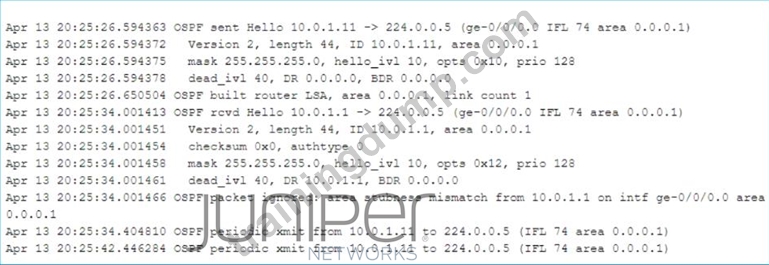
What would case this error?
- A. MD5 authentication error
- B. stub area mismatch
- C. missing route policy
- D. subnet mismatch
Answer: B
NEW QUESTION 63
Click the Exhibit button.
Your switches are managed using Junos Space Network Director. You want to secure the switches using a Network Director filter profile. A filter profile containing one term shown in the exhibit is deployed to ports on managed devices.
Which traffic will be accepted by the filter?
- A. All traffic will be accepted.
- B. Traffic containing a source MAC of 02:85:05:00:00:00/24 will be accepted.
- C. No traffic will be accepted.
- D. Traffic containing a destination MAC of 02:85:05:00:00:00/24 will be accepted.
Answer: B
NEW QUESTION 64
Which statement is true about IP-IP tunnels?
- A. The packet header is replaced before entering the tunnel
- B. The time-to-live value of the original packet Is decremented.
- C. IP-IP tunnels are protocol agnostic.
- D. The packet is encapsulated unchanged before entering the tunnel
Answer: D
NEW QUESTION 65
You are concerned that someone from outside the company could use an open conference room port to access the network.
Which feature should you use to address this concern?
- A. 802.1X
- B. MAC limiting
- C. persistent MAC learning
- D. DHCP snooping
Answer: A
NEW QUESTION 66
Which two OSPF header fields must match to form an adjacency over a broadcast connection? (Choose two.)
- A. neighbor
- B. options
- C. hello interval
- D. router priority
Answer: B,C
NEW QUESTION 67
Which OSPF packet type is sent when an OSPF router detects its database is state?
- A. Database description
- B. Link-state acknowledgment
- C. Link-state request
- D. Hello
Answer: C
NEW QUESTION 68
Which two port security features use the DHCP snooping database for additional port security? (Choose two.)
- A. MACsec
- B. dynamic ARP inspection
- C. MAC learning
- D. IP Source Guard
Answer: B,D
NEW QUESTION 69
Which statement about persistent MAC learning is correct?
- A. 802.1X must be configured on the port for persistent MAC learning to work.
- B. Access ports must be configured with the no-mac-learning command.
- C. Port moves require manual operator intervention.
- D. Trunk ports require MAC addresses to be configured on each VLAN.
Answer: C
NEW QUESTION 70
Click the Exhibit button.
Referring to the output shown in the exhibit, which two statements are correct? (Choose two.)
- A. The device is not an ABR.
- B. The device is an ABR.
- C. The device originated the 192.168.1.2 database entry.
- D. The device originated the 192.168.1.1 database entry.
Answer: B,C
NEW QUESTION 71
......
Best JN0-349 Exam Preparation Material with New Dumps Questions https://www.trainingdump.com/Juniper/JN0-349-practice-exam-dumps.html
Fast Exam Updates JN0-349 dumps with PDF Test Engine Practice https://drive.google.com/open?id=1AzScqAvIHWahw6NftfVklSPazs2WD7gq