

2024 Realistic TrainingDump CPC-SEN Dumps PDF - 100% Passing Guarantee
Free CyberArk CPC-SEN Exam Questions and Answer
NEW QUESTION # 25
To disable the PSM default Support for Browser Sessions, which option should be set to 'No* before running Hardening?
- A. SupportHTML5Content
- B. SupportWebApplications
- C. SupportBrowsers
- D. SupportWebBrowsers
Answer: C
Explanation:
To disable the PSM default support for browser sessions, the option SupportBrowsers should be set to 'No' before running the hardening process. This configuration change is made within the PSM's configuration files, typically found in the PSM's administrative interface or directly within specific XML configuration files like PSMHardening.xml. Setting this option to 'No' prevents the PSM from processing session requests that involve web browsers, thereby enhancing security by limiting the session types the PSM will support. This setting is particularly important in environments where web browsing sessions are deemed unnecessary or too risky.
NEW QUESTION # 26
Which statement is correct about using the AllowedSafes platform parameter?
- A. It prevents the CPM from processing pending items in the Discovery safes enforcing manual intervention to complete the onboarding process.
- B. It allows the CPM to access PSM safes to monitor platform configuration and connection component changes.
- C. It allows users to access accounts in specific safes.
- D. It prevents the CPM from scanning all safes, restricting it to scan only safes that match the AllowedSafes configuration.
Answer: D
Explanation:
The correct statement about using the AllowedSafes platform parameter is that it prevents the Central Policy Manager (CPM) from scanning all safes, restricting it to scan only safes that match the AllowedSafes configuration. This parameter is crucial in large-scale deployments where efficiency and resource management are key. By specifying which safes the CPM should manage, unnecessary scanning of irrelevant safes is avoided, thus optimizing the CPM's performance and reducing the load on the CyberArk environment. This configuration can be found in the platform management section of the CyberArk documentation.
NEW QUESTION # 27
On the CPM, you want to verify if DEP is disabled for the required executables According to best practices, which executables should be listed? (Choose 2.)
- A. Telnet.exe
- B. Plink.exe
- C. putty.exe
- D. mstsc.exe
Answer: B,C
Explanation:
On the Central Policy Manager (CPM), it is crucial to verify that Data Execution Prevention (DEP) is disabled for specific executables required for proper operation according to best practices. The relevant executables include:
Plink.exe (Option B): This executable is commonly used for SSH communications and may require DEP to be disabled to function correctly under certain configurations.
putty.exe (Option C): Similar to Plink.exe, Putty is another essential tool for SSH communications and might also require DEP to be disabled to prevent any execution issues.
NEW QUESTION # 28
What is the default username for the PSM for SSH maintenance user?
- A. proxyusr
- B. proxymng
- C. psmpmaintenanceuser
- D. psmp_maintenance
Answer: D
Explanation:
The default username for the Privileged Session Manager (PSM) for SSH maintenance user in CyberArk Privilege Cloud is psmp_maintenance. This account is used for maintenance purposes and is integral for administrative tasks and configurations related to SSH sessions managed by the PSM. The username is predefined and standardized across deployments to maintain consistency and ensure security best practices are adhered to. The username is mentioned in the CyberArk official documentation regarding PSM configuration for SSH.
NEW QUESTION # 29
Your customer is using Privilege Cloud Shared Services. What is the correct CyberArk Vault address for this customer?
- A. vault-<subdomain>.privilegecloud.cyberark.cloud
- B. carkvault-<subdomain>.privilegecloud.cyberark.cloud
- C. v-<subdomain>.privilegecloud.cyberark.cloud
- D. carkvlt-<subdomain> privilegecloud.cyberark.cloud
Answer: A
Explanation:
For customers using CyberArk Privilege Cloud Shared Services, the correct format for the CyberArk Vault address is:
vault-<subdomain>.privilegecloud.cyberark.cloud (Option B). This format is used to access the vault services provided by CyberArk in the cloud environment, where <subdomain> is the unique identifier assigned to the customer's specific instance of the Privilege Cloud.
NEW QUESTION # 30
Following the installation of the PSM for SSH server, which additional tasks should be performed? (Choose 2.)
- A. Package all installation log files for upload to CyberArk.
- B. Delete the psmpparms file you used during installation.
- C. Delete the user.cred file used during installation.
- D. Delete the vault.ini you used during installation.
Answer: B,C
Explanation:
Following the installation of the PSM for SSH server, certain security and cleanup tasks are crucial to secure the environment and eliminate potential vulnerabilities:
Delete the user.cred file used during installation (A): The user.cred file contains sensitive credential information used during the installation process. Deleting this file post-installation ensures that this sensitive data is not left accessible on the system, mitigating the risk of unauthorized access.
Delete the psmpparms file you used during installation (C): Similar to the user.cred file, the psmpparms file often contains parameters that might include sensitive configuration details. Removing this file after the installation process is completed helps in securing the server by removing potential leakage points of sensitive information.
These actions are part of best practices to secure the installation environment and reduce the risk of sensitive information exposure.
NEW QUESTION # 31
Which option correctly describes the authentication differences between CyberArk Privilege Cloud and CyberArk PAM Self-Hosted?
- A. CyberArk Privilege Cloud requires on-premises components for all authentication and does not support other cloud-based authentication protocols; CyberArk PAM Self-Hosted offers a wide array of methods, including support for SAML. OIDC. and other modern protocols, without needing on-premises components.
- B. Both use the same authentication methods.
- C. CyberArk Privilege Cloud uses cloud-based methods, integrating with CyberArk Identity for MFA. and supports SAML and OIDC; CyberArk PAM Self-Hosted depends on on-premises methods such as RADIUS and LDAP, but can adopt SAML or OIDC with additional setups.
- D. CyberArk Privilege Cloud only provides a username and password authentication without third-party IdP integration; CyberArk PAM Self-Hosted uses traditional on-premises methods such as Windows and LDAP. but lacks modern protocols such as SAML or OIDC.
Answer: C
Explanation:
The correct description of the authentication differences between CyberArk Privilege Cloud and CyberArk PAM Self-Hosted is that CyberArk Privilege Cloud uses cloud-based methods, integrating with CyberArk Identity for Multi-Factor Authentication (MFA), and supports SAML and OIDC, while CyberArk PAM Self-Hosted relies on on-premises methods such as RADIUS and LDAP, but can adopt SAML or OIDC with additional setups. CyberArk Privilege Cloud is designed to leverage modern cloud-based authentication protocols to enhance security and ease of use, particularly in distributed and diverse IT environments. In contrast, CyberArk PAM Self-Hosted offers flexibility to use traditional on-premises authentication methods but also supports modern protocols if configured to do so.
NEW QUESTION # 32
Which tool configures the user object that will be used during the installation of the PSM for SSH component?
- A. ConfigureUserPass
- B. CreateUserPass
- C. CreateCredFile
- D. ConfigureCredFile
Answer: C
Explanation:
The tool used to configure the user object for the installation of the PSM for SSH component is CreateCredFile. This tool is responsible for creating a credentials file that stores the necessary user details required during the installation process, ensuring secure and correct authentication.
Reference:
CyberArk Privilege Cloud Introduction
NEW QUESTION # 33
In large-scale environments, it is important to enable the CPM to focus its search operations on specific Safes instead of scanning all Safes it sees in the Vault. How is this accomplished?
- A. AllowedSafes Parameter on each platform policy
- B. Administration > Options > CPM Scanner.
- C. MaxConcurrentConnection parameter on each platform policy
- D. Administration Options > CPM Settings
Answer: A
Explanation:
In large-scale environments, to enable the Central Policy Manager (CPM) to focus its search operations on specific Safes instead of scanning all Safes it sees in the Vault, the AllowedSafes parameter on each platform policy is used. This parameter can be configured within the platform settings in the CyberArk administration interface. By specifying safes in the AllowedSafes parameter, the CPM will only manage credentials within those designated safes, thereby optimizing performance and managing resources more efficiently by not scanning unnecessary safes. This setting is crucial for large environments where the CPM needs to be as efficient as possible due to the volume of managed accounts.
NEW QUESTION # 34
After correctly configuring reconciliation parameters in the Prod-AIX-Root-Accounts Platform, this error message appears in the CPM log: CACPM410E Ending password policy Prod-AIX-Root-Accounts since the reconciliation task is active but the AllowedSafes parameter was not updated What caused this situation?
- A. The reconciliation account defined in the Platform is in a locked state and is not accessible.
- B. A second CPM is incorrectly configured to manage the reconciliation account's safe which is causing a deadlock situation between the two CPMs.
- C. The CPM is currently configured to use to an unsigned engine.
- D. The AllowedSafes parameter does not include the safe containing the reconciliation account defined in the Platform.
Answer: D
Explanation:
The error message "CACPM410E Ending password policy Prod-AIX-Root-Accounts since the reconciliation task is active but the AllowedSafes parameter was not updated" suggests an issue with configuration parameters. The likely cause is:
The AllowedSafes parameter does not include the safe containing the reconciliation account defined in the Platform (Option C). This parameter must accurately reflect all safes where the reconciliation account operates to ensure proper management and access by the Central Policy Manager (CPM). If the safe containing the reconciliation account is not listed, the CPM cannot perform its tasks, leading to this error.
NEW QUESTION # 35
Refer to the exhibit.
You set up your LDAP Directory in CyberArk Identity, but encountered an error during the connection test.
Which scenarios could represent a valid misconfiguration? (Choose 2.)
- A. Verify Server Certificate' is activated but the provided hostname is not listed as a Subject Alternative Name (SAN) in the LDAP server's certificate.
- B. TCP Port 636 could be blocked by a network firewall, preventing communication between the CyberArk Identity Connector and the LDAP Server.
- C. TCP Port 636 could be blocked by a network firewall, preventing communication between the Secure Tunnel and the LDAP Server.
- D. All required CA Certificates have been installed on the CyberArk Identity Connector but the LDAP Bind credentials provided are incorrect.
Answer: A,B
Explanation:
From the error message provided, two likely scenarios could represent valid misconfigurations:
TCP Port 636 could be blocked by a network firewall, preventing communication between the CyberArk Identity Connector and the LDAP Server (A). This is a common issue where firewall settings prevent the secure communication port (typically 636 for LDAPS) from transmitting data between the server and the connector, thus blocking the connection attempt.
'Verify Server Certificate' is activated but the provided hostname is not listed as a Subject Alternative Name (SAN) in the LDAP server's certificate (C). This scenario occurs when SSL/TLS security measures are stringent, requiring that the hostname used to connect to the LDAP server must match one listed in the server's SSL certificate. If the hostname does not match, the connection will fail due to SSL certificate validation errors.
NEW QUESTION # 36
Arrange the steps to install passive CPM using Connector Management in the correct sequence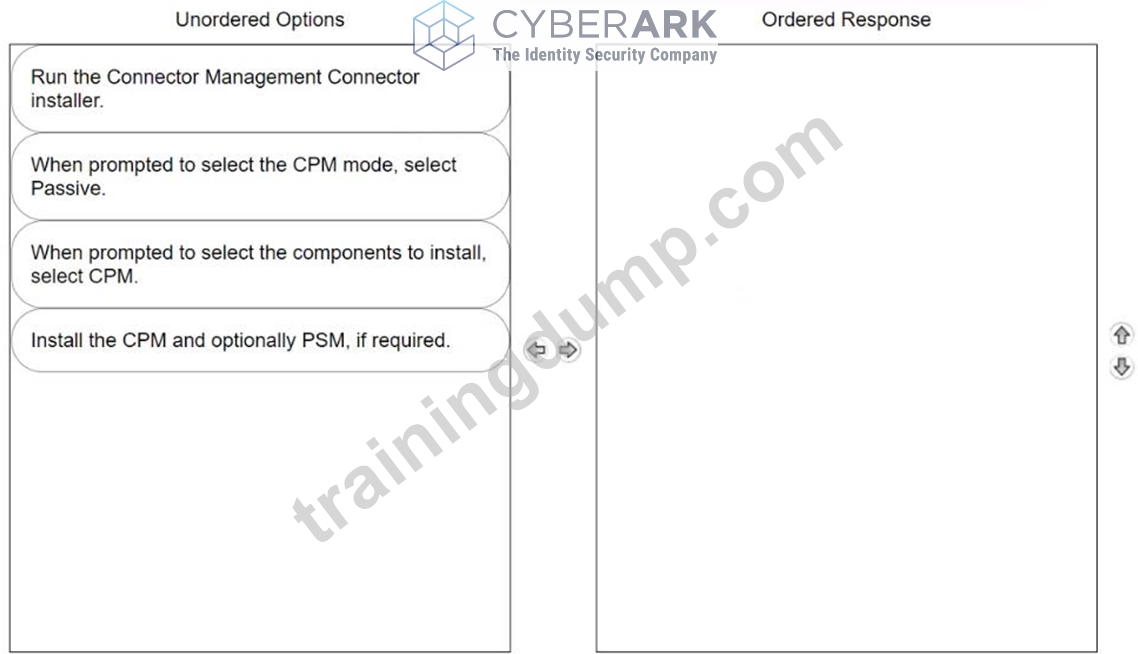
Answer:
Explanation:
1 - Run the Connector Management Connector installer.
2 - When prompted to select the components to install, select CPM.
3 - When prompted to select the CPM mode, select Passive.
4 - Install the CPM and optionally PSM, if required.
NEW QUESTION # 37
How should you configure PSM for SSH to support load balancing?
- A. in PVWA > Options > PSM for SSH Proxy > Servers > VIP
- B. by editing sshd.config on the all the PSM for SSH servers
- C. by using a network load balancer
- D. in PVWA > Options > PSM for SSH Proxy > Servers
Answer: C
Explanation:
To support load balancing for PSM for SSH, the configuration should be done by using a network load balancer. This method involves placing a network load balancer in front of multiple PSM for SSH servers to distribute incoming SSH traffic evenly among them. This setup enhances the availability and scalability of PSM for SSH by ensuring that no single server becomes a bottleneck, thereby improving performance and reliability during high usage scenarios.
NEW QUESTION # 38
What creating a new safe, what is the default number of password versions stored if using 'Save latest account versions' within version management settings?
- A. 0
- B. 1
- C. 2
- D. 3
Answer: D
Explanation:
When creating a new safe and configuring the 'Save latest account versions' within version management settings, the default number of password versions stored is 10. This setting allows the safe to maintain up to 10 past versions of each password managed within it. This capability is essential for ensuring that previous password states can be accessed if needed, such as for audit purposes or rollback scenarios in the event of an update error or compromise.
NEW QUESTION # 39
You are implementing LDAPS Integration for a standard Privilege Cloud environment.
Which information must be provided to the CyberArk Privilege Cloud support team through a Service Request? (Choose 2.)
- A. LDAPS certificate chain for all domain controllers to be integrated
- B. remote port set during secure tunnel configuration for each domain controller to be integrated
- C. LDAP bind username and password used to authenticate to the directory to be integrated C Domain Base Context used to locate the users and groups in the Active Directory to be integrated
- D. Fully Qualified Domain Name and IP Address of the domain controllers to be integrated
Answer: A,D
NEW QUESTION # 40
Your customer recently merged with a smaller organization. The customer's connector has no network connectivity to the smaller organization's infrastructure. You need to map LDAP users from both your customer and the smaller organization. How is this achieved?
- A. Switch all users to SAML authentication as there can only be one Identity Connector.
- B. Create the required users in one directory and configure the Identity Connector to read that directory, as there can only be one Identity Connector.
- C. Deploy Identity Connectors in the newly acquired infrastructure and create user mappings.
- D. Create mappings for both directories from the original Identity Connector.
Answer: C
Explanation:
To map LDAP users from both your customer and the smaller organization they have merged with, especially when there is no network connectivity between the two infrastructures, the best approach is to:
Deploy Identity Connectors in the newly acquired infrastructure and create user mappings (Option C). This involves setting up additional Identity Connectors within the smaller organization's network. These connectors will facilitate the integration of user directories from both organizations into the customer's Privilege Cloud environment.
NEW QUESTION # 41
You are implementing LDAPS Integration for a standard Privilege Cloud environment.
Which information must be provided to the CyberArk Privilege Cloud support team through a Service Request? (Choose 2.)
- A. LDAPS certificate chain for all domain controllers to be integrated
- B. remote port set during secure tunnel configuration for each domain controller to be integrated
- C. LDAP bind username and password used to authenticate to the directory to be integrated C Domain Base Context used to locate the users and groups in the Active Directory to be integrated
- D. Fully Qualified Domain Name and IP Address of the domain controllers to be integrated
Answer: A,D
Explanation:
When implementing LDAPS Integration for a standard Privilege Cloud environment, certain information is crucial and must be provided to the CyberArk Privilege Cloud support team through a Service Request. The necessary details include:
LDAPS certificate chain for all domain controllers to be integrated (Option A): This information is critical to establishing a trusted secure connection between the Privilege Cloud and the domain controllers using LDAP over SSL (LDAPS).
Fully Qualified Domain Name and IP Address of the domain controllers to be integrated (Option D): This information is essential for accurately identifying and configuring the network connections to each domain controller that will be integrated with the Privilege Cloud.
NEW QUESTION # 42
......
Verified CPC-SEN dumps Q&As Latest CPC-SEN Download: https://www.trainingdump.com/CyberArk/CPC-SEN-practice-exam-dumps.html
Updated 100% Cover Real CPC-SEN Exam Questions - 100% Pass Guarantee: https://drive.google.com/open?id=1IDHzS3eHhtSNpgh9yrBuSPoVqkUf6MVu