

Achive your Success with Latest PECB ISO-IEC-27001-Lead-Auditor Exam [Dec 23, 2023]
The ISO-IEC-27001-Lead-Auditor Exam Test For Brief Preparation
PECB ISO-IEC-27001-Lead-Auditor certification exam is a rigorous and challenging assessment of an individual's knowledge and skills related to information security management. It is an excellent way for professionals to demonstrate their expertise in this field and advance their careers.
NEW QUESTION # 24
Four types of Data Classification (Choose two)
- A. Restricted Data, Confidential Data
- B. Financial Data, Highly Confidential Data
- C. Unrestricted Data, Highly Confidential Data
- D. Project Data, Highly Confidential Data
Answer: A,C
Explanation:
Two types of data classification are restricted data and unrestricted data. Restricted data is data that has a high level of sensitivity or confidentiality, and requires strict protection from unauthorized access, disclosure, modification or destruction. Examples of restricted data include personal data, financial data, trade secrets, intellectual property, etc. Unrestricted data is data that has a low level of sensitivity or confidentiality, and can be freely accessed, disclosed, modified or destroyed without significant consequences. Examples of unrestricted data include public information, marketing materials, general news, etc. Data classification is a process of assigning categories or labels to data based on its value, sensitivity, criticality and legal requirements. Data classification helps to determine the appropriate level of security controls and handling procedures for different types of data. ISO/IEC 27001:2022 requires the organization to classify information in terms of legal requirements, value, criticality and sensitivity to unauthorized disclosure or modification (see clause A.8.2.1). Reference: [CQI & IRCA Certified ISO/IEC 27001:2022 Lead Auditor Training Course], ISO/IEC 27001:2022 Information technology - Security techniques - Information security management systems - Requirements, What is Data Classification?
NEW QUESTION # 25
You receive the following mail from the IT support team: Dear User,Starting next week, we will be deleting all inactive email accounts in order to create spaceshare the below details in order to continue using your account. In case of no response, Name:
Email ID:
Password:
DOB:
Kindly contact the webmail team for any further support. Thanks for your attention.
Which of the following is the best response?
- A. Respond it by saying that one should not share the password with anyone
- B. One should not respond to these mails and report such email to your supervisor
- C. Ignore the email
Answer: B
NEW QUESTION # 26
Select the words that best complete the sentence:
To complete the sentence with the word(s) click on the blank section you want to complete so that it is highlighted in red, and then click on the application text from the options below. Alternatively, you may drag and drop the option to the appropriate blank section.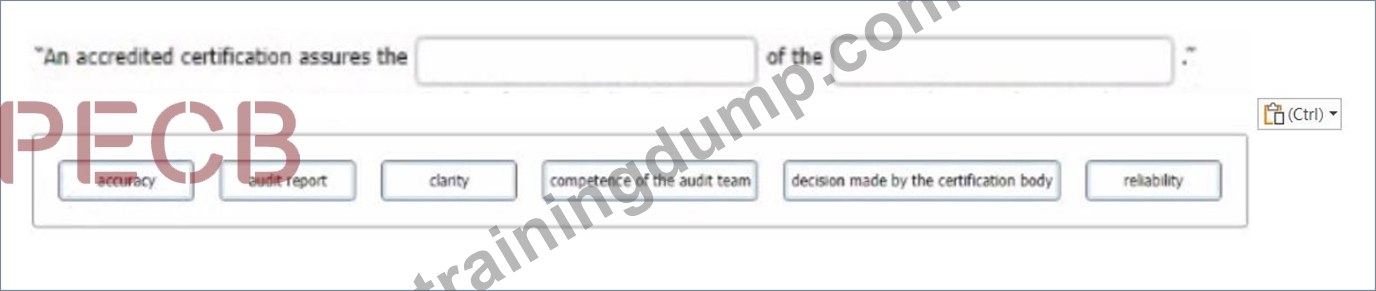
Answer:
Explanation: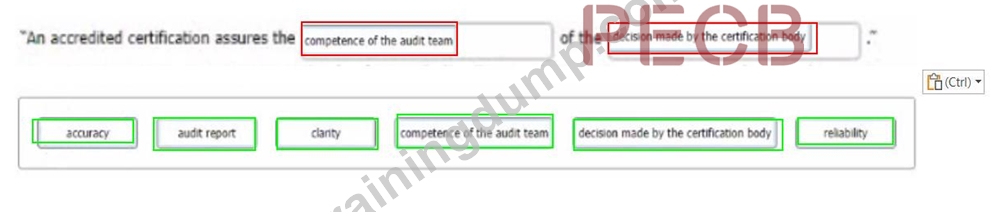
NEW QUESTION # 27
You are an ISMS auditor conducting a third-party surveillance audit of a telecom's provider. You are in the equipment staging room where network switches are pre-programmed before being despatched to clients. You note that recently there has been a significant increase in the number of switches failing their initial configuration test and being returned for reprogramming.
You ask the Chief Tester why and she says, 'It's a result of the recent ISMS upgrade'. Before the upgrade each technician had their own hard copy work instructions. Now, the eight members of my team have to share two laptops to access the clients' configuration instructions online. These delays put pressure on the technicians, resulting in more mistakes being made'.
Based solely on the information above, which clause of ISO to raise a nonconformity against' Select one.
- A. Clause 7.3 - Awareness
- B. Clause 7.2 - Competence
- C. Clause 7.5 - Documented information
- D. Clause 10.2 - Nonconformity and corrective action
- E. Clause 7.4 - Communication
- F. Clause 8.1 - Operational planning and control
Answer: F
Explanation:
According to ISO/IEC 27001:2022, which specifies the requirements for establishing, implementing, maintaining and continually improving an information security management system (ISMS), clause 8.1 requires an organization to plan, implement and control its processes needed to meet ISMS requirements2. This includes determining what needs to be done, how it will be done, who will do it, when it will be done, what resources are required, how performance will be evaluated, etc2. Therefore, if an ISMS auditor conducting a third-party surveillance audit of a telecom's provider notes that there has been a significant increase in the number of switches failing their initial configuration test and being returned for reprogramming due to a recent ISMS upgrade that reduced access to work instructions, this indicates a nonconformity against clause 8.1 of ISO/IEC 27001:2022. The organization has failed to plan and control its operational processes effectively to ensure information security and quality2. The other options are not correct clauses to raise a nonconformity against based solely on this information. For example, clause 7.5 deals with documented information required by ISMS or determined by an organization as necessary for its effectiveness2, but it does not specify how many copies or formats of work instructions should be available; clause 10.2 deals with nonconformity and corrective action as a response to an identified problem or incident2, but it does not address how to prevent or avoid such problems or incidents in operational processes; clause 7.3 deals with awareness of ISMS policy, objectives, roles and responsibilities among persons doing work under an organization's control2, but it does not relate to how work instructions are accessed or followed; clause 7.2 deals with competence of persons doing work under an organization's control that affects its ISMS performance2, but it does not imply that lack of competence is caused by insufficient work instructions; clause 7.4 deals with communication about ISMS among internal and external interested parties2, but it does not cover how operational information is communicated within an organization. Reference: ISO/IEC 27001:2022 - Information technology - Security techniques - Information security management systems - Requirements
NEW QUESTION # 28
CEO sends a mail giving his views on the status of the company and the company's future strategy and the CEO's vision and the employee's part in it. The mail should be classified as
- A. Restricted Mail
- B. Public Mail
- C. Confidential Mail
- D. Internal Mail
Answer: D
Explanation:
The mail sent by the CEO giving his views on the status of the company and the company's future strategy and the CEO's vision and the employee's part in it should be classified as internal mail. Internal mail is a type of classification that indicates that the information is intended for internal use only, and should not be disclosed to external parties without authorization. The mail sent by the CEO contains information that is relevant and important for the employees of the company, but may not be suitable for public disclosure, as it may contain sensitive or confidential information about the company's performance, goals, or plans. Reference: : CQI & IRCA ISO 27001:2022 Lead Auditor Course Handbook, page 34. : CQI & IRCA ISO 27001:2022 Lead Auditor Course Handbook, page 37. : [ISO/IEC 27001 LEAD AUDITOR - PECB], page 14.
NEW QUESTION # 29
You are performing an ISMS audit at a nursing home where residents always wear an electronic wristband for monitoring their location, heartbeat, and blood pressure. The wristband automatically uploads this data to a cloud server for healthcare monitoring and analysis by staff.
You now wish to verify that the information security policy and objectives have been established by top management. You are sampling the mobile device policy and identify a security objective of this policy is "to ensure the security of teleworking and use of mobile devices" The policy states the following controls will be applied in order to achieve this.
Personal mobile devices are prohibited from connecting to the nursing home network, processing, and storing residents' data.
The company's mobile devices within the ISMS scope shall be registered in the asset register.
The company's mobile devices shall implement or enable physical protection, i.e., pin-code protected screen lock/unlock, facial or fingerprint to unlock the device.
The company's mobile devices shall have a regular backup.
To verify that the mobile device policy and objectives are implemented and effective, select three options for your audit trail.
- A. Interview top management to verify their involvement in establishing the information security policy and the information security objectives
- B. Sampling some mobile devices from on-duty medical staff and validate the mobile device information with the asset register
- C. Review the asset register to make sure all company's mobile devices are registered
- D. Review the internal audit report to make sure the IT department has been audited
- E. Review the asset register to make sure all personal mobile devices are registered
- F. Interview the supplier of the devices to make sure they are aware of the ISMS policy
- G. Review visitors' register book to make sure no visitor can have their personal mobile phone in the nursing home
- H. Interview the reception personnel to make sure all visitor and employee bags are checked before entering the nursing home
Answer: B,C,D
Explanation:
According to ISO/IEC 27001:2022, which specifies the requirements for establishing, implementing, maintaining and continually improving an information security management system (ISMS), clause 5.2 requires top management to establish an information security policy that provides the framework for setting information security objectives1. Clause 6.2 requires top management to ensure that the information security objectives are established at relevant functions and levels1. Therefore, when verifying that the information security policy and objectives have been established by top management, an ISMS auditor should review relevant documents and records that demonstrate top management's involvement and commitment.
To verify that the mobile device policy and objectives are implemented and effective, an ISMS auditor should review relevant documents and records that demonstrate how the policy and objectives are communicated, monitored, measured, analyzed, and evaluated. The auditor should also sample and verify the implementation of the controls that are stated in the policy.
Three options for the audit trail that are relevant to verifying the mobile device policy and objectives are:
Review the internal audit report to make sure the IT department has been audited: This option is relevant because it can provide evidence of how the IT department, which is responsible for managing the mobile devices and their security, has been evaluated for its conformity and effectiveness in implementing the mobile device policy and objectives. The internal audit report can also reveal any nonconformities, corrective actions, or opportunities for improvement related to the mobile device policy and objectives.
Sampling some mobile devices from on-duty medical staff and validate the mobile device information with the asset register: This option is relevant because it can provide evidence of how the mobile devices that are used by the medical staff, who are involved in processing and storing residents' data, are registered in the asset register and have physical protection enabled. This can verify the implementation and effectiveness of two of the controls that are stated in the mobile device policy.
Review the asset register to make sure all company's mobile devices are registered: This option is relevant because it can provide evidence of how the company's mobile devices that are within the ISMS scope are identified and accounted for. This can verify the implementation and effectiveness of one of the controls that are stated in the mobile device policy.
The other options for the audit trail are not relevant to verifying the mobile device policy and objectives, as they are not related to the policy or objectives or their implementation or effectiveness. For example:
Interview the reception personnel to make sure all visitor and employee bags are checked before entering the nursing home: This option is not relevant because it does not provide evidence of how the mobile device policy and objectives are implemented or effective. It may be related to another policy or objective regarding physical security or access control, but not specifically to mobile devices.
Review visitors' register book to make sure no visitor can have their personal mobile phone in the nursing home: This option is not relevant because it does not provide evidence of how the mobile device policy and objectives are implemented or effective. It may be related to another policy or objective regarding information security awareness or compliance, but not specifically to mobile devices.
Interview the supplier of the devices to make sure they are aware of the ISMS policy: This option is not relevant because it does not provide evidence of how the mobile device policy and objectives are implemented or effective. It may be related to another policy or objective regarding information security within supplier relationships, but not specifically to mobile devices.
Interview top management to verify their involvement in establishing the information security policy and the information security objectives: This option is not relevant because it does not provide evidence of how the mobile device policy and objectives are implemented or effective. It may be related to verifying that the information security policy and objectives have been established by top management, but not specifically to mobile devices.
NEW QUESTION # 30
Integrity of data means
- A. Accuracy and completeness of the data
- B. Data should be accessed by only the right people
- C. Data should be viewable at all times
Answer: A
NEW QUESTION # 31
Which of the following does a lack of adequate security controls represent?
- A. Asset
- B. Threat
- C. Impact
- D. Vulnerability
Answer: D
Explanation:
A lack of adequate security controls represents a vulnerability, which is a weakness or flaw in an asset or its protection that can be exploited by a threat. A vulnerability can increase the likelihood or impact of a security incident, and therefore should be identified and treated as part of the risk management process. ISO/IEC 27001:2022 defines vulnerability as "the absence or weakness of a safeguard that could be exploited by a threat source" (see clause 3.49). Reference: [CQI & IRCA Certified ISO/IEC 27001:2022 Lead Auditor Training Course], ISO/IEC 27001:2022 Information technology - Security techniques - Information security management systems - Requirements
NEW QUESTION # 32
There was a fire in a branch of the company Midwest Insurance. The fire department quickly arrived at the scene and could extinguish the fire before it spread and burned down the entire premises. The server, however, was destroyed in the fire. The backup tapes kept in another room had melted and many other documents were lost for good.
What is an example of the indirect damage caused by this fire?
- A. Burned computer systems
- B. Water damage due to the fire extinguishers
- C. Burned documents
- D. Melted backup tapes
Answer: B
NEW QUESTION # 33
There is a network printer in the hallway of the company where you work. Many employees don't pick up their printouts immediately and leave them on the printer.
What are the consequences of this to the reliability of the information?
- A. The availability of the information is no longer guaranteed.
- B. The confidentiality of the information is no longer guaranteed.
- C. The Security of the information is no longer guaranteed.
- D. The integrity of the information is no longer guaranteed.
Answer: A
NEW QUESTION # 34
CMM stands for?
- A. Capable Mature Model
- B. Capability Maturity Model
- C. Capability Maturity Matrix
- D. Capacity Maturity Matrix
Answer: B
Explanation:
Capability Maturity Model (CMM) is a framework that describes the key elements of an effective software process. It defines five levels of maturity for software development organizations, from initial to optimized. The CMM helps organizations to assess their current level of process capability and identify the areas for improvement1. Reference: ISO/IEC 27001:2022 Lead Auditor - IECB
NEW QUESTION # 35
Select the words that best complete the sentence:
To complete the sentence with the best word(s), click on the blank section you want to complete so that it is highlighted in red, and then click on the applicable text from the options below. Alternatively, you may drag and drop the option to the appropriate blank section.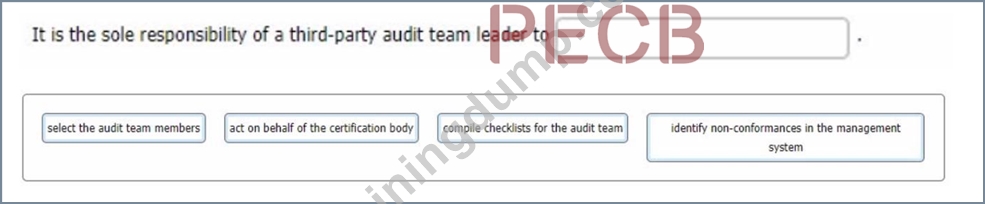
Answer:
Explanation: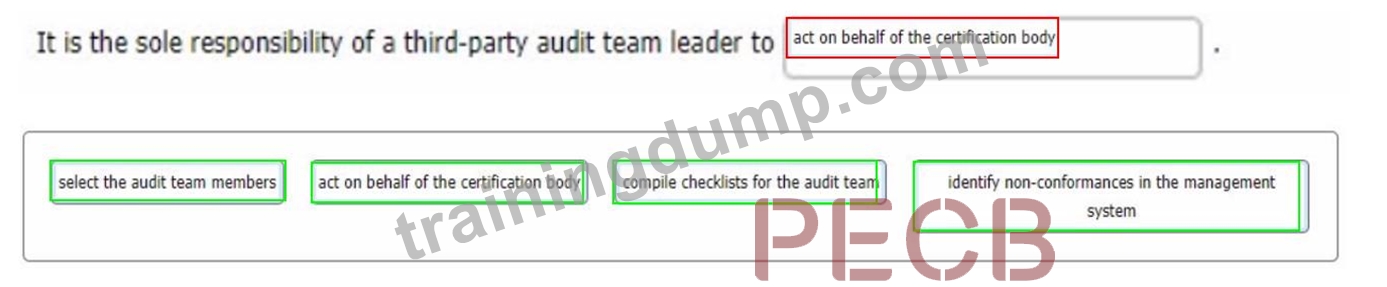
NEW QUESTION # 36
You are preparing the audit findings. Select two options that are correct.
- A. There is a nonconformity (NC). Based on sampling interview results, none of the interviewees were able to describe the incident management procedure reporting process including the role and responsibilities of personnel. This is not conforming with clause 9.1 and control A.5.24.
- B. There is a nonconformity (NC). The information security incident training has failed. This is not conforming with clause 7.2 and control A.6.3.
- C. There is no nonconformance. The information security handling training has performed, and its effectiveness was evaluated. This conforms with clause 7.2 and control A.6.3.
- D. There is an opportunity for improvement (OFI). The iLiirmation security incident training effectiveness can be improved. This is relevant to clause 7.2 and control A.6.3.
- E. There is no nonconformance. The information security weaknesses, events, and incidents are reported. This conforms with clause 9.1 and control A.5.24.
- F. There is an opportunity for improvement (OFI). The information security weaknesses, events, and madents are reported. This is relevant to clause 9.1 and control A.5.24.
Answer: A,D
Explanation:
According to ISO/IEC 27001:2022, which specifies the requirements for establishing, implementing, maintaining and continually improving an information security management system (ISMS), clause 7.2 requires an organization to determine the necessary competence of persons doing work under its control that affects its ISMS performance, and to provide training or take other actions to acquire or maintain the necessary competence1. Control A.6.3 requires an organization to ensure that all employees and contractors are aware of information security threats and concerns, their responsibilities and liabilities, and are equipped to support organizational policies and procedures in this respect2. Therefore, if an ISMS auditor finds that the information security incident training effectiveness can be improved, this indicates an opportunity for improvement (OFI) that is relevant to clause 7.2 and control A.6.3.
According to ISO/IEC 27001:2022, clause 9.1 requires an organization to monitor, measure, analyze and evaluate its ISMS performance and effectiveness1. Control A.5.24 requires an organization to define and apply procedures for reporting information security events and weaknesses2. Therefore, if an ISMS auditor finds that based on sampling interview results, none of the interviewees were able to describe the incident management procedure reporting process including the role and responsibilities of personnel, this indicates a nonconformity (NC) that is not conforming with clause 9.1 and control A.5.24.
The other options are not correct options for preparing the audit findings based on the given information. For example, there is no nonconformance if the information security weaknesses, events, and incidents are reported, as this conforms with clause 9.1 and control A.5.24; there is no nonconformance if the information security handling training has performed, and its effectiveness was evaluated, as this conforms with clause 7.2 and control A.6.3; there is no nonconformity if the information security incident training has failed, as this may not necessarily indicate a lack of conformity with clause 7.2 or control A.6.3; there is no opportunity for improvement if the information security weaknesses, events, and incidents are reported, as this is already conforming with clause 9.1 and control A.5.24. Reference: ISO/IEC 27001:2022 - Information technology - Security techniques - Information security management systems - Requirements, ISO/IEC 27002:2013 - Information technology - Security techniques - Code of practice for information security controls
NEW QUESTION # 37
A well-executed risk analysis provides a great deal of useful information. A risk analysis has four main objectives.
What is not one of the four main objectives of a risk analysis?
- A. Establishing a balance between the costs of an incident and the costs of a security measure
- B. Identifying assets and their value
- C. Implementing counter measures
- D. Determining relevant vulnerabilities and threats
Answer: C
Explanation:
Implementing countermeasures is not one of the four main objectives of a risk analysis. A risk analysis is a systematic process that involves identifying, assessing, and evaluating potential risks to understand their likelihood and impact. Its objective is to develop strategies to manage or mitigate those risks effectively. The four main objectives of a risk analysis are:
Identifying assets and their value: This involves determining what are the information assets that need to be protected and how valuable they are for the organization.
Determining relevant vulnerabilities and threats: This involves identifying what are the weaknesses or flaws in the information assets or systems that could be exploited by malicious actors or events and what are the sources or causes of those potential attacks or incidents.
Establishing a balance between the costs of an incident and the costs of a security measure: This involves estimating what are the potential consequences or impacts of a risk occurrence in terms of financial, operational, reputational, or legal losses and comparing them with what are the costs or benefits of implementing a security measure to prevent or reduce that risk.
Providing a basis for risk treatment decisions: This involves prioritizing the risks based on their likelihood and impact and selecting the most appropriate risk treatment options such as avoiding, transferring, reducing, or accepting the risk.
Implementing countermeasures is not an objective but an outcome of a risk analysis. Countermeasures are specific actions or controls that are designed to prevent or mitigate a risk occurrence or impact. Countermeasures are selected based on the results of a risk analysis and aligned with the organization's risk appetite and objectives. Therefore, the correct answer is B. Reference: [ISO/IEC 27005:2018], clauses 6-9; Risk Analysis - What Is It, Benefits, Example, Methods - WallStreetMojo.
NEW QUESTION # 38
-------------------------is an asset like other important business assets has value to an organization and consequently needs to be protected.
- A. Security
- B. Information
- C. Infrastructure
- D. Data
Answer: B
NEW QUESTION # 39
How are data and information related?
- A. Information consists of facts and statistics collected together for reference or analysis
- B. When meaning and value are assigned to data, it becomes information
- C. Data is a collection of structured and unstructured information
Answer: B
NEW QUESTION # 40
What would be the reference for you to know who should have access to data/document?
- A. Masterlist of Project Records (MLPR)
- B. Information Rights Management (IRM)
- C. Data Classification Label
- D. Access Control List (ACL)
Answer: D
Explanation:
The reference for you to know who should have access to data/document is the Access Control List (ACL), which is a list of users or groups who are authorized to access a specific data/document and their respective access rights (such as read, write, modify, delete, etc.). The ACL is a tool for implementing the access control policy of the organization, which is defined in accordance with ISO/IEC 27001:2022 clause 9.4.1. The ACL should be maintained and updated regularly to ensure that only authorized users can access the data/document. Reference: [CQI & IRCA Certified ISO/IEC 27001:2022 Lead Auditor Training Course], [ISO/IEC 27001:2022 Information technology - Security techniques - Information security management systems - Requirements]
NEW QUESTION # 41
Information Security is a matter of building and maintaining ________ .
- A. Confidentiality
- B. Firewalls
- C. Protection
- D. Trust
Answer: D
Explanation:
Information security is a matter of building and maintaining trust. Trust is the confidence that information and information processing facilities are protected from unauthorized or malicious actions that could compromise their confidentiality, integrity or availability. Trust is essential for establishing and maintaining relationships with customers, partners, suppliers, employees and other stakeholders who rely on the organization's information and services. Trust is also a key factor for achieving compliance with legal, regulatory and contractual obligations, as well as meeting the organization's own information security objectives and policies. ISO/IEC 27001:2022 defines information security as "preservation of confidentiality, integrity and availability of information" (see clause 3.28) and states that "the purpose of an information security management system is to provide a framework for managing activities that influence the trustworthiness of information" (see Introduction). Reference: CQI & IRCA Certified ISO/IEC 27001:2022 Lead Auditor Training Course, ISO/IEC 27001:2022 Information technology - Security techniques - Information security management systems - Requirements, What is Trust?
NEW QUESTION # 42
Changes on project-managed applications or database should undergo the change control process as documented.
- A. False
- B. True
Answer: B
NEW QUESTION # 43
An employee caught with offense of abusing the internet, such as P2P file sharing or video/audio streaming, will not receive a warning for committing such act but will directly receive an IR.
- A. False
- B. True
Answer: B
NEW QUESTION # 44
Implement plan on a test basis - this comes under which section of PDCA
- A. Do
- B. Plan
- C. Check
- D. Act
Answer: A
Explanation:
The PDCA cycle is a four-step method for managing and improving processes. The steps are Plan, Do, Check, and Act. In the Plan phase, the objectives and scope of the process are defined, and the resources and activities are planned. In the Do phase, the process is implemented on a test basis, and the results are recorded and analyzed1. Reference: ISO/IEC 27001:2022 Lead Auditor (Information Security Management Systems) | CQI | IRCA
NEW QUESTION # 45
......
Revolutionary Guide To Exam PECB Dumps: https://www.trainingdump.com/PECB/ISO-IEC-27001-Lead-Auditor-practice-exam-dumps.html
Pass ISO-IEC-27001-Lead-Auditor Exam Latest Practice Questions: https://drive.google.com/open?id=1vWf8s9rLVOKdb9vFss15FYyt7vKcMaWE