

Free Microsoft DP-600 Exam Questions and Answer from Training Expert TrainingDump
Top Microsoft DP-600 Courses Online
Microsoft DP-600 Exam Syllabus Topics:
| Topic | Details |
|---|---|
| Topic 1 |
|
| Topic 2 |
|
| Topic 3 |
|
NEW QUESTION # 86
You need to design a semantic model for the customer satisfaction report.
Which data source authentication method and mode should you use? To answer, select the appropriate options in the answer area.
NOTE: Each correct selection is worth one point.
Answer:
Explanation:
Explanation:
For the semantic model design required for the customer satisfaction report, the choices for data source authentication method and mode should be made based on security and performance considerations as per the case study provided.
Authentication method: The data should be accessed securely, and given that row-level security (RLS) is required for users executing T-SQL queries, you should use an authentication method that supports RLS.
Service principal authentication is suitable for automated and secure access to the data, especially when the access needs to be controlled programmatically and is not tied to a specific user's credentials.
Mode: The report needs to show data as soon as it is updated in the data store, and it should only contain data from the current and previous year. DirectQuery mode allows for real-time reporting without importing data into the model, thus meeting the need for up-to-date data. It also allows for RLS to be implemented and enforced at the data source level, providing the necessary security measures.
Based on these considerations, the selections should be:
* Authentication method: Service principal authentication
* Mode: DirectQuery
NEW QUESTION # 87
You are implementing two dimension tables named Customers and Products in a Fabric warehouse.
You need to use slowly changing dimension (SCO) to manage the versioning of data. The solution must meet the requirements shown in the following table.
Which type of SCD should you use for each table? To answer, drag the appropriate SCD types to the correct tables. Each SCD type may be used once, more than once, or not at all. You may need to drag the split bar between panes o r scroll to view content.
NOTE: Each correct selection is worth one point.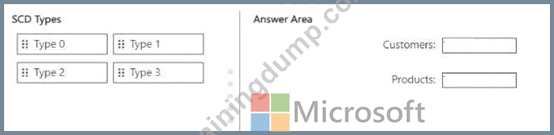
Answer:
Explanation:
Explanation:
For the Customers table, where the requirement is to create a new version of the row, you would use:
* Type 2 SCD: This type allows for the creation of a new record each time a change occurs, preserving the history of changes over time.
For the Products table, where the requirement is to overwrite the existing value in the latest row, you would use:
* Type 1 SCD: This type updates the record directly, without preserving historical data.
NEW QUESTION # 88
You have a Fabric tenant that contains a semantic model.
You need to prevent report creators from populating visuals by using implicit measures.
What are two tools that you can use to achieve the goal? Each correct answer presents a complete solution.
NOTE: Each correct answer is worth one point.
- A. Microsoft Power BI Desktop
- B. DAX Studio
- C. Tabular Editor
- D. Microsoft SQL Server Management Studio (SSMS)
Answer: A,C
Explanation:
Microsoft Power BI Desktop (A) and Tabular Editor (B) are the tools you can use to prevent report creators from using implicit measures. In Power BI Desktop, you can define explicit measures which can be used in visuals. Tabular Editor allows for advanced model editing, where you can enforce the use of explicit measures.
References = Guidance on using explicit measures and preventing implicit measures in reports can be found in the Power BI and Tabular Editor official documentation.
NEW QUESTION # 89
You have a Fabric tenant that contains a warehouse.
You are designing a star schema model that will contain a customer dimension. The customer dimension table will be a Type 2 slowly changing dimension (SCD).
You need to recommend which columns to add to the table. The columns must NOT already exist in the source.
Which three types of columns should you recommend? Each correct answer presents part of the solution.
NOTE: Each correct answer is worth one point.
- A. a foreign key
- B. a natural key
- C. an effective end date and time
- D. a surrogate key
- E. an effective start date and time
Answer: C,D,E
Explanation:
For a Type 2 slowly changing dimension (SCD), you typically need to add the following types of columns that do not exist in the source system:
* An effective start date and time (E): This column records the date and time from which the data in the row is effective.
* An effective end date and time (A): This column indicates until when the data in the row was effective.
It allows you to keep historical records for changes over time.
* A surrogate key (C): A surrogate key is a unique identifier for each row in a table, which is necessary for Type 2 SCDs to differentiate between historical and current records.
References: Best practices for designing slowly changing dimensions in data warehousing solutions, which include Type 2 SCDs, are commonly discussed in data warehousing and business intelligence literature and would be part of the modeling guidance in a Fabric tenant's documentation.
Topic 1, Litware. Inc. Case Study
Overview
Litware. Inc. is a manufacturing company that has offices throughout North America. The analytics team at Litware contains data engineers, analytics engineers, data analysts, and data scientists.
Existing Environment
litware has been using a Microsoft Power Bl tenant for three years. Litware has NOT enabled any Fabric capacities and features.
Fabric Environment
Litware has data that must be analyzed as shown in the following table.
The Product data contains a single table and the following columns.
The customer satisfaction data contains the following tables:
* Survey
* Question
* Response
For each survey submitted, the following occurs:
* One row is added to the Survey table.
* One row is added to the Response table for each question in the survey.
The Question table contains the text of each survey question. The third question in each survey response is an overall satisfaction score. Customers can submit a survey after each purchase.
User Problems
The analytics team has large volumes of data, some of which is semi-structured. The team wants to use Fabric to create a new data store.
Product data is often classified into three pricing groups: high, medium, and low. This logic is implemented in several databases and semantic models, but the logic does NOT always match across implementations.
Planned Changes
Litware plans to enable Fabric features in the existing tenant. The analytics team will create a new data store as a proof of concept (PoC). The remaining Litware users will only get access to the Fabric features once the PoC is complete. The PoC will be completed by using a Fabric trial capacity.
The following three workspaces will be created:
* AnalyticsPOC: Will contain the data store, semantic models, reports, pipelines, dataflows, and notebooks used to populate the data store
* DataEngPOC: Will contain all the pipelines, dataflows, and notebooks used to populate Onelake
* DataSciPOC: Will contain all the notebooks and reports created by the data scientists The following will be created in the AnalyticsPOC workspace:
* A data store (type to be decided)
* A custom semantic model
* A default semantic model
* Interactive reports
The data engineers will create data pipelines to load data to OneLake either hourly or daily depending on the data source. The analytics engineers will create processes to ingest transform, and load the data to the data store in the AnalyticsPOC workspace daily. Whenever possible, the data engineers will use low-code tools for data ingestion. The choice of which data cleansing and transformation tools to use will be at the data engineers' discretion.
All the semantic models and reports in the Analytics POC workspace will use the data store as the sole data source.
Technical Requirements
The data store must support the following:
* Read access by using T-SQL or Python
* Semi-structured and unstructured data
* Row-level security (RLS) for users executing T-SQL queries
Files loaded by the data engineers to OneLake will be stored in the Parquet format and will meet Delta Lake specifications.
Data will be loaded without transformation in one area of the AnalyticsPOC data store. The data will then be cleansed, merged, and transformed into a dimensional model.
The data load process must ensure that the raw and cleansed data is updated completely before populating the dimensional model.
The dimensional model must contain a date dimension. There is no existing data source for the date dimension. The Litware fiscal year matches the calendar year. The date dimension must always contain dates from 2010 through the end of the current year.
The product pricing group logic must be maintained by the analytics engineers in a single location. The pricing group data must be made available in the data store for T-SQL queries and in the default semantic model. The following logic must be used:
* List prices that are less than or equal to 50 are in the low pricing group.
* List prices that are greater than 50 and less than or equal to 1,000 are in the medium pricing group.
* List pnces that are greater than 1,000 are in the high pricing group.
Security Requirements
Only Fabric administrators and the analytics team must be able to see the Fabric items created as part of the PoC. Litware identifies the following security requirements for the Fabric items in the AnalyticsPOC workspace:
* Fabric administrators will be the workspace administrators.
* The data engineers must be able to read from and write to the data store. No access must be granted to datasets or reports.
* The analytics engineers must be able to read from, write to, and create schemas in the data store. They also must be able to create and share semantic models with the data analysts and view and modify all reports in the workspace.
* The data scientists must be able to read from the data store, but not write to it. They will access the data by using a Spark notebook.
* The data analysts must have read access to only the dimensional model objects in the data store. They also must have access to create Power Bl reports by using the semantic models created by the analytics engineers.
* The date dimension must be available to all users of the data store.
* The principle of least privilege must be followed.
Both the default and custom semantic models must include only tables or views from the dimensional model in the data store. Litware already has the following Microsoft Entra security groups:
* FabricAdmins: Fabric administrators
* AnalyticsTeam: All the members of the analytics team
* DataAnalysts: The data analysts on the analytics team
* DataScientists: The data scientists on the analytics team
* Data Engineers: The data engineers on the analytics team
* Analytics Engineers: The analytics engineers on the analytics team
Report Requirements
The data analysis must create a customer satisfaction report that meets the following requirements:
* Enables a user to select a product to filter customer survey responses to only those who have purchased that product
* Displays the average overall satisfaction score of all the surveys submitted during the last 12 months up to a selected date
* Shows data as soon as the data is updated in the data store
* Ensures that the report and the semantic model only contain data from the current and previous year
* Ensures that the report respects any table-level security specified in the source data store
* Minimizes the execution time of report queries
NEW QUESTION # 90
You have a Fabric tenant that contains a workspace named Workspace1 and a user named DBUser.
Workspace1 contains a lakehouse named Lakehousel. DBUser does NOT have access to the tenant.
You grant DBUser access to Lakehouse1 as shown in the following exhibit.
Use the drop-down menus to select the answer choice that completes each statement based on the information presented in the graphic.
NOTE: Each correct selection is worth one point.
Answer:
Explanation:
Explanation:
In Microsoft Fabric, the OneLake endpoint allows users with appropriate permissions to read data from a lakehouse, leveraging the unified data storage system. Since DBUser has been granted access to Lakehouse1, they can utilize the OneLake endpoint for reading data. For querying, the OneLake file explorer provides a user interface to interact with and query data within the lakehouse, aligning with DBUser's access rights without requiring broader tenant permissions.
NEW QUESTION # 91
You have a Fabric tenant that contains the workspaces shown in the following table.
You have a deployment pipeline named Pipeline1 that deploys items from Workspace_DEV to Workspace_TEST. In Pipeline1, all items that have matching names are paired.
You deploy the contents of Workspace_DEV to Workspace_TEST by using Pipeline1.
What will the contents of Workspace_TEST be once the deployment is complete?
- A. Lakehouse1
Lakehouse2
Notebook1
Notebook2
Pipeline1
SemanticModel1 - B. Lakehouse2
Notebook2
SemanticModel1 - C. Lakehouse2
Notebook2
Pipeline1
SemanticModel1 - D. Lakehouse1
Notebook1
Pipeline1
SemanticModel1
Answer: D
Explanation:
Workspace_DEV contents:
Lakehouse1, Notebook1, Pipeline1, SemanticModel1
Workspace_TEST contents (before deployment):
Lakehouse2, Notebook2, SemanticModel1
After deployment:
SemanticModel1 # same name, so it will be paired and overwritten with the DEV version.
Lakehouse1 and Notebook1 # new items, so they will be added to TEST.
Lakehouse2 and Notebook2 # remain because they don't conflict in name.
Pipeline1 # new item, so it will also be added.
So the final content is:
Lakehouse1, Lakehouse2, Notebook1, Notebook2, Pipeline1, SemanticModel1
Reference:
Deployment pipelines pairing behavior
NEW QUESTION # 92
You have a Fabric tenant that contains two lakehouses.
You are building a dataflow that will combine data from the lakehouses. The applied steps from one of the queries in the dataflow is shown in the following exhibit.
Use the drop-down menus to select the answer choice that completes each statement based on the information presented in the graphic. NOTE: Each correct selection is worth one point.
Answer:
Explanation:
Explanation:
Folding in Power Query refers to operations that can be translated into source queries. In this case, "some" of the steps can be folded, which means that some transformations will be executed at the data source level. The steps that cannot be folded will be executed within the Power Query engine. Custom steps, especially those that are not standard query operations, are usually executed within Power Query engine rather than being pushed down to the source system.
References =
* Query folding in Power Query
* Power Query M formula language
NEW QUESTION # 93
You have a Fabric tenant that contains a complex semantic model. The model is based on a star schema and contains many tables, including a fact table named Sales. You need to create a diagram of the model. The diagram must contain only the Sales table and related tables. What should you use from Microsoft Power Bl Desktop?
- A. Data view
- B. Model view
- C. DAX query view
- D. data categories
Answer: B
NEW QUESTION # 94
What should you use to implement calculation groups for the Research division semantic models?
- A. DAX Studio
- B. the Power Bl service
- C. Microsoft Power Bl Desktop
- D. Tabular Editor
Answer: B
Explanation:
Topic 1, Contoso, ltd.
Overview
Contoso, ltd. is a US-based health supplements company, Contoso has two divisions named Sales and Research. The Sales division contains two departments named Online Sales and Retail Sales. The Research division assigns internally developed product lines to individual teams of researchers and analysts.
Identity Environment
Contoso has a Microsoft Entra tenant named contoso.com. The tenant contains two groups named ResearchReviewersGroupi and ReseachReviewefsGfoup2.
Data Environment
Contoso has the following data environment
* The Sales division uses a Microsoft Power B1 Premium capacity.
* The semantic model of the Online Sales department includes a fact table named Orders that uses import mode. In the system of origin, the OrderlD value represents the sequence in which orders are created.
* The Research department uses an on-premises. third-party data warehousing product.
* Fabric is enabled for contoso.com.
* An Azure Data Lake Storage Gen2 storage account named storage1 contains Research division data for a product line named Producthne1. The data is in the delta format.
* A Data Lake Storage Gen2 storage account named storage2 contains Research division data for a product line named Productline2. The data is in the CSV format.
Planned Changes
Contoso plans to make the following changes:
* Enable support for Fabric in the Power Bl Premium capacity used by the Sales division.
* Make all the data for the Sales division and the Research division available in Fabric.
* For the Research division, create two Fabric workspaces named Producttmelws and Productline2ws.
* in Productlinelws. create a lakehouse named LakehouseV
* In Lakehouse1. create a shortcut to storage1 named ResearchProduct.
Data Analytics Requirements
Contoso identifies the following data analytics requirements:
* All the workspaces for the Sales division and the Research division must support all Fabric experiences.
* The Research division workspaces must use a dedicated, on-demand capacity that has per-minute billing.
* The Research division workspaces must be grouped together logically to support OneLake data hub filtering based on the department name.
* For the Research division workspaces, the members of ResearchRevtewersGroupl must be able to read lakehouse and warehouse data and shortcuts by using SQL endpoints.
* For the Research division workspaces, the members of ResearchReviewersGroup2 must be able to read lakehouse data by using Lakehouse explorer.
* All the semantic models and reports for the Research division must use version control that supports branching Data Preparation Requirements Contoso identifies the following data preparation requirements:
* The Research division data for Producthne2 must be retrieved from Lakehouset by using Fabric notebooks.
* All the Research division data in the lakehouses must be presented as managed tables in Lakehouse explorer.
Semantic Model Requirements
Contoso identifies the following requirements for implementing and managing semantic models;
* The number of rows added to the Orders table during refreshes must be minimized.
* The semantic models in the Research division workspaces must use Direct Lake mode.
General Requirements
Contoso identifies the following high-level requirements that must be considered for all solutions:
* Follow the principle of least privilege when applicable
* Minimize implementation and maintenance effort when possible.
NEW QUESTION # 95
You have a Fabric warehouse named Warehouse1 that contains a table named dbo.Product. dbo.Product contains the following columns.
You need to use a T-SQL query to add a column named PriceRange to dbo.Product. The column must categorize each product based on UnitPrice. The solution must meet the following requirements:
* If UnitPrice is 0, PriceRange is "Not for resale".
* If UnitPrice is less than 50, PriceRange is "Under $50".
* If UnitPrice is between 50 and 250, PriceRange is "Under $250".
* In all other instances, PriceRange is "$250+".
How should you complete the query? To answer, drag the appropriate values to the correct targets. Each value may be used once, more than once, or not at all. You may need to drag the split bar between panes or scroll to view content.
NOTE: Each correct selection is worth one point.
Answer:
Explanation: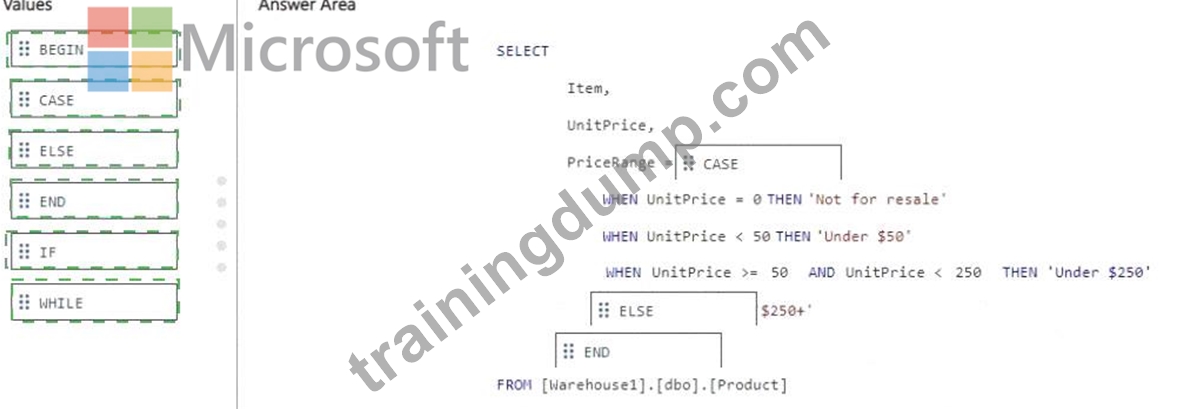
Explanation:
Comprehensive Detailed Explanation
We need to create a computed column PriceRange based on the UnitPrice column in the dbo.Product table.
Step 1: Requirements
If UnitPrice = 0 # "Not for resale"
If UnitPrice < 50 # "Under $50"
If UnitPrice >= 50 AND UnitPrice < 250 # "Under $250"
Otherwise # "$250+"
This matches a CASE expression in T-SQL.
Step 2: CASE Expression Structure
The syntax is:
CASE
WHEN condition THEN result
WHEN condition THEN result
ELSE result
END
Step 3: Apply to Problem
SELECT
Item,
UnitPrice,
PriceRange = CASE
WHEN UnitPrice = 0 THEN 'Not for resale'
WHEN UnitPrice < 50 THEN 'Under $50'
WHEN UnitPrice >= 50 AND UnitPrice < 250 THEN 'Under $250'
ELSE '$250+'
END
FROM [Warehouse1].[dbo].[Product];
Step 4: Why This is Correct
CASE starts the conditional evaluation.
ELSE handles the default branch ($250+).
END closes the expression.
Meets all requirements exactly.
References
CASE expression in T-SQL
Computed columns in T-SQL
NEW QUESTION # 96
You have an Azure Data Lake Storage Gen2 account named storage! that contains a Parquet file named sales.
parquet.
You have a Fabric tenant that contains a workspace named Workspace1.
Using a notebook in Workspace1, you need to load the content of the file to the default lakehouse. The solution must ensure that the content will display automatically as a table named Sales in Lakehouse explorer.
How should you complete the code? To answer, select the appropriate options in the answer area.
NOTE: Each correct selection is worth one point.
Answer:
Explanation:
Explanation:
NEW QUESTION # 97
You have a Microsoft Power BI semantic model that contains measures. The measures use multiple CALCULATE functions and a FILTER function.
You are evaluating the performance of the measures.
In which use case will replacing the FILTER function with the KEEPFILTERS function reduce execution time?
- A. when the FILTER function references columns from multiple tables
- B. when the FILTER function references a measure
- C. when the FILTER function references a column from a single table that uses Import mode
- D. when the FILTER function uses a nested calculate function
Answer: C
Explanation:
https://learn.microsoft.com/en-us/dax/best-practices/dax-avoid-avoid-filter-as-filter-argument FILTER returns a table whereas KEEPFILTERS returns a Boolean. So, A, B and C are limitations of uses of Boolean expressions.
NEW QUESTION # 98
You have a Fabric tenant that contains a semantic model named Model1. Model1 uses Import mode. Model1 contains a table named Orders. Orders has 100 million rows and the following fields.
You need to reduce the memory used by Model1 and the time it takes to refresh the model.
Which two actions should you perform? Each correct answer presents part of the solution.
NOTE: Each correct answer is worth one point.
- A. Replace TotalQuantity with a calculated column.
- B. Split OrderDateTime into separate date and time columns.
- C. Replace TotalSalesAmount with a measure.
- D. Convert Quantity into the Text data type.
Answer: B,C
NEW QUESTION # 99
Drag and Drop Question
You are building a solution by using a Fabric notebook.
You have a Spark DataFrame assigned to a variable named df. The DataFrame returns four columns.
You need to change the data type of a string column named Age to integer. The solution must return a DataFrame that includes all the columns.
How should you complete the code? To answer, drag the appropriate values to the correct targets. Each value may be used once, more than once, or not at all. You may need to drag the split bar between panes or scroll to view content.
NOTE: Each correct selection is worth one point.
Answer:
Explanation:
NEW QUESTION # 100
Drag and Drop Question
You have a Fabric warehouse named Warehouse1 that contains a table named dbo.Product.
dbo.Product contains the following columns.
You need to use a T-SQL query to add a column named PriceRange to dbo.Product. The column must categorize each product based on UnitPrice. The solution must meet the following requirements:
- If UnitPrice is 0, PriceRange is "Not for resale".
- If UnitPrice is less than 50, PriceRange is "Under $50".
- If UnitPrice is between 50 and 250, PriceRange is "Under $250".
- In all other instances, PriceRange is "$250+".
How should you complete the query? To answer, drag the appropriate values to the correct targets. Each value may be used once, more than once, or not at all. You may need to drag the split bar between panes or scroll to view content.
NOTE: Each correct selection is worth one point.
Answer:
Explanation:
NEW QUESTION # 101
You have a Fabric tenant that contains a warehouse named Warehouse1. Warehouse1 contains a fact table named FactSales that has one billion rows. You run the following T-SQL statement.
CREATE TABLE test.FactSales AS CLONE OF Dbo.FactSales;
For each of the following statements, select Yes if the statement is true. Otherwise, select No. NOTE: Each correct selection is worth one point.
Answer:
Explanation:
Explanation:
* A replica of dbo.Sales is created in the test schema by copying the metadata only. - Yes
* Additional schema changes to dbo.FactSales will also apply to test.FactSales. - No
* Additional data changes to dbo.FactSales will also apply to test.FactSales. - No The CREATE TABLE AS CLONE statement creates a copy of an existing table, including its data and any associated data structures, like indexes. Therefore, the statement does not merely copy metadata; it also copies the data. However, subsequent schema changes to the original table do not automatically propagate to the cloned table. Any data changes in the original table after the clone operation will not be reflected in the clone unless explicitly updated.
References =
* CREATE TABLE AS SELECT (CTAS) in SQL Data Warehouse
NEW QUESTION # 102
Hotspot Question
You have a Fabric warehouse that contains a table named Sales.Orders. Sales.Orders contains the following columns.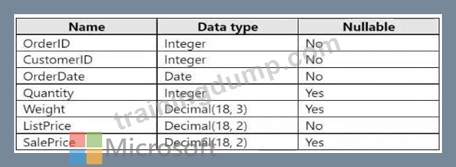
You need to write a T-SQL query that will return the following columns.
How should you complete the code? To answer, select the appropriate options in the answer area.
NOTE: Each correct answer is worth one point.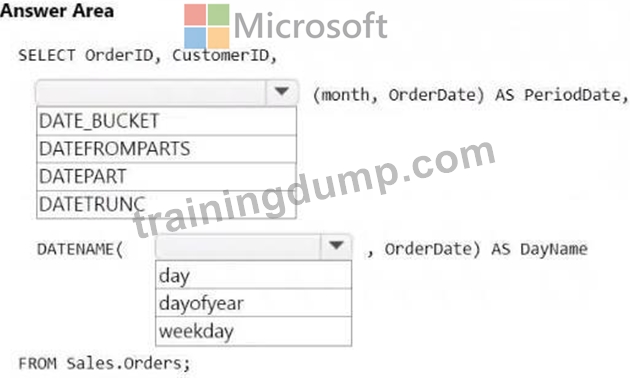
Answer:
Explanation:
Explanation:
https://learn.microsoft.com/en-us/sql/t-sql/functions/datetrunc-transact-sql?view=sql-server-ver16
https://learn.microsoft.com/en-us/sql/t-sql/functions/datename-transact-sql?view=sql-server-ver16
NEW QUESTION # 103
You have a Fabric tenant.
You are creating a Fabric Data Factory pipeline.
You have a stored procedure that returns the number of active customers and their average sales for the current month.
You need to add an activity that will execute the stored procedure in a warehouse. The returned values must be available to the downstream activities of the pipeline.
Which type of activity should you add?
- A. Lookup
- B. Stored procedure
- C. Copy data
- D. Get metadata
Answer: A
Explanation:
In a Fabric Data Factory pipeline, to execute a stored procedure and make the returned values available for downstream activities, the Lookup activity is used. This activity can retrieve a dataset from a data store and pass it on for further processing. Here's how you would use the Lookup activity in this context:
* Add a Lookup activity to your pipeline.
* Configure the Lookup activity to use the stored procedure by providing the necessary SQL statement or stored procedure name.
* In the settings, specify that the activity should use the stored procedure mode.
* Once the stored procedure executes, the Lookup activity will capture the results and make them available in the pipeline's memory.
* Downstream activities can then reference the output of the Lookup activity.
References: The functionality and use of Lookup activity within Azure Data Factory is documented in Microsoft's official documentation for Azure Data Factory, under the section for pipeline activities.
NEW QUESTION # 104
You have a Fabric workspace that contains a lakehouse named Lakehouse1. Lakehouse1 contains a Delta Parquet table named FactSales. You use a Describe command to review the history of FactSales and notice that you have over 1000 versions of the table, and the retention policy is six months.
You need to reduce the size of the FactSales table and the number of files in the table. What should you configure on the table?
- A. Delete the FactSales table from Lakehouse1.
- B. Run the VACUUM command under Maintenance.
- C. Apply V-Order under Maintenance.
- D. Run the OPTIMIZE command under Maintenance.
Answer: B
NEW QUESTION # 105
Note: This section contains one or more sets of questions with the same scenario and problem. Each question presents a unique solution to the problem. You must determine whether the solution meets the stated goals. More than one solution in the set might solve the problem. It is also possible that none of the solutions in the set solve the problem.
After you answer a question in this section, you will NOT be able to return. As a result, these questions do not appear on the Review Screen.
Your network contains an on-premises Active Directory Domain Services (AD DS) domain named contoso.com that syncs with a Microsoft Entra tenant by using Microsoft Entra Connect.
You have a Fabric tenant that contains a semantic model.
You enable dynamic row-level security (RLS) for the mode! and deploy the model to the Fabric service.
You query a measure that includes the username () function, and the query returns a blank result.
You need to ensure that the measure returns the user principal name (UPNJ of a user.
Solution: You add user objects to the list of synced objects in Microsoft Entra Connect.
Does this meet the goal?
- A. No
- B. Yes
Answer: A
NEW QUESTION # 106
You have a Fabric tenant that contains a warehouse named Warehouse!. Warehousel contains two schemas name schemal and schema2 and a table named schemal.city.
You need to make a copy of schemal.city in schema2. The solution must minimize the copying of data.
Which T-SQL statement should you run?
- A. SELECT * INTO schema2.eity FROM schemal.city;
- B. CREATE TABLE schema2.city AS CLONE OF schemal.city;
- C. INSERT INTO schema2.city SELECT * FROM schemal.city;
- D. CREATE TABLE schema2.city AS SELECT * FROM schemal.city;
Answer: B
NEW QUESTION # 107
You have a semantic model named Model 1. Model 1 contains five tables that all use Import mode. Model1 contains a dynamic row-level security (RLS) role named HR. The HR role filters employee data so that HR managers only see the data of the department to which they are assigned.
You publish Model1 to a Fabric tenant and configure RLS role membership. You share the model and related reports to users.
An HR manager reports that the data they see in a report is incomplete.
What should you do to validate the data seen by the HR Manager?
- A. Select Test as role to view the data as the HR role.
- B. Ask the HR manager to open the report in Microsoft Power Bl Desktop.
- C. Filter the data in the report to match the intended logic of the filter for the HR department.
- D. Select Test as role to view the report as the HR manager,
Answer: A
Explanation:
To validate the data seen by the HR manager, you should use the 'Test as role' feature in Power BI service. This allows you to see the data exactly as it would appear for the HR role, considering the dynamic RLS setup. Here is how you would proceed:
Navigate to the Power BI service and locate Model1.
Access the dataset settings for Model1.
Find the security/RLS settings where you configured the roles.
Use the 'Test as role' feature to simulate the report viewing experience as the HR role.
Review the data and the filters applied to ensure that the RLS is functioning correctly.
If discrepancies are found, adjust the RLS expressions or the role membership as needed.
NEW QUESTION # 108
......
New (2026) Microsoft DP-600 Exam Dumps: https://www.trainingdump.com/Microsoft/DP-600-practice-exam-dumps.html
DP-600 Practice Dumps - Verified By TrainingDump Updated 166 Questions: https://drive.google.com/open?id=1EBBsY3smJHbcYiFNIg1CAAe4AWaSx5cf