

[Jan-2022] Microsoft DP-200 Exam Practice Test Questions - TrainingDump
Updated Certification Exam DP-200 Dumps - Practice Test Questions
Certification Path
The Microsoft Certified Azure Data Engineer Associate Certification include DP-200 and DP-201 exams.
NEW QUESTION 137
Note: This question is part of a series of questions that present the same scenario. Each question in the series contains a unique solution that might meet the stated goals. Some question sets might have more than one correct solution, while others might not have a correct solution.
After you answer a question in this section, you will NOT be able to return to it. As a result, these questions will not appear in the review screen.
You need to implement diagnostic logging for Data Warehouse monitoring.
Which log should you use?
- A. RequestSteps
- B. ExecRequests
- C. DmsWorkers
- D. SqlRequests
Answer: D
Explanation:
Explanation
Explanation:
Scenario:
The Azure SQL Data Warehouse cache must be monitored when the database is being used.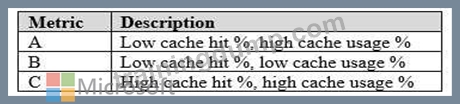
References:
https://docs.microsoft.com/en-us/sql/relational-databases/system-dynamic-management-views/sys-dm-pdw- sql-requests-transact-sq Monitor and optimize data solutions Testlet 3 Case Study This is a case study. Case studies are not timed separately. You can use as much exam time as you would like to complete each case. However, there may be additional case studies and sections on this exam. You must manage your time to ensure that you are able to complete all questions included on this exam in the time provided.
To answer the questions included in a case study, you will need to reference information that is provided in the case study. Case studies might contain exhibits and other resources that provide more information about the scenario that is described in the case study. Each question is independent of the other questions in this case study.
At the end of this case study, a review screen will appear. This screen allows you to review your answers and to make changes before you move to the next section of the exam. After you begin a new section, you cannot return to this section.
To start the case study
To display the first question in this case study, click the Next button. Use the buttons in the left pane to explore the content of the case study before you answer the questions. Clicking these buttons displays information such as business requirements, existing environment, and problem statements. If the case study has an All Information tab, note that the information displayed is identical to the information displayed on the subsequent tabs. When you are ready to answer a question, click the Question button to return to the question.
Overview
General Overview
Litware, Inc. is an international car racing and manufacturing company that has 1,000 employees. Most employees are located in Europe. The company supports racing teams that complete in a worldwide racing series.
Physical Locations
Litware has two main locations: a main office in London, England, and a manufacturing plant in Berlin, Germany.
During each race weekend, 100 engineers set up a remote portable office by using a VPN to connect the datacentre in the London office. The portable office is set up and torn down in approximately 20 different countries each year.
Existing environment
Race Central
During race weekends, Litware uses a primary application named Race Central. Each car has several sensors that send real-time telemetry data to the London datacenter. The data is used for real-time tracking of the cars.
Race Central also sends batch updates to an application named Mechanical Workflow by using Microsoft SQL Server Integration Services (SSIS).
The telemetry data is sent to a MongoDB database. A custom application then moves the data to databases in SQL Server 2017. The telemetry data in MongoDB has more than 500 attributes. The application changes the attribute names when the data is moved to SQL Server 2017.
The database structure contains both OLAP and OLTP databases.
Mechanical Workflow
Mechanical Workflow is used to track changes and improvements made to the cars during their lifetime.
Currently, Mechanical Workflow runs on SQL Server 2017 as an OLAP system.
Mechanical Workflow has a table named Table1 that is 1 TB. Large aggregations are performed on a single column of Table1.
Requirements
Planned Changes
Litware is in the process of rearchitecting its data estate to be hosted in Azure. The company plans to decommission the London datacentre and move all its applications to an Azure datacenter.
Technical Requirements
Litware identifies the following technical requirements:
* Data collection for Race Central must be moved to Azure Cosmos DB and Azure SQL Database. The data must be written to the Azure datacenter closest to each race and must converge in the least amount of time.
* The query performance of Race Central must be stable, and the administrative time it takes to perform optimizations must be minimized.
* The database for Mechanical Workflow must be moved to Azure Synapse Analytics.
* Transparent data encryption (TDE) must be enabled on all data stores, whenever possible.
* An Azure Data Factory pipeline must be used to move data from Cosmos DB to SQL Database for Race Central. If the data load takes longer than 20 minutes, configuration changes must be made to Data Factory.
* The telemetry data must migrate toward a solution that is native to Azure.
* The telemetry data must be monitored for performance issues. You must adjust the Cosmos DB Request Units per second (RU/s) to maintain a performance SLA while minimizing the cost of the RU/s.
Data Masking Requirements
During race weekends, visitors will be able to enter the remote portable offices. Litware is concerned that some proprietary information might be exposed. The company identifies the following data masking requirements for the Race Central data that will be stored in SQL Database:
* Only show the last four digits of the values in a column named SuspensionSprings.
* Only show a zero value for the values in a column named ShockOilWeight.
NEW QUESTION 138
Which masking functions should you implement for each column to meet the data masking requirements? To answer, select the appropriate options in the answer area.
NOTE: Each correct selection is worth one point.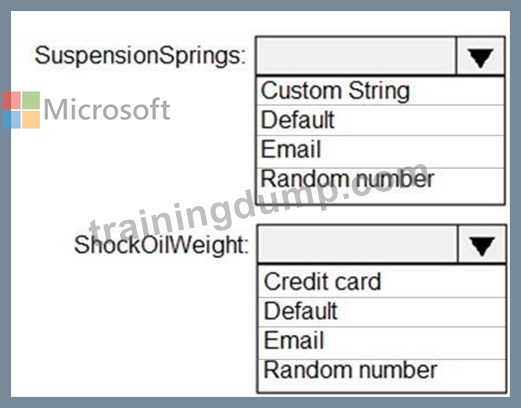
Answer:
Explanation: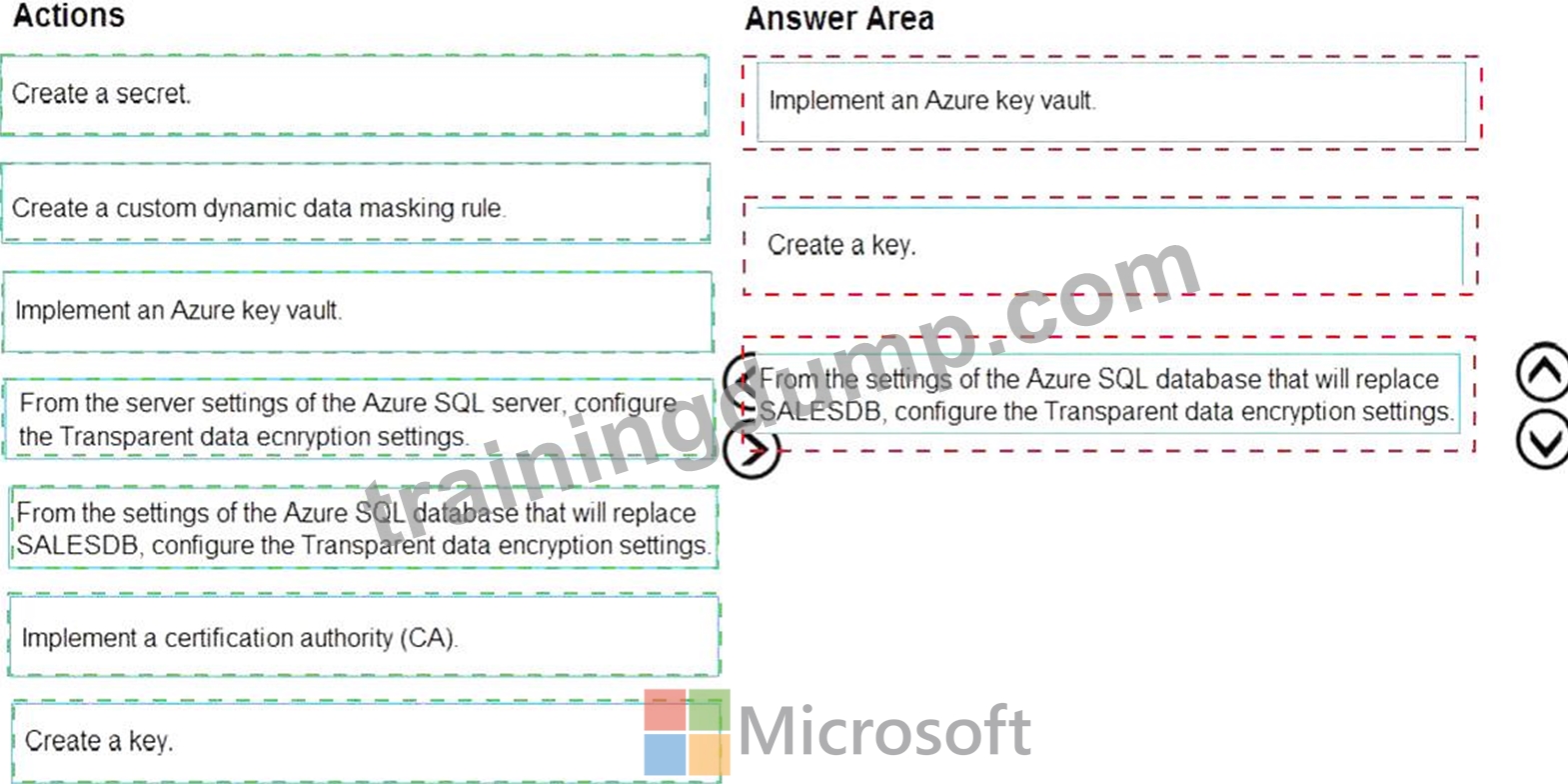
Explanation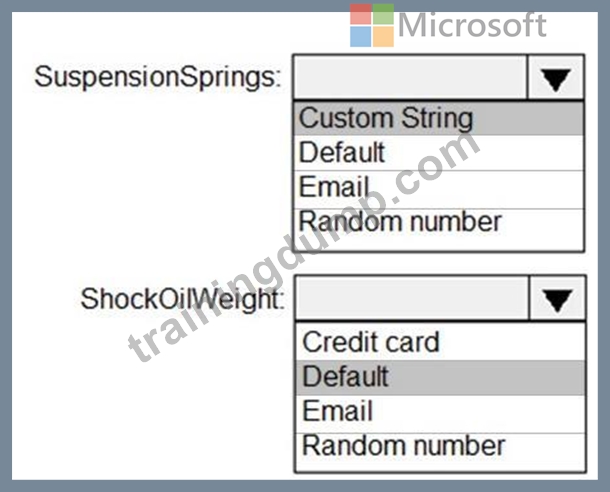
Box 1: Custom text/string: A masking method, which exposes the first and/or last characters and adds a custom padding string in the middle.
Only show the last four digits of the values in a column named SuspensionSprings.
Box 2: Default
Default uses a zero value for numeric data types (bigint, bit, decimal, int, money, numeric, smallint, smallmoney, tinyint, float, real).
Scenario: Only show a zero value for the values in a column named ShockOilWeight.
Scenario:
The company identifies the following data masking requirements for the Race Central data that will be stored in SQL Database:
* Only show a zero value for the values in a column named ShockOilWeight.
* Only show the last four digits of the values in a column named SuspensionSprings.
Reference:
https://docs.microsoft.com/en-us/azure/azure-sql/database/dynamic-data-masking-overview
NEW QUESTION 139
A company has a real-lime data analysis solution that is hosted on Microsoft Azure the solution uses Azure Event Hub to ingest data and an Azure Stream Analytics cloud job to analyze the data. The cloud job is configured to use 120 Streaming Units (SU).
You need to optimize performance for the Azure Stream Analytics job.
Which two actions should you perform? Each correct answer presents part of the solution.
NOTE: Each correct selection is worth one port.
- A. Implement event ordering
- B. Scale the SU count for the job up
- C. Implement query parallelization by partitioning the data output
- D. Implement query parallelization by partitioning the data input
- E. Scale the SU count for the job down
- F. Implement Azure Stream Analytics user-defined functions (UDF)
Answer: B,D
Explanation:
Scale out the query by allowing the system to process each input partition separately.
F: A Stream Analytics job definition includes inputs, a query, and output. Inputs are where the job reads the data stream from.
References:
https://docs.microsoft.com/eHYPERLINK%20
NEW QUESTION 140
Note: This question is part of a series of questions that present the same scenario. Each question in the series contains a unique solution that might meet the stated goals. Some question sets might have more than one correct solution, while others might not have a correct solution.
After you answer a question in this scenario, you will NOT be able to return to it. As a result, these questions will not appear in the review screen.
You have a container named Sales in an Azure Cosmos DB database. Sales has 120 GB of data. Each entry in Sales has the following structure.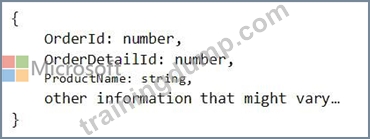
The partition key is set to the OrderId attribute.
Users report that when they perform queries that retrieve data by ProductName, the queries take longer than expected to complete.
You need to reduce the amount of time it takes to execute the problematic queries.
Solution: You create a lookup collection that uses ProductName as a partition key and OrderId as a value.
Does this meet the goal?
- A. No
- B. Yes
Answer: B
Explanation:
Explanation
One option is to have a lookup collection "ProductName" for the mapping of "ProductName" to "OrderId".
References:
https://azure.microsoft.com/sv-se/blog/azure-cosmos-db-partitioning-design-patterns-part-1/
NEW QUESTION 141
You plan to implement an Azure Cosmos DB database that will write 100,000 JSON every 24 hours. The database will be replicated to three regions. Only one region will be writable.
You need to select a consistency level for the database to meet the following requirements:
* Guarantee monotonic reads and writes within a session.
* Provide the fastest throughput.
* Provide the lowest latency.
Which consistency level should you select?
- A. Eventual
- B. Session
- C. Consistent Prefix
- D. Bounded Staleness
- E. Strong
Answer: B
Explanation:
Session: Within a single client session reads are guaranteed to honor the consistent-prefix (assuming a single "writer" session), monotonic reads, monotonic writes, read-your-writes, and write-follows-reads guarantees.
Clients outside of the session performing writes will see eventual consistency.
References:
https://docs.microsoft.com/en-us/azure/cosmos-db/consistency-levels
NEW QUESTION 142
You have an Azure SQL database that contains a table named Employee. Employee contains sensitive data in a decimal (10,2) column named Salary.
You need to ensure that nonprivileged users can view the table data, but Salary must display a number from 0 to 100.
What should you configure? To answer, select the appropriate options in the answer area.
NOTE: Each correct selection is worth one point.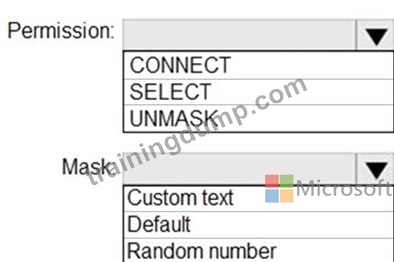
Answer:
Explanation: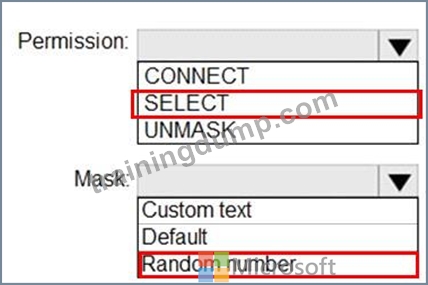
NEW QUESTION 143
You need to ensure phone-based polling data upload reliability requirements are met. How should you configure monitoring? To answer, select the appropriate options in the answer area.
NOTE: Each correct selection is worth one point.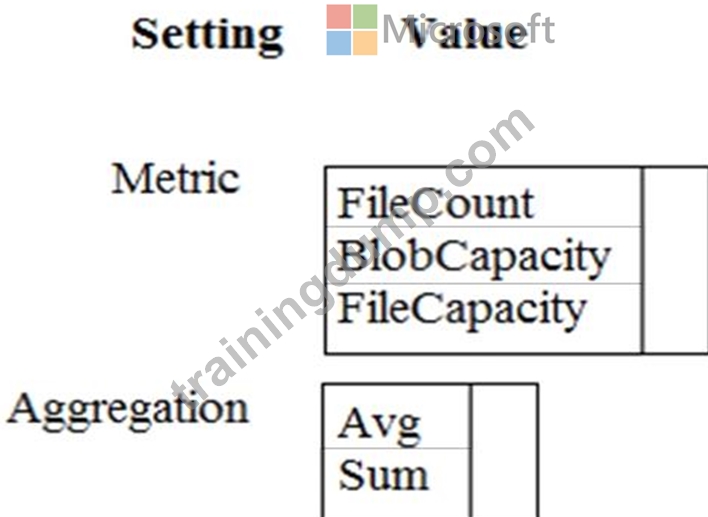
Answer:
Explanation: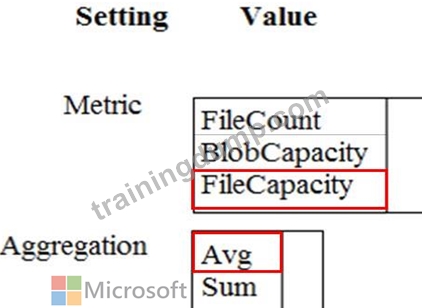
Explanation:
Box 1: FileCapacity
FileCapacity is the amount of storage used by the storage account's File service in bytes.
Box 2: Avg
The aggregation type of the FileCapacity metric is Avg.
Scenario:
All services and processes must be resilient to a regional Azure outage.
All Azure services must be monitored by using Azure Monitor. On-premises SQL Server performance must be monitored.
References:
https://docs.microsoft.com/en-us/azure/azure-monitor/platform/metrics-supported
NEW QUESTION 144
Note: This question is part of a series of questions that present the same scenario. Each question in the series contains a unique solution that might meet the stated goals. Some question sets might have more than one correct solution, while others might not have a correct solution.
After you answer a question in this scenario, you will NOT be able to return to it. As a result, these questions will not appear in the review screen.
You have an Azure Storage account that contains 100 GB of files. The files contain text and numerical values. 75% of the rows contain description data that has an average length of 1.1 MB.
You plan to copy the data from the storage account to an Azure SQL data warehouse.
You need to prepare the files to ensure that the data copies quickly.
Solution: You modify the files to ensure that each row is more than 1 MB.
Does this meet the goal?
- A. No
- B. Yes
Answer: A
Explanation:
Explanation
Instead modify the files to ensure that each row is less than 1 MB.
References:
https://docs.microsoft.com/en-us/azure/sql-data-warehouse/guidance-for-loading-data
NEW QUESTION 145
You have two Azure Storage accounts named Storage1 and Storage2. Each account contains an Azure Data Lake Storage file system. The system has files that contain data stored in the Apache Parquet format.
You need to copy folders and files from Storage1 to Storage2 by using a Data Factory copy activity. The solution must meet the following requirements:
* No transformations must be performed.
* The original folder structure must be retained.
How should you configure the copy activity? To answer, select the appropriate options in the answer area.
NOTE: Each correct selection is worth one point.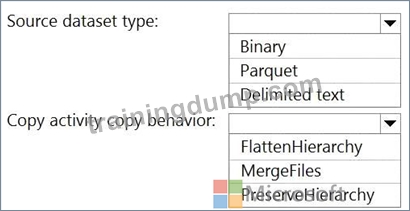
Answer:
Explanation: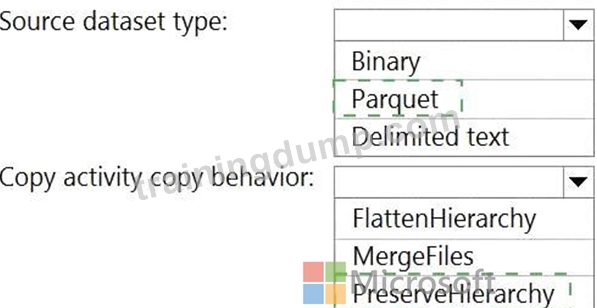
Explanation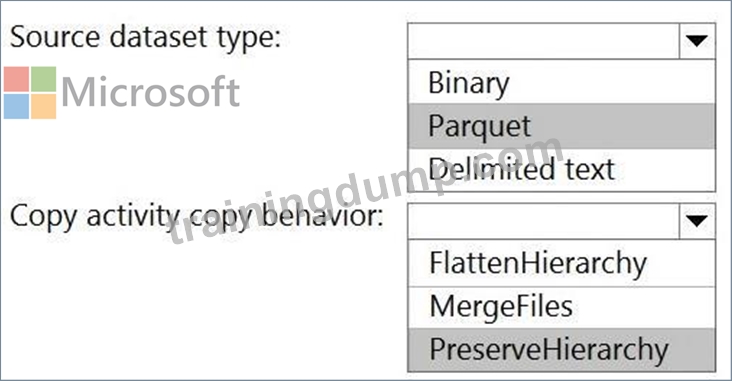
Box 1: Parquet
For Parquet datasets, the type property of the copy activity source must be set to ParquetSource..
Box 2: PreserveHierarchy
PreserveHierarchy (default): Preserves the file hierarchy in the target folder. The relative path of the source file to the source folder is identical to the relative path of the target file to the target folder.
Reference:
https://docs.microsoft.com/en-us/azure/data-factory/format-parquet
https://docs.microsoft.com/en-us/azure/data-factory/connector-azure-data-lake-storage
NEW QUESTION 146
A company has a real-lime data analysis solution that is hosted on Microsoft Azure the solution uses Azure Event Hub to ingest data and an Azure Stream Analytics cloud job to analyze the data. The cloud job is configured to use 120 Streaming Units (SU).
You need to optimize performance for the Azure Stream Analytics job.
Which two actions should you perform? Each correct answer presents part of the solution.
NOTE: Each correct selection is worth one port.
- A. Implement event ordering
- B. Scale the SU count for the job up
- C. Implement query parallelization by partitioning the data output
- D. Implement query parallelization by partitioning the data input
- E. Scale the SU count for the job down
- F. Implement Azure Stream Analytics user-defined functions (UDF)
Answer: B,D
Explanation:
Explanation
Scale out the query by allowing the system to process each input partition separately.
F: A Stream Analytics job definition includes inputs, a query, and output. Inputs are where the job reads the data stream from.
References:
https://docs.microsoft.com/en-us/azure/stream-analytics/stream-analytics-parallelization
NEW QUESTION 147
You plan to use Microsoft Azure SQL Database instances with strict user access control. A user object must:
Move with the database if it is run elsewhere
Be able to create additional users
You need to create the user object with correct permissions.
Which two Transact-SQL commands should you run? Each correct answer presents part of the solution.
NOTE: Each correct selection is worth one point.
- A. ALTER LOGIN Mary WITH PASSWORD = 'strong_password';
- B. ALTER ROLE db_owner ADD MEMBER Mary;
- C. CREATE LOGIN Mary WITH PASSWORD = 'strong_password';
- D. CREATE USER Mary WITH PASSWORD = 'strong_password';
- E. GRANT ALTER ANY USER TO Mary;
Answer: B,D
Explanation:
Explanation/Reference:
Explanation:
C: ALTER ROLE adds or removes members to or from a database role, or changes the name of a user- defined database role.
Members of the db_owner fixed database role can perform all configuration and maintenance activities on the database, and can also drop the database in SQL Server.
D: CREATE USER adds a user to the current database.
Note: Logins are created at the server level, while users are created at the database level. In other words, a login allows you to connect to the SQL Server service (also called an instance), and permissions inside the database are granted to the database users, not the logins. The logins will be assigned to server roles (for example, serveradmin) and the database users will be assigned to roles within that database (eg.
db_datareader, db_bckupoperator).
References:
https://docs.microsoft.com/en-us/sql/t-sql/statements/alter-role-transact-sql
https://docs.microsoft.com/en-us/sql/t-sql/statements/create-user-transact-sql Testlet 2 Background Proseware, Inc, develops and manages a product named Poll Taker. The product is used for delivering public opinion polling and analysis.
Polling data comes from a variety of sources, including online surveys, house-to-house interviews, and booths at public events.
Polling data
Polling data is stored in one of the two locations:
An on-premises Microsoft SQL Server 2019 database named PollingData
Azure Data Lake Gen 2
Data in Data Lake is queried by using PolyBase
Poll metadata
Each poll has associated metadata with information about the poll including the date and number of respondents. The data is stored as JSON.
Phone-based polling
Security
Phone-based poll data must only be uploaded by authorized users from authorized devices
Contractors must not have access to any polling data other than their own
Access to polling data must set on a per-active directory user basis
Data migration and loading
All data migration processes must use Azure Data Factory
All data migrations must run automatically during non-business hours
Data migrations must be reliable and retry when needed
Performance
After six months, raw polling data should be moved to a lower-cost storage solution.
Deployments
All deployments must be performed by using Azure DevOps. Deployments must use templates used in
multiple environments
No credentials or secrets should be used during deployments
Reliability
All services and processes must be resilient to a regional Azure outage.
Monitoring
All Azure services must be monitored by using Azure Monitor. On-premises SQL Server performance must be monitored.
Testlet 3
Overview
Current environment
Contoso relies on an extensive partner network for marketing, sales, and distribution. Contoso uses external companies that manufacture everything from the actual pharmaceutical to the packaging.
The majority of the company's data reside in Microsoft SQL Server database. Application databases fall into one of the following tiers: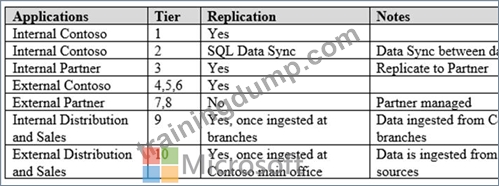
The company has a reporting infrastructure that ingests data from local databases and partner services.
Partners services consists of distributors, wholesales, and retailers across the world. The company performs daily, weekly, and monthly reporting.
Requirements
Tier 3 and Tier 6 through Tier 8 application must use database density on the same server and Elastic pools in a cost-effective manner.
Applications must still have access to data from both internal and external applications keeping the data encrypted and secure at rest and in transit.
A disaster recovery strategy must be implemented for Tier 3 and Tier 6 through 8 allowing for failover in the case of server going offline.
Selected internal applications must have the data hosted in single Microsoft Azure SQL Databases.
Tier 1 internal applications on the premium P2 tier
Tier 2 internal applications on the standard S4 tier
The solution must support migrating databases that support external and internal application to Azure SQL Database. The migrated databases will be supported by Azure Data Factory pipelines for the continued movement, migration and updating of data both in the cloud and from local core business systems and repositories.
Tier 7 and Tier 8 partner access must be restricted to the database only.
In addition to default Azure backup behavior, Tier 4 and 5 databases must be on a backup strategy that performs a transaction log backup eve hour, a differential backup of databases every day and a full back up every week.
Back up strategies must be put in place for all other standalone Azure SQL Databases using Azure SQL- provided backup storage and capabilities.
Databases
Contoso requires their data estate to be designed and implemented in the Azure Cloud. Moving to the cloud must not inhibit access to or availability of data.
Databases:
Tier 1 Database must implement data masking using the following masking logic: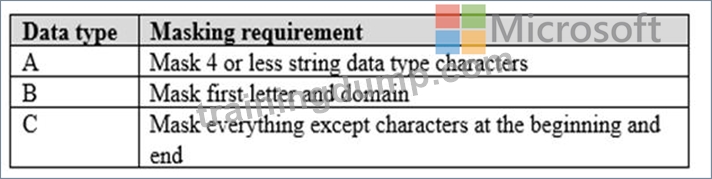
Tier 2 databases must sync between branches and cloud databases and in the event of conflicts must be set up for conflicts to be won by on-premises databases.
Tier 3 and Tier 6 through Tier 8 applications must use database density on the same server and Elastic pools in a cost-effective manner.
Applications must still have access to data from both internal and external applications keeping the data encrypted and secure at rest and in transit.
A disaster recovery strategy must be implemented for Tier 3 and Tier 6 through 8 allowing for failover in the case of a server going offline.
Selected internal applications must have the data hosted in single Microsoft Azure SQL Databases.
Tier 1 internal applications on the premium P2 tier
Tier 2 internal applications on the standard S4 tier
Reporting
Security and monitoring
Security
A method of managing multiple databases in the cloud at the same time is must be implemented to streamlining data management and limiting management access to only those requiring access.
Monitoring
Monitoring must be set up on every database. Contoso and partners must receive performance reports as part of contractual agreements.
Tiers 6 through 8 must have unexpected resource storage usage immediately reported to data engineers.
The Azure SQL Data Warehouse cache must be monitored when the database is being used. A dashboard monitoring key performance indicators (KPIs) indicated by traffic lights must be created and displayed based on the following metrics: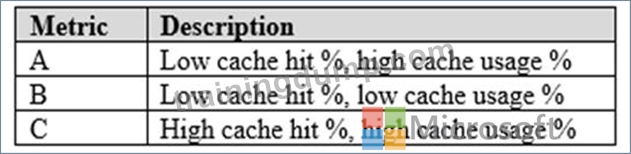
Existing Data Protection and Security compliances require that all certificates and keys are internally managed in an on-premises storage.
You identify the following reporting requirements:
Azure Data Warehouse must be used to gather and query data from multiple internal and external
databases
Azure Data Warehouse must be optimized to use data from a cache
Reporting data aggregated for external partners must be stored in Azure Storage and be made
available during regular business hours in the connecting regions
Reporting strategies must be improved to real time or near real time reporting cadence to improve
competitiveness and the general supply chain
Tier 9 reporting must be moved to Event Hubs, queried, and persisted in the same Azure region as the
company's main office
Tier 10 reporting data must be stored in Azure Blobs
Issues
Team members identify the following issues:
Both internal and external client application run complex joins, equality searches and group-by clauses.
Because some systems are managed externally, the queries will not be changed or optimized by Contoso External partner organization data formats, types and schemas are controlled by the partner companies
Internal and external database development staff resources are primarily SQL developers familiar with
the Transact-SQL language.
Size and amount of data has led to applications and reporting solutions not performing are required
speeds
Tier 7 and 8 data access is constrained to single endpoints managed by partners for access
The company maintains several legacy client applications. Data for these applications remains isolated
form other applications. This has led to hundreds of databases being provisioned on a per application basis
NEW QUESTION 148
You are developing a solution to visualize multiple terabytes of geospatial data.
The solution has the following requirements:
*Data must be encrypted.
*Data must be accessible by multiple resources on Microsoft Azure.
You need to provision storage for the solution.
Which four actions should you perform in sequence? To answer, move the appropriate action from the list of actions to the answer area and arrange them in the correct order.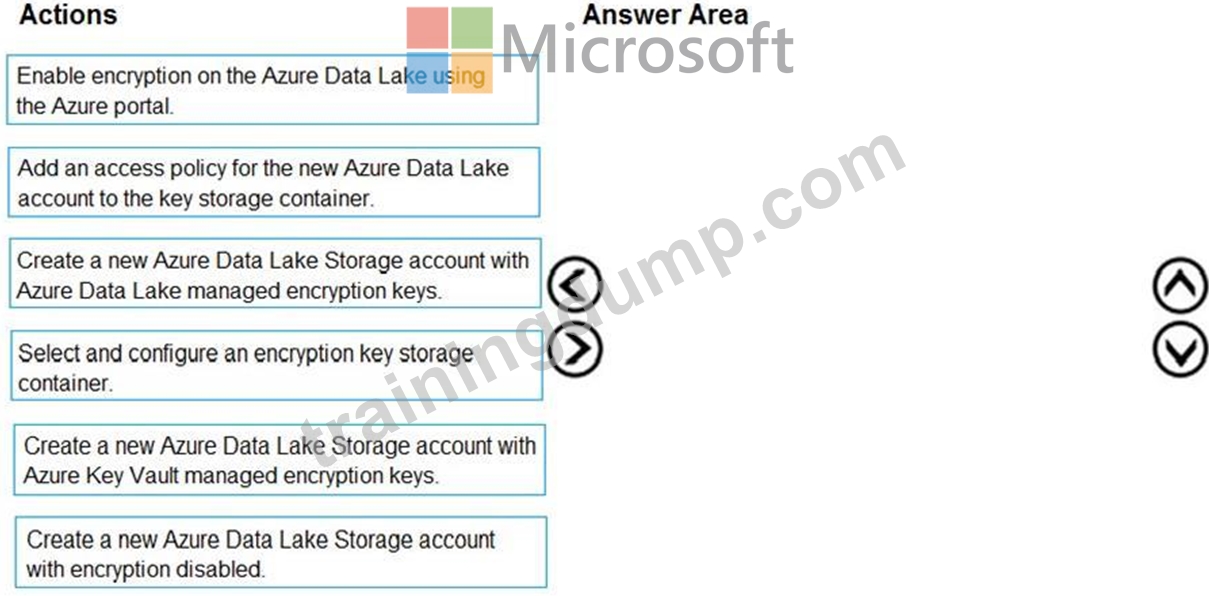
Answer:
Explanation: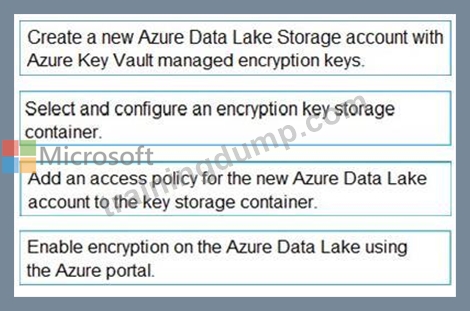
Create a new Azure Data Lake Storage account with Azure Data Lake managed encryption keys For Azure services, Azure Key Vault is the recommended key storage solution and provides a common management experience across services. Keys are stored and managed in key vaults, and access to a key vault can be given to users or services. Azure Key Vault supports customer creation of keys or import of customer keys for use in customer-managed encryption key scenarios.
Note: Data Lake Storage Gen1 account Encryption Settings. There are three options:
* Do not enable encryption.
* Use keys managed by Data Lake Storage Gen1, if you want Data Lake Storage Gen1 to manage your encryption keys.
* Use keys from your own Key Vault. You can select an existing Azure Key Vault or create a new Key Vault. To use the keys from a Key Vault, you must assign permissions for the Data Lake Storage Gen1 account to access the Azure Key Vault.
References:
https://docs.microsoft.com/en-us/azure/security/fundamentals/encryption-atrest
NEW QUESTION 149 
Use the following login credentials as needed:
Azure Username: xxxxx
Azure Password: xxxxx
The following information is for technical support purposes only:
Lab Instance: 10277521
You plan to generate large amounts of real-time data that will be copied to Azure Blob storage.
You plan to create reports that will read the data from an Azure Cosmos DB database.
You need to create an Azure Stream Analytics job that will input the data from a blob storage named storage10277521 to the Cosmos DB database.
To complete this task, sign in to the Azure portal.
Answer:
Explanation:
See the explanation below.
Explanation
Step 1: Create a Stream Analytics job
1. Sign in to the Azure portal.
2. Select Create a resource in the upper left-hand corner of the Azure portal.
3. Select Analytics > Stream Analytics job from the results list.
4. Fill out the Stream Analytics job page.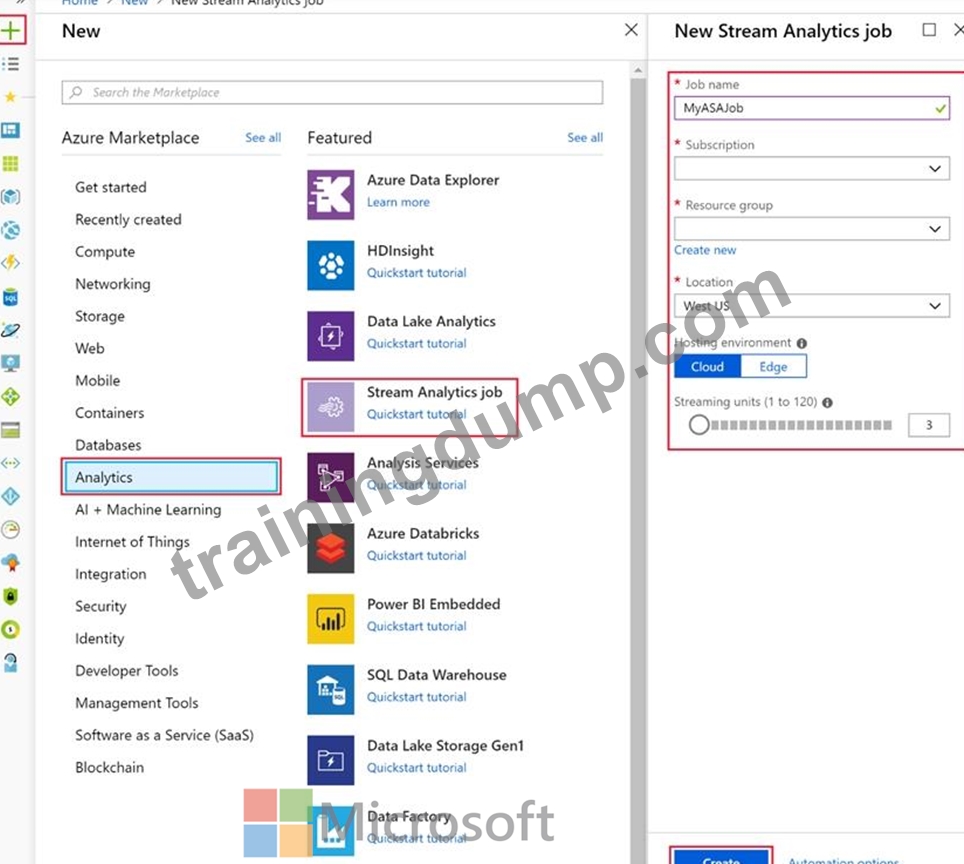
5. Check the Pin to dashboard box to place your job on your dashboard and then select Create.
6. You should see a Deployment in progress... notification displayed in the top right of your browser window.
Step 2: Configure job input
1. Navigate to your Stream Analytics job.
2. Select Inputs > Add Stream input > Azure Blob storage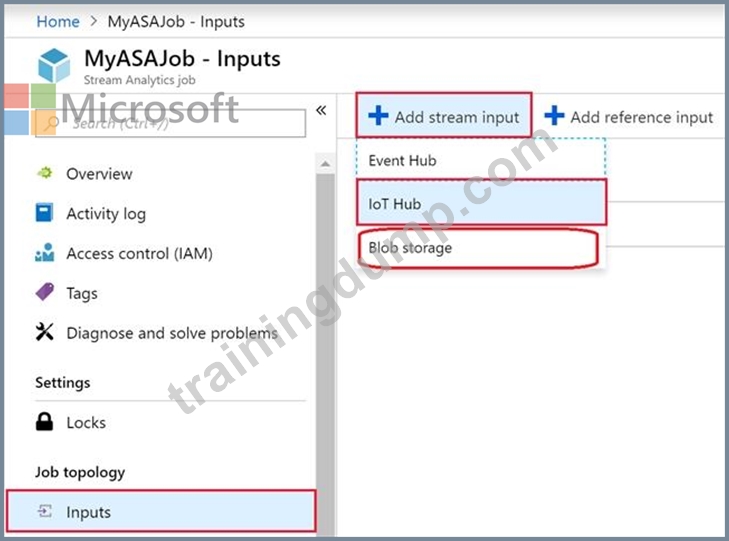
3. In the Azure Blob storage setting choose: storage10277521. Leave other options to default values and select Save to save the settings.
Reference:
https://docs.microsoft.com/en-us/azure/stream-analytics/stream-analytics-quick-create-portal
NEW QUESTION 150
Note: This question is part of a series of questions that present the same scenario. Each question in the series contains a unique solution that might meet the stated goals. Some question sets might have more than one correct solution, while others might not have a correct solution.
After you answer a question in this scenario, you will NOT be able to return to it. As a result, these questions will not appear in the review screen.
You have a container named Sales in an Azure Cosmos DB database. Sales has 120 GB of data. Each entry in Sales has the following structure.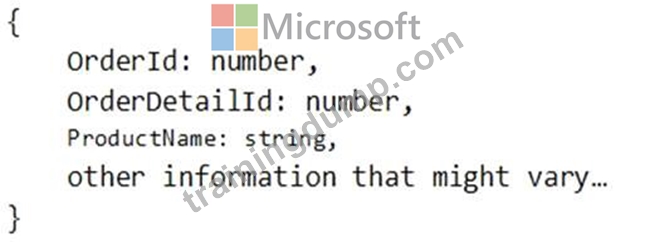
The partition key is set to the OrderId attribute.
Users report that when they perform queries that retrieve data by ProductName, the queries take longer than expected to complete.
You need to reduce the amount of time it takes to execute the problematic queries.
Solution: You create a lookup collection that uses ProductName as a partition key.
Does this meet the goal?
- A. No
- B. Yes
Answer: A
Explanation:
Explanation
One option is to have a lookup collection "ProductName" for the mapping of "ProductName" to "OrderId".
References:
https://azure.microsoft.com/sv-se/blog/azure-cosmos-db-partitioning-design-patterns-part-1/
NEW QUESTION 151
Note: This question is part of a series of questions that present the same scenario. Each question in the series contains a unique solution that might meet the stated goals. Some questions sets might have more than one correct solution, while others might not have a correct solution.
After you answer a question in this section, you will NOT be able to return to it. As a result, these questions will not appear in the review screen.
You have an Azure subscription that contains an Azure Storage account.
You plan to implement changes to a data storage solution to meet regulatory and compliance standards.
Every day, Azure needs to identify and delete blobs that were NOT modified during the last 100 days.
Solution: You schedule an Azure Data Factory pipeline.
Does this meet the goal?
- A. No
- B. Yes
Answer: A
Explanation:
Instead apply an Azure Blob storage lifecycle policy.
Reference:
https://docs.microsoft.com/en-us/azure/storage/blobs/storage-lifecycle-management-concepts?tabs=azure-portal
NEW QUESTION 152
You develop data engineering solutions for a company.
You need to deploy a Microsoft Azure Stream Analytics job for an IoT solution. The solution must:
* Minimize latency.
* Minimize bandwidth usage between the job and IoT device.
Which four actions should you perform in sequence? To answer, move the appropriate actions from the list of actions to the answer area and arrange them in the correct order.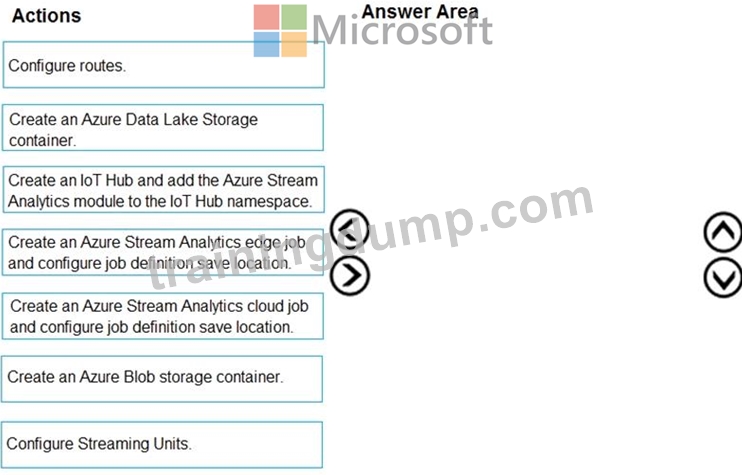
Answer:
Explanation: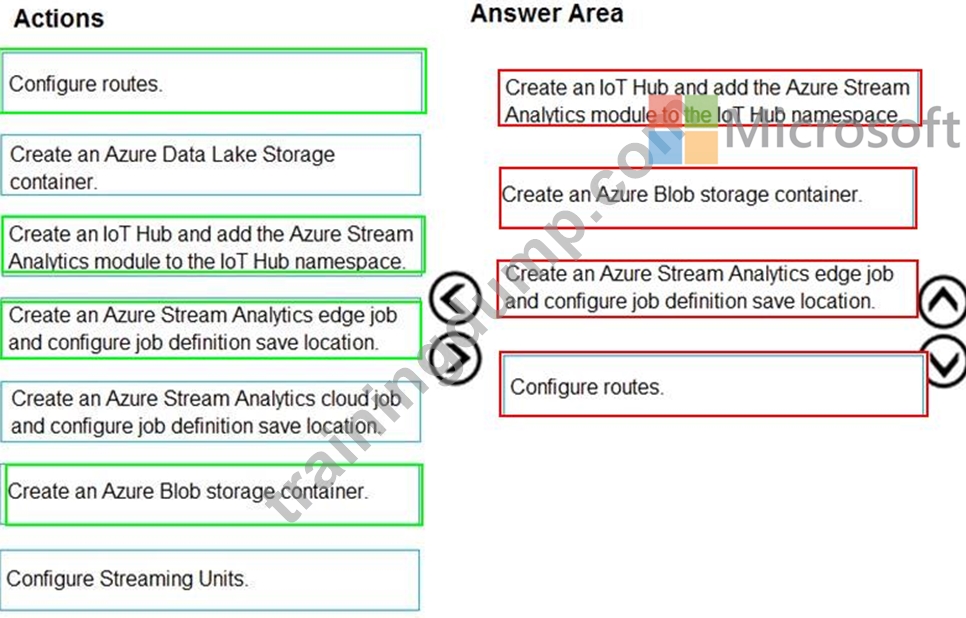
NEW QUESTION 153
Use the following login credentials as needed:
Azure Username: xxxxx
Azure Password: xxxxx
The following information is for technical support purposes only:
Lab Instance: 10543936
You need to replicate db1 to a new Azure SQL server named db1-copy10543936 in the US West region.
To complete this task, sign in to the Azure portal.
Answer:
Explanation:
See the explanation below.
Explanation
1. In the Azure portal, browse to the database db1-copy10543936 that you want to set up for geo-replication.
2. On the SQL database page, select geo-replication, and then select the region to create the secondary database: US West region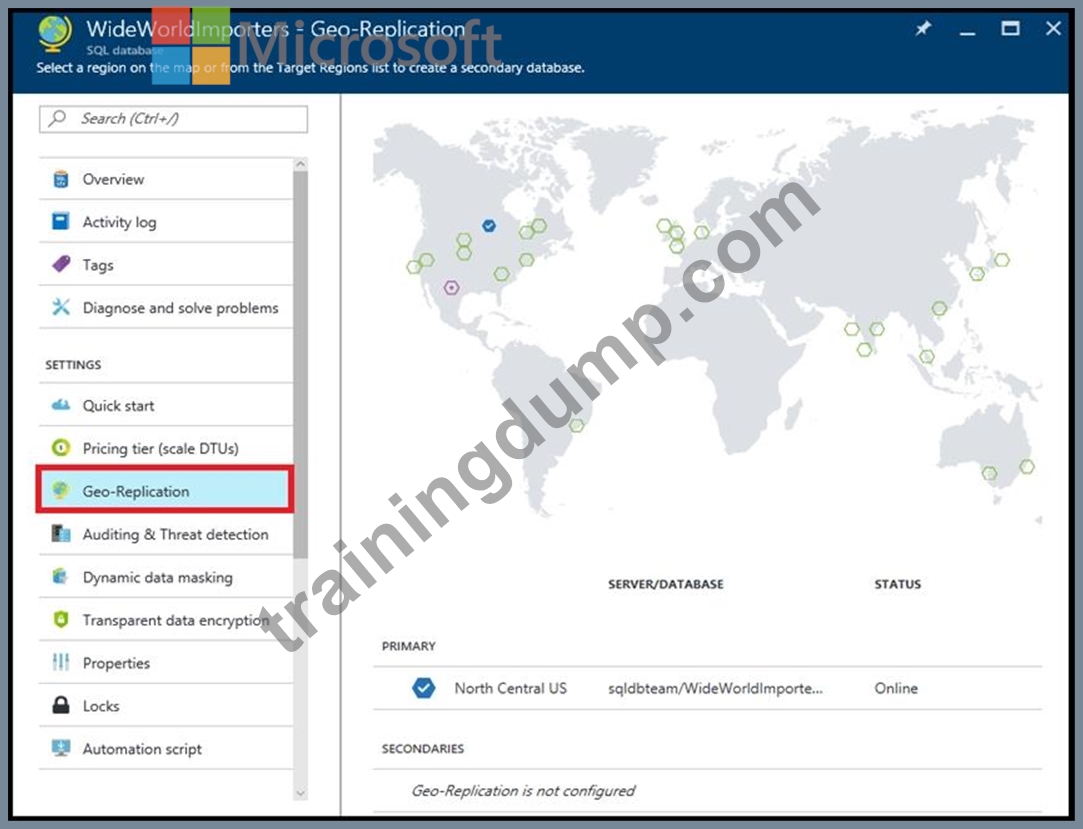
3. Select or configure the server and pricing tier for the secondary database.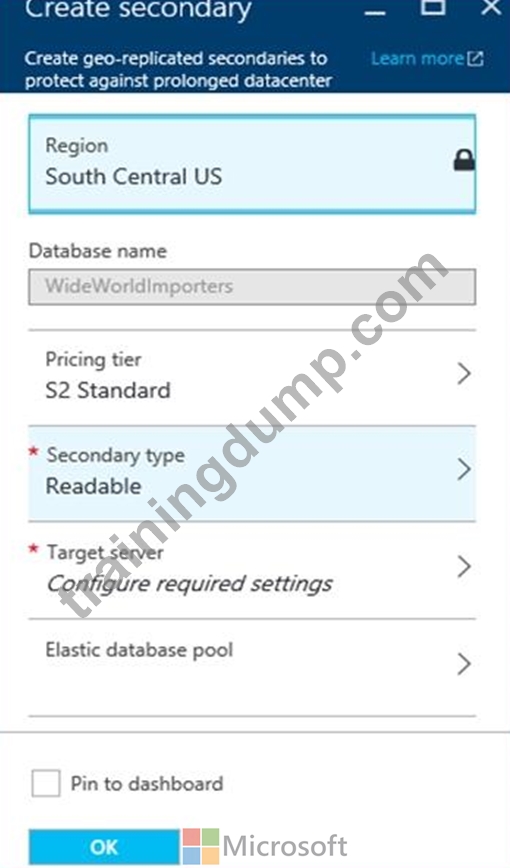
4. Click Create to add the secondary.
5. The secondary database is created and the seeding process begins.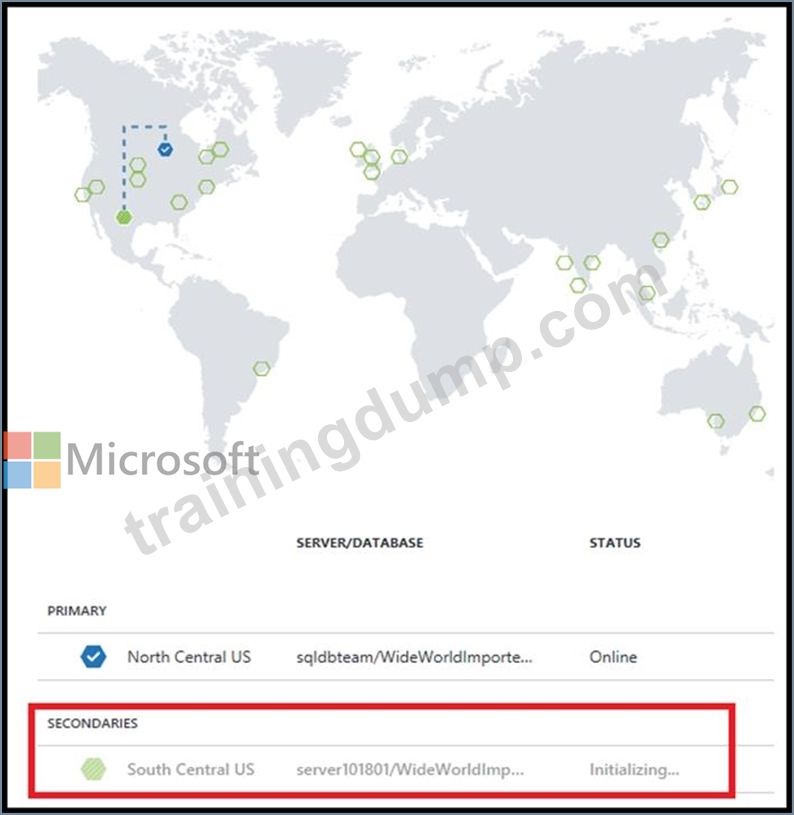
6. When the seeding process is complete, the secondary database displays its status.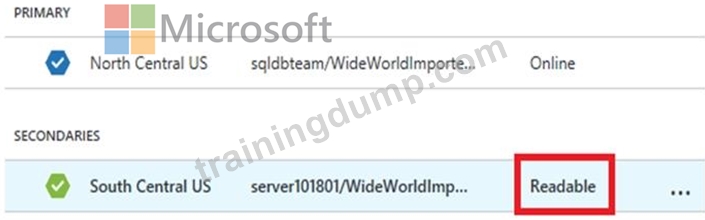
Reference:
https://docs.microsoft.com/en-us/azure/sql-database/sql-database-active-geo-replication-portal
NEW QUESTION 154
You develop data engineering solutions for a company.
A project requires an in-memory batch data processing solution.
You need to provision an HDInsight cluster for batch processing of data on Microsoft Azure.
How should you complete the PowerShell segment? To answer, select the appropriate options in the answer area.
NOTE: Each correct selection is worth one point.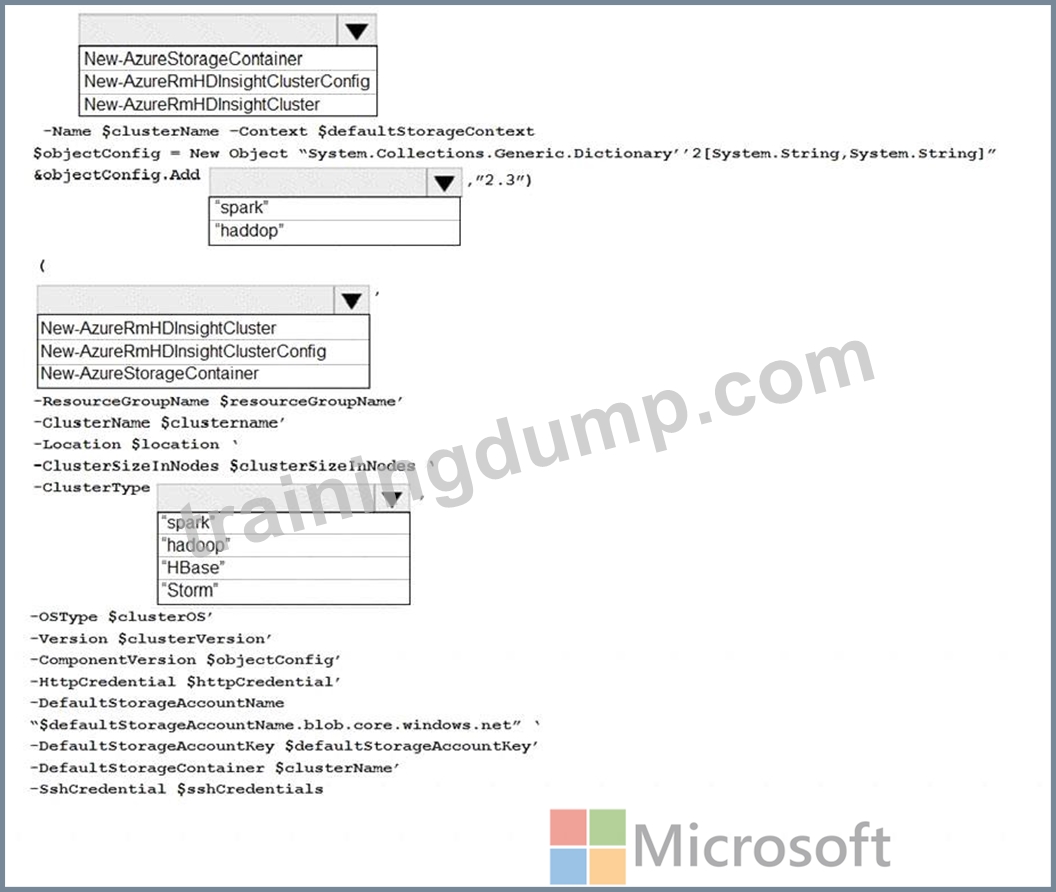
Answer:
Explanation: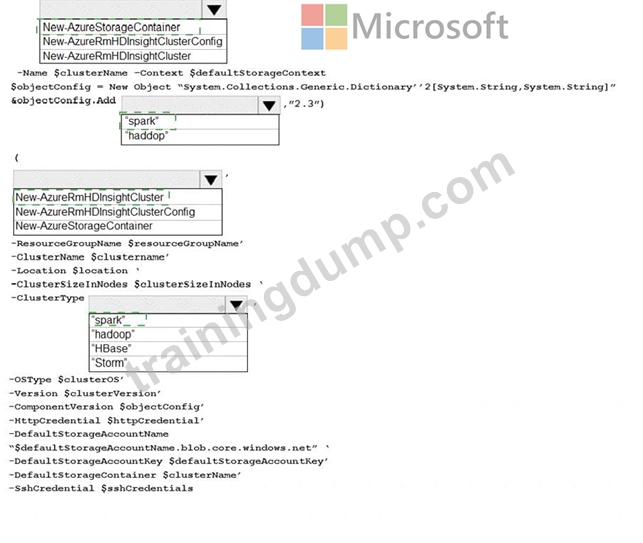
Explanation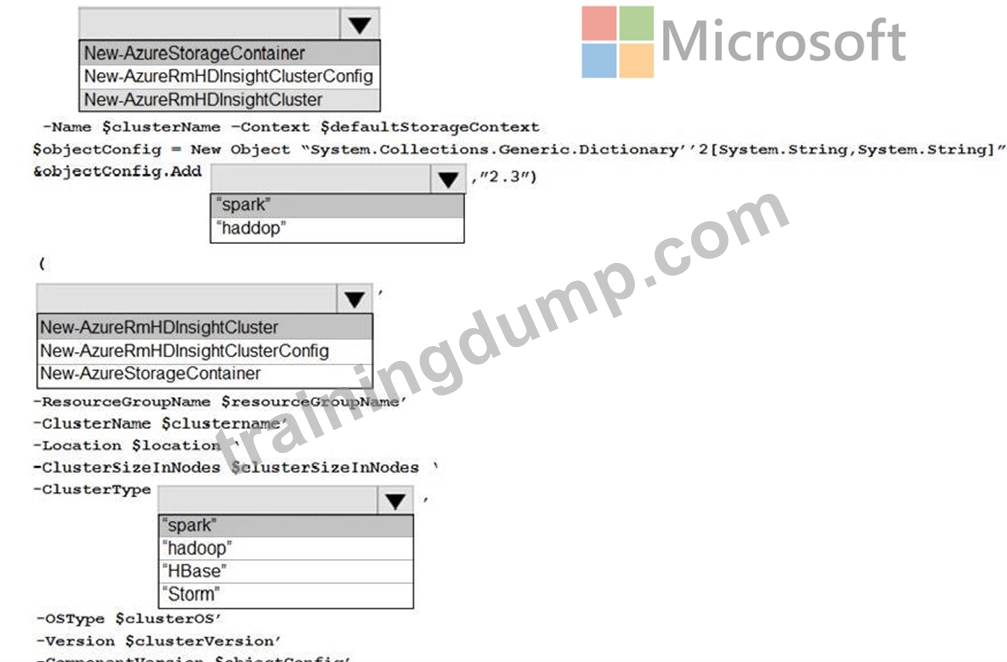
Box 1: New-AzStorageContainer
# Example: Create a blob container. This holds the default data store for the cluster.
New-AzStorageContainer `
-Name $clusterName `
-Context $defaultStorageContext
$sparkConfig = New-Object "System.Collections.Generic.Dictionary``2[System.String,System.String]"
$sparkConfig.Add("spark", "2.3")
Box 2: Spark
Spark provides primitives for in-memory cluster computing. A Spark job can load and cache data into memory and query it repeatedly. In-memory computing is much faster than disk-based applications than disk-based applications, such as Hadoop, which shares data through Hadoop distributed file system (HDFS).
Box 3: New-AzureRMHDInsightCluster
# Create the HDInsight cluster. Example:
New-AzHDInsightCluster `
-ResourceGroupName $resourceGroupName `
-ClusterName $clusterName `
-Location $location `
-ClusterSizeInNodes $clusterSizeInNodes `
-ClusterType $"Spark" `
-OSType "Linux" `
Box 4: Spark
HDInsight is a managed Hadoop service. Use it deploy and manage Hadoop clusters in Azure. For batch processing, you can use Spark, Hive, Hive LLAP, MapReduce.
References:
https://docs.microsoft.com/bs-latn-ba/azure/hdinsight/spark/apache-spark-jupyter-spark-sql-use-powershell
https://docs.microsoft.com/bs-latn-ba/azure/hdinsight/spark/apache-spark-overview
NEW QUESTION 155
Note: This question is part of series of questions that present the same scenario. Each question in the series contains a unique solution. Determine whether the solution meets the stated goals.
You develop a data ingestion process that will import data to a Microsoft Azure SQL Data Warehouse. The data to be ingested resides in parquet files stored in an Azure Data Lake Gen 2 storage account.
You need to load the data from the Azure Data Lake Gen 2 storage account into the Azure SQL Data Warehouse.
Solution:
1. Create an external data source pointing to the Azure storage account
2. Create a workload group using the Azure storage account name as the pool name
3. Load the data using the INSERT...SELECTstatement
Does the solution meet the goal?
- A. No
- B. Yes
Answer: A
Explanation:
You need to create an external file format and external table using the external data source.
You then load the data using the CREATE TABLE AS SELECT statement.
References:
https://docs.microsoft.com/en-us/azure/sql-data-warehouse/sql-data-warehouse-load-from-azure-data-lake- store
NEW QUESTION 156
You need set up the Azure Data Factory JSON definition for Tier 10 data.
What should you use? To answer, select the appropriate options in the answer area.
NOTE: Each correct selection is worth one point.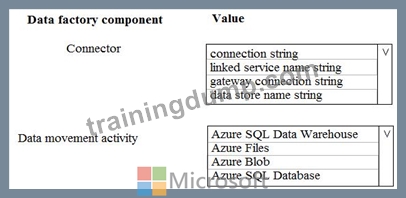
Answer:
Explanation: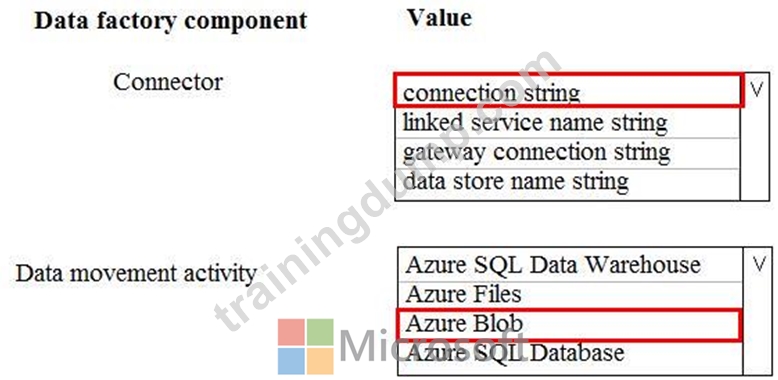
Explanation:
Box 1: Connection String
To use storage account key authentication, you use the ConnectionString property, which xpecify the information needed to connect to Blobl Storage.
Mark this field as a SecureString to store it securely in Data Factory. You can also put account key in Azure Key Vault and pull the accountKey configuration out of the connection string.
Box 2: Azure Blob
Tier 10 reporting data must be stored in Azure Blobs
References:
https://docs.microsoft.com/en-us/azure/data-factory/connector-azure-blob-storage
NEW QUESTION 157
Your company uses several Azure HDInsight clusters.
The data engineering team reports several errors with some application using these clusters.
You need to recommend a solution to review the health of the clusters.
What should you include in you recommendation?
- A. Azure Automation
- B. Log Analytics
- C. Application Insights
Answer: C
NEW QUESTION 158
Note: This question is part of a series of questions that present the same scenario. Each question in the series contains a unique solution that might meet the stated goals. Some question sets might have more than one correct solution, while others might not have a correct solution.
After you answer a question in this section, you will NOT be able to return to it. As a result, these questions will not appear in the review screen.
You have an Azure subscription that contains an Azure Storage account.
You plan to implement changes to a data storage solution to meet regulatory and compliance standards.
Every day, Azure needs to identify and delete blobs that were NOT modified during the last 100 days.
Solution: You apply an Azure policy that tags the storage account.
Does this meet the goal?
- A. No
- B. Yes
Answer: A
Explanation:
Instead apply an Azure Blob storage lifecycle policy.
Reference:
https://docs.microsoft.com/en-us/azure/storage/blobs/storage-lifecycle-management-concepts?tabs=azure- portal
NEW QUESTION 159
You are designing a new Lambda architecture on Microsoft Azure.
The real-time processing layer must meet the following requirements:
Ingestion:
* Receive millions of events per second
* Act as a fully managed Platform-as-a-Service (PaaS) solution
* Integrate with Azure Functions
Stream processing:
* Process on a per-job basis
* Provide seamless connectivity with Azure services
* Use a SQL-based query language
Analytical data store:
* Act as a managed service
* Use a document store
* Provide data encryption at rest
You need to identify the correct technologies to build the Lambda architecture using minimal effort. Which technologies should you use? To answer, select the appropriate options in the answer area.
NOTE: Each correct selection is worth one point.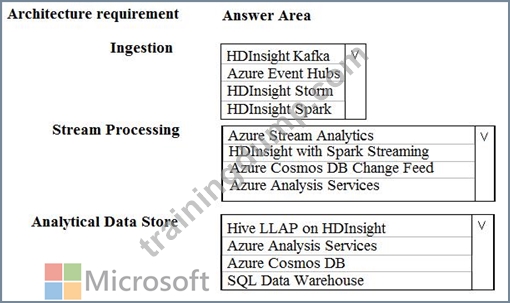
Answer:
Explanation: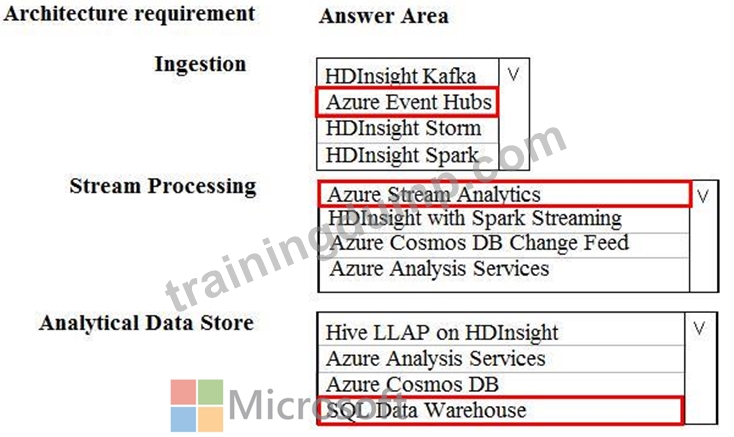
Explanation:
Box 1: Azure Event Hubs
This portion of a streaming architecture is often referred to as stream buffering. Options include Azure Event Hubs, Azure IoT Hub, and Kafka.
Incorrect Answers: Not HDInsight Kafka
Azure Functions need a trigger defined in order to run. There is a limited set of supported trigger types, and Kafka is not one of them.
Box 2: Azure Stream Analytics
Azure Stream Analytics provides a managed stream processing service based on perpetually running SQL queries that operate on unbounded streams.
You can also use open source Apache streaming technologies like Storm and Spark Streaming in an HDInsight cluster.
Box 3: Azure SQL Data Warehouse
Azure SQL Data Warehouse provides a managed service for large-scale, cloud-based data warehousing. HDInsight supports Interactive Hive, HBase, and Spark SQL, which can also be used to serve data for analysis.
References:
https://docs.microsoft.com/en-us/azure/architecture/data-guide/big-data/
NEW QUESTION 160
Use the following login credentials as needed:
Azure Username: xxxxx
Azure Password: xxxxx
The following information is for technical support purposes only:
Lab Instance: 10543936
You need to create an elastic pool that contains an Azure SQL database named db2 and a new SQL database named db3.
To complete this task, sign in to the Azure portal.
Answer:
Explanation:
See the explanation below.
Explanation
Step 1: Create a new SQL database named db3
1. Select SQL in the left-hand menu of the Azure portal. If SQL is not in the list, select All services, then type SQL in the search box.
2. Select + Add to open the Select SQL deployment option page. Select Single Database. You can view additional information about the different databases by selecting Show details on the Databases tile.
3. Select Create: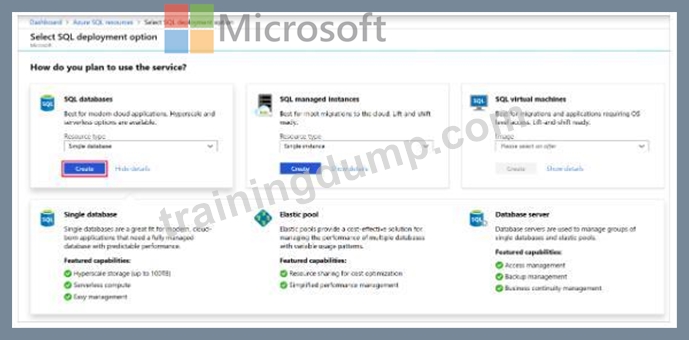
4. Enter the required fields if necessary.
5. Leave the rest of the values as default and select Review + Create at the bottom of the form.
6. Review the final settings and select Create. Use Db3 as database name.
On the SQL Database form, select Create to deploy and provision the resource group, server, and database.
Step 2: Create your elastic pool using the Azure portal.
1. Select Azure SQL in the left-hand menu of the Azure portal. If Azure SQL is not in the list, select All services, then type Azure SQL in the search box.
2. Select + Add to open the Select SQL deployment option page.
3. Select Elastic pool from the Resource type drop-down in the SQL Databases tile. Select Create to create your elastic pool.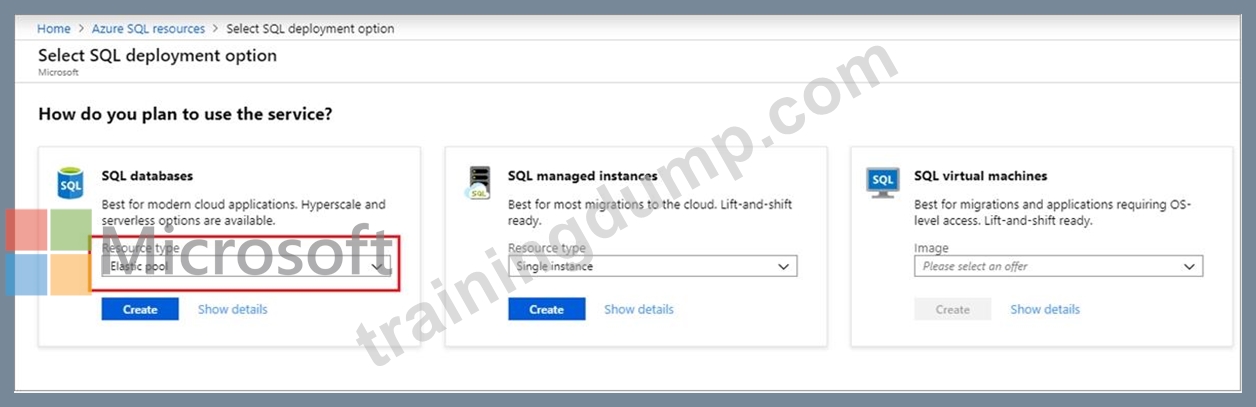
4. Configure your elastic pool with the following values:
Name: Provide a unique name for your elastic pool, such as myElasticPool.
Subscription: Select your subscription from the drop-down.
ResourceGroup: Select the resource group.
Server: Select the server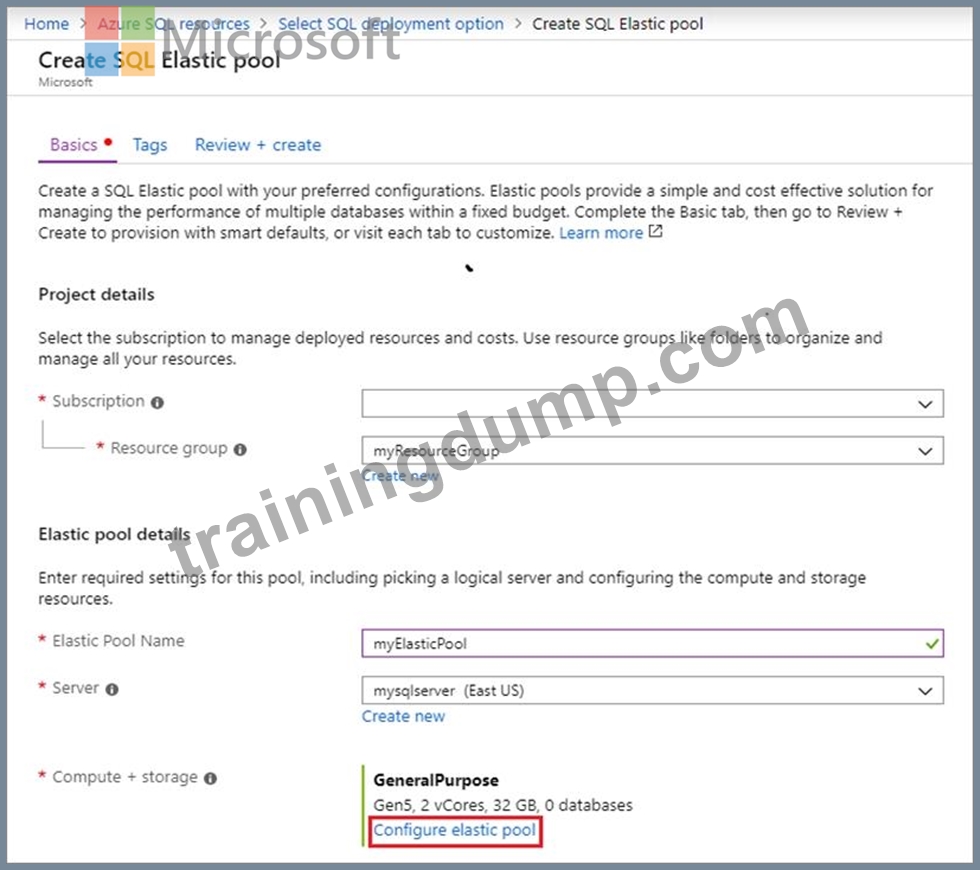
5. Select Configure elastic pool
6. On the Configure page, select the Databases tab, and then choose to Add database.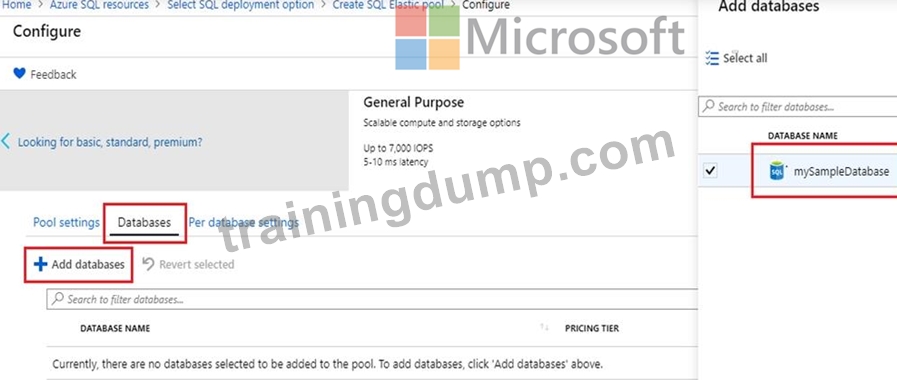
7. Add the Azure SQL database named db2, and the new SQL database named db3 that you created in Step 1.
8. Select Review + create to review your elastic pool settings and then select Create to create your elastic pool.
Reference:
https://docs.microsoft.com/bs-latn-ba/azure/sql-database/sql-database-elastic-pool-failover-group-tutorial
NEW QUESTION 161
Use the following login credentials as needed:
Azure Username: xxxxx
Azure Password: xxxxx
The following information is for technical support purposes only:
Lab Instance: 10543936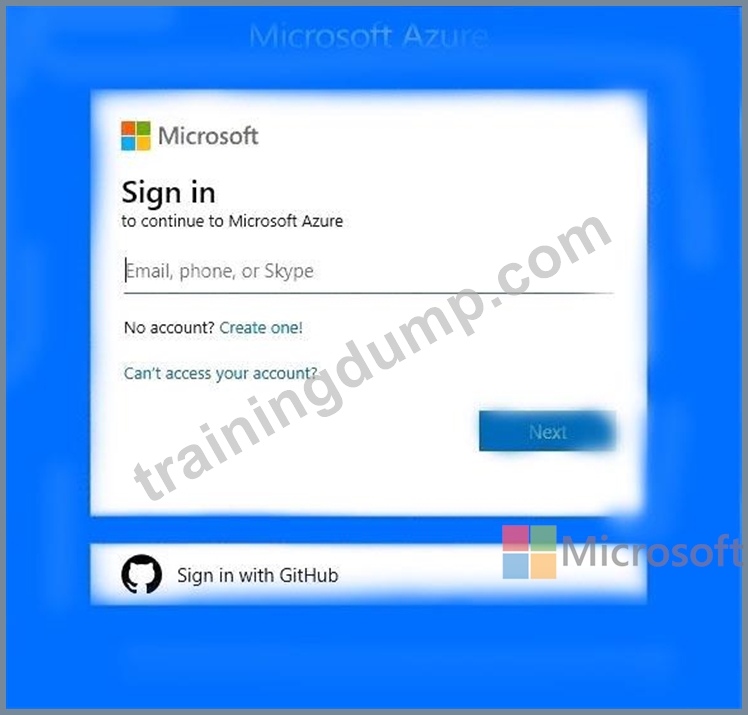
Your company's compliance policy states that administrators must be able to review a list of the database object changes that occurred in an Azure SQL database named db2 during the last 100 days.
You need to modify your Azure environment to meet the compliance policy requirements.
To complete this task, sign in to the Azure portal.
Answer:
Explanation:
See the explanation below.
Explanation
Set up auditing for your database
The following section describes the configuration of auditing using the Azure portal.
1. Go to the Azure portal.
2. Navigate to Auditing under the Security heading in your SQL database db2/server pane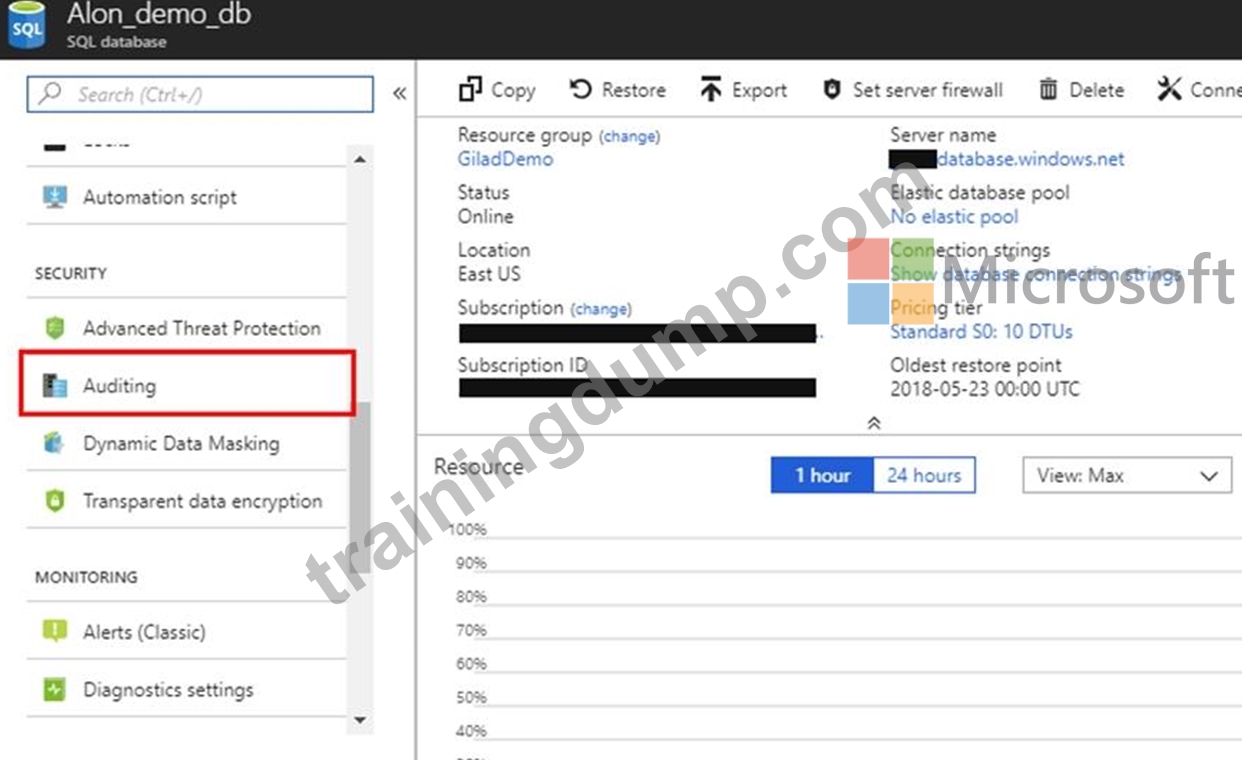
3. If you prefer to enable auditing on the database level, switch Auditing to ON.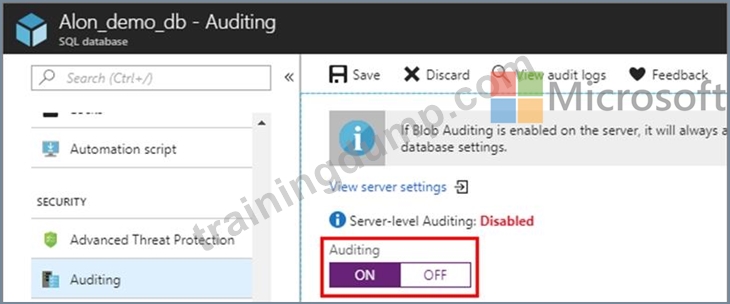
Note: By default the audit database data retention period is set to 100 days.
Reference:
https://docs.microsoft.com/en-us/azure/sql-database/sql-database-auditing
NEW QUESTION 162
......
Potential Candidates and Requirements
According to the fact that this is an associate-level certification track, there are no strict requirements that you must fulfill except passing two exams. Thus, if you are planning to take Microsoft DP-200, you can be an Azure Data Engineer who wants to verify the skills to get certified or a specialist who is just starting an IT career. In both cases, you should have a solid knowledge of the content and be able to clear the tests with high results.
A potential candidate for the Microsoft DP-200 exam should know how to identify and meet the requirements by collaborating with the business stakeholders to implement data solutions that use Azure data services. Besides that, it is required that the individuals have the relevant skills in implementing various data solutions, such as Azure Blob storage, Azure Databricks, Azure Data Factory, Azure Stream Analytics, Azure Synapse Analytics, and Azure Cosmos DB. Also, they need to be able to ingest batch and streaming data, provision data storage services, identify performance bottlenecks, implement security requirements, access external data sources, transform data, and implement data retention policies. /
Updated Verified DP-200 dumps Q&As - Pass Guarantee or Full Refund: https://www.trainingdump.com/Microsoft/DP-200-practice-exam-dumps.html