

[May-2024] OGEA-10B Exam Dumps - Free Demo & 365 Day Updates
Free Sales Ending Soon - Use Real OGEA-10B PDF Questions
NEW QUESTION # 15
Complete the sentence The TOGAF standard covers the development of four architecture domains. Business.
Data, Technology and__________________.
- A. Transition
- B. Application
- C. Segment
- D. Capability
Answer: B
Explanation:
The TOGAF standard covers the development of four architecture domains: Business, Data, Technology and Application. These domains represent different aspects of an enterprise's architecture and provide a consistent way of describing, analyzing, and designing them. Reference: The TOGAF Standard | The Open Group Website, Section 2.2 Architecture Development Method (ADM).
NEW QUESTION # 16
Complete the sentence A business scenario describes______________
- A. business domain gaps such as cross-training requirements
- B. business and technology environment in which those problems occur
- C. shortfalls between the Baseline and Target Architectures
- D. general rules and guidelines tor the architecture being developed
Answer: B
Explanation:
A business scenario describes business and technology environment in which those problems occur. It provides a realistic context for identifying and addressing business problems and opportunities, as well as their impact on the enterprise's architecture. Reference: The TOGAF Standard | The Open Group Website, Section 3.3.1 Business Scenarios.
NEW QUESTION # 17 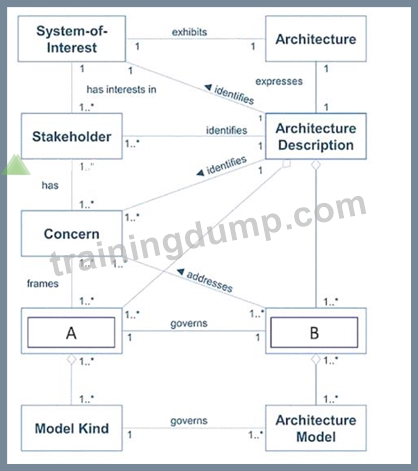
Consider the image showing basic architectural concepts.
What are items A and B?
- A. A-Architecture Board, B-Architecture Capability
- B. A-Candidate Architecture, B-Trade-off
- C. A-Architecture Viewpoint, B-Architecture View
- D. A-Requirement. B-Candidate Architecture
Answer: C
Explanation:
The image shows a diagram that illustrates the basic concepts of architecture description as defined by the ISO/IEC/IEEE 42010:2011 standard1, which is also adopted by the TOGAF standard2.
According to the ISO/IEC/IEEE 42010:2011 standard, an architecture description is a work product used to express an architecture, and it consists of one or more architecture views1.
An architecture view is a representation of a system from the perspective of a related set of concerns, and it conforms to an architecture viewpoint1.
An architecture viewpoint is a specification of the conventions for constructing and using an architecture view to address specific stakeholder concerns1.
Therefore, the correct answer is option A, which identifies the items labeled as "A" and "B" in the image as an architecture viewpoint and an architecture view, respectively. References:
1: ISO/IEC/IEEE 42010:2011 - Systems and software engineering - Architecture description1
2: TOGAF Standard, Version 9.2 - Part IV: Architecture Content Framework - 31. Architectural Artifacts2
NEW QUESTION # 18
Complete the sentence. The four purposes that typically frame the planning horizon, depth and breadth of an Architecture Project, and the contents of the EA Repository are Strategy, Portfolio,
- A. Discreet, and Cohesive.
- B. Segment, and End-to-end Target Architecture.
- C. Subordinate, and Superior Architecture.
- D. Project, and Solution Delivery.
Answer: B
Explanation:
The planning horizon, depth, and breadth of an Architecture Project, along with the contents of the EA Repository, are typically framed by Strategy, Portfolio, Segment, and End-to-end Target Architecture. The
'Segment' refers to a part of the organization, typically addressed in a Segment Architecture, while 'End-to-end Target Architecture' encompasses the complete view of the planned architecture across the entire organization.
NEW QUESTION # 19
Which of the following is the ability to develop use and sustain the architecture of a particular enterprise using architecture to govern change?
- A. An EA framework
- B. An EA repository
- C. An EA Capability
- D. An Enterprise Architecture
Answer: C
Explanation:
The ability to develop, use, and sustain the architecture of a particular enterprise using architecture to govern change is an EA Capability. An EA Capability is a set of skills, processes, roles, responsibilities, tools, and techniques that enable an enterprise to successfully develop and maintain its Enterprise Architecture and achieve its desired outcomes. An EA Capability is part of an enterprise's overall capability portfolio and should be aligned with its strategy and objectives. Reference: The TOGAF Standard | The Open Group Website, Section 3.2 Preliminary Phase.
NEW QUESTION # 20
Which of the following supports the need to govern Enterprise Architecture?
- A. The TOGAF standard cannot be used without executive governance
- B. Best practice governance enables the organization to control value realization
- C. The Stakeholders preferences may go beyond the architecture project scope and needs control
- D. The Architecture Project mandates the governance of the target architecture
Answer: B
Explanation:
This statement best supports the need to govern Enterprise Architecture. Best practice governance enables the organization to control value realization by ensuring that architectures are aligned with the enterprise's strategy and objectives, meet the quality and performance requirements, and deliver the expected benefits and outcomes. The Architecture Project does not mandate the governance of the target architecture, but rather follows the governance framework established by the enterprise. The TOGAF standard can be used without executive governance, but it is recommended that executive sponsorship and support are obtained for successful architecture development and transition. The Stakeholders preferences may go beyond the architecture project scope and need control, but this is not the primary reason for governing Enterprise Architecture. Reference: The TOGAF Standard | The Open Group Website, Section 3.3.6 Architecture Governance.
NEW QUESTION # 21
In which phase(s) of the ADM would you deal with the actions resulting from a transformation readiness assessment?
- A. Phase E and F
- B. Phase A
- C. Phase G
- D. Phase F
Answer: A
Explanation:
According to the TOGAF Standard, 10th Edition, a transformation readiness assessment is a technique that evaluates the preparedness of the organization to undergo a change, and identifies the actions needed to increase the likelihood of a successful outcome. A transformation readiness assessment can be conducted in Phase E: Opportunities and Solutions, and the actions resulting from it can be dealt with in Phase F: Migration Planning 1. In Phase E, the transformation readiness assessment can help to identify the major implementation challenges and risks, and to define the critical success factors and key performance indicators for the architecture project. In Phase F, the actions resulting from the transformation readiness assessment can help to develop a detailed and realistic migration plan, and to address the gaps, issues, and dependencies that may affect the transition to the target architecture 1. References: 1: TOGAF Standard, 10th Edition, Part III: ADM Guidelines and Techniques, Chapter 29: Business Transformation Readiness Assessment.
NEW QUESTION # 22
What is used to structure architectural information in an orderly way so that it can be processed to meet stakeholder needs?
- A. An Architecture Framework
- B. An EA Library
- C. Content Metamodel
- D. A Stakeholder Map
Answer: C
Explanation:
A content metamodel is a formal structure that defines the types of entities and relationships that are used to capture, store, filter, query, and represent architectural information in a way that supports consistency, completeness, and traceability12.
A stakeholder map is a tool that identifies and analyzes the key stakeholders and their interests, influence, and expectations in relation to the architecture3. It is not used to structure architectural information, but rather to understand the stakeholder needs and concerns.
An architecture framework is a set of principles, guidelines, standards, and tools that provide a common structure and methodology for developing architectures4. It is not used to structure architectural information, but rather to guide the architecture development process and ensure alignment with the business strategy and objectives.
An EA library is a repository that stores and manages the architecture artifacts, deliverables, and other relevant information produced and consumed during the architecture development and governance. It is not used to structure architectural information, but rather to provide access, security, and version control for the architecture content.
References: 1: The TOGAF Standard, Version 9.2 - Content Metamodel 2: TOGAF 9.2 Content Metamodel Framework - A Quick Guide - KnowledgeHut 3: The TOGAF Standard, Version 9.2 - Stakeholder Management 4: The TOGAF Standard, Version 9.2 - Architecture Framework : The TOGAF Standard, Version 9.2 - Architecture Repository
NEW QUESTION # 23
Which phase of the ADM has the purpose to develop an Enterprise Architecture Capability?
- A. Preliminary Phase
- B. Phase A
- C. Phase G
- D. Phase B
Answer: A
Explanation:
According to the TOGAF Standard, 10th Edition, the Preliminary Phase of the Architecture Development Method (ADM) has the purpose to develop an Enterprise Architecture Capability 1. An Enterprise Architecture Capability is the ability of the organization to perform the activities and tasks related to Enterprise Architecture, such as defining the scope, principles, vision, governance, and stakeholders of the architecture. The Preliminary Phase also establishes the architecture framework, the architecture repository, the architecture tools, and the architecture team 1. The other options are not correct, as they have different purposes in the ADM. Phase G: Implementation Governance has the purpose to ensure that the implementation projects conform to the target architecture 2. Phase A: Architecture Vision has the purpose to define the scope, stakeholders, business drivers, and objectives of the architecture project 3. Phase B: Business Architecture has the purpose to describe the baseline and target business architecture, and to identify the gaps between them . References: 1: TOGAF Standard, 10th Edition, Part II: Architecture Development Method, Chapter 6: Preliminary Phase. 2: TOGAF Standard, 10th Edition, Part II: Architecture Development Method, Chapter 18: Phase G: Implementation Governance. 3: TOGAF Standard, 10th Edition, Part II: Architecture Development Method, Chapter 12: Phase A: Architecture Vision. : TOGAF Standard, 10th Edition, Part II:
Architecture Development Method, Chapter 13: Phase B: Business Architecture.
NEW QUESTION # 24
Which of the following best describes the class of information known as the Reference Library within the Architecture Repository?
- A. A record of the governance activity across the enterprise
- B. Guidelines and templates used to create new architectures
- C. Processes to support governance of the Architecture Repository
- D. Specifications to which architectures must conform
Answer: B
Explanation:
The class of information known as the Reference Library within the Architecture Repository contains guidelines and templates used to create new architectures. The Reference Library provides a set of resources that can be leveraged or customized for specific architecture development purposes. It includes generic building blocks, patterns, models, standards, frameworks, methods, techniques, best practices, etc. Reference:
The TOGAF Standard | The Open Group Website, Section 2.4 Architecture Repository.
NEW QUESTION # 25
Please read this scenario prior to answering the question
Your role is that of a consultant to the Lead Enterprise Architect to an international supplier of engineering services and automated manufacturing systems. It has three manufacturing plants where it assembles both standard and customized products for industrial production automation. Each of these plants has been operating its own planning and production scheduling systems, as well as applications and control systems that drive the automated production line.
The Enterprise Architecture department has been operating for several years and has mature, well-developed architecture governance and development processes that are based on the TOGAF Standard. The CIO sponsors the Enterprise Architecture.
During a recent management meeting, a senior Vice-President highlighted an interview where a competitor company's CIO is reported as saying that their production efficiency had been improved by replacing multiple planning and scheduling systems with a common Enterprise Resource Planning (ERP) system located in a central data center. Some discussion followed, with the CIO responding that the situations are not comparable, and the current architecture is already optimized.
In response, the Architecture Board approved a Request for Architecture Work covering the investigations to determine if such an architecture transformation would lead to improvements in efficiency. You have been assigned to support the architecture team working on this project.
A well-known concern of the plant managers is about the security and reliability of driving their planning and production scheduling from a remote centralized system. Any chosen system would also need to support the current supply chain network consisting of local partners at each of the plants.
Refer to the scenario
You have been asked to explain how you will initiate the architecture project.
Based on the TOGAF Standard, which of the following is the best answer?
- A. You would conduct a pilot project that will enable vendors to demonstrate potential off-the-shelf solutions that address the concerns of the stakeholders. Running a pilot project will save time and money later in the process. Based on the findings of that pilot project, a complete set of requirements can then be developed that will drive the evolution of the architecture. Once the requirements are completed, a formal stakeholder review should be held, and permission sought to proceed to develop the target architecture.
- B. You would develop baseline and target Architectures for each of the manufacturing plants, ensuring that the views corresponding to selected viewpoints address key concerns of the stakeholders. A business case, together with performance metrics and measures should be defined to ensure the architecture meets the business needs. A consolidated gap analysis between the architectures will then validate the approach and determine the capability increments needed to achieve the target state.
- C. You would research vendor literature and conduct a series of briefings with vendors that are on the current approved supplier list. Based on the findings from the research, you would define a preliminary Architecture Vision including summary views, high-level requirements, and high-level definitions of the baseline and target environments from a business, information systems, and technology perspective. You would then use that to build consensus among the key stakeholders.
- D. You would hold a series of interviews at each of the manufacturing plants using the business scenarios technique. This will allow you to understand the systems and integrations with local partners. You would use stakeholder analysis to identify key players in the engagement, and to understand their concerns. You will then identify and document the key high-level stakeholder requirements for the architecture. You will then generate high level definitions of the baseline and target architectures.
Answer: D
Explanation:
The best answer is C. You would hold a series of interviews at each of the manufacturing plants using the business scenarios technique. This will allow you to understand the systems and integrations with local partners. You would use stakeholder analysis to identify key players in the engagement, and to understand their concerns. You will then identify and document the key high-level stakeholder requirements for the architecture. You will then generate high level definitions of the baseline and target architectures.
This answer is based on the TOGAF standard, which recommends the following steps to initiate the architecture project1:
Establish the architecture project
Identify stakeholders, concerns, and business requirements
Confirm and elaborate business goals, business drivers, and constraints Evaluate business capabilities Assess readiness for business transformation Define scope Confirm and elaborate Architecture Principles, including business principles Develop Architecture Vision Define the Target Architecture value propositions and KPIs Identify the business transformation risks and mitigation activities Secure stakeholder and sponsor approval The answer C covers most of these steps, by using the business scenarios technique to elicit and validate the business requirements, goals, drivers, and constraints, as well as the current and future states of the architecture2. The answer C also uses stakeholder analysis to identify and engage the key stakeholders, and to address their concerns and expectations3. The answer C also generates high level definitions of the baseline and target architectures, which can be used to develop the Architecture Vision and the value propositions4.
The other answers are not the best approach for architecture development, because:
Answer A focuses on researching vendor literature and conducting briefings with vendors, which is not the best way to understand the business needs and the current situation of the enterprise. Answer A also defines a preliminary Architecture Vision without involving the stakeholders or validating the requirements, which may lead to misalignment and lack of consensus.
Answer B conducts a pilot project that will enable vendors to demonstrate potential solutions, which is premature and costly at this stage of the architecture project. Answer B also does not address the stakeholder concerns or the current systems and integrations, which may result in gaps and risks.
Answer B also develops the requirements after the pilot project, which may not reflect the actual business needs and goals.
Answer D develops baseline and target architectures for each of the manufacturing plants, which may not consider the enterprise-wide perspective and the potential benefits of a common ERP system.
Answer D also does not involve the stakeholders or address their concerns, which may result in resistance and conflict. Answer D also does not define the business case or the performance metrics, which are essential for demonstrating the value and feasibility of the architecture.
References: 1: The TOGAF Standard, Version 9.2 - Architecture Vision 2: The TOGAF Standard, Version 9.2
- Business Scenarios 3: [The TOGAF Standard, Version 9.2 - Stakeholder Management] 4: [The TOGAF Standard, Version 9.2 - Architecture Definition Document]
NEW QUESTION # 26
According to the TOGAF standard, what term describes an individual with an interest in a system?
- A. sponsor
- B. lead architect
- C. consumer
- D. stakeholder
Answer: D
Explanation:
According to the TOGAF Standard, 10th Edition, a stakeholder is "an individual with an interest in a system"
1. A stakeholder can be anyone who is affected by the system, or who can influence or be influenced by the system. Stakeholders can have different roles, perspectives, and concerns regarding the system, and they can be internal or external to the organization. Stakeholder management is a technique that helps to identify, analyze, and engage the stakeholders of an architecture project, and to address their needs and expectations 2.
The other options are not correct, as they are not the term used by the TOGAF Standard to describe an individual with an interest in a system. A consumer is "an individual or group that uses a product or service" 1.
A lead architect is "an individual who is responsible for leading the development of an architecture" 1. A sponsor is "an individual who provides funding and support for an architecture project" 1. References: 1:
TOGAF Standard, 10th Edition, Part I: Introduction, Chapter 3: Definitions. 2: TOGAF Standard, 10th Edition, Part III: ADM Guidelines and Techniques, Chapter 24: Stakeholder Management.
NEW QUESTION # 27
Which of the following are the four purposes that typically frame the planning horizon, depth and breadth of an Architecture Project, and the contents of the EA Repository-?
- A. Avant-Garde Big-Bang, Discreet and Cohesive
- B. General Foundational Subordinate and Superior Architecture
- C. Strategy Portfolio Project Solution Delivery
- D. Segment, Capability. Enterprise and End-to-end Target Architecture
Answer: C
Explanation:
Strategy Portfolio Project Solution Delivery are the four purposes that typically frame the planning horizon, depth and breadth of an Architecture Project, and the contents of the EA Repository. They correspond to different levels of abstraction and granularity in the architecture development process. Reference: The TOGAF Standard, Version 9.2 - The Open Group, Section 2.4 Architecture Repository.
NEW QUESTION # 28
Please read this scenario prior to answering the question
You are the Chief Enterprise Architect at a large food service company specializing in sales to trade and wholesale, for example, restaurants and other food retailers.
One of your company's competitors has launched a revolutionary product range and is running a very aggressive marketing campaign. Your company's resellers are successively announcing that they are not interested in your company's products and will sell your competitor's.
The CEO has stated there must be significant change to address the situation. He has made it clear that new markets must be found for the company's products, and that the business needs to pivot, and address the retail market as well as the existing wholesale market.
A consideration is the company's ability and willingness to change its business model, and if it is a temporary or permanent change. An additional risk factor is one of culture. The company has been used to a stable business with a reasonably well known and settled client base - all with its own local understandings and practices.
The CEO is the sponsor of the EA program within the company. You have been engaged with the sales, logistics, production, and marketing teams, enabling the architecture activity to start. An Architecture Vision, Architecture Principles, and Requirements have all been agreed. As you move forward to develop a possible Target Architecture you have identified that some of the key stakeholders' preferences are incompatible. The incompatibilities are focused primarily on time-to-market, cost savings, and the need to bring out a fully featured product range, but there are additional factors.
Refer to the scenario
You have been asked how you will address the incompatibilities between key stakeholder preferences.
Based on the TOGAF standard which of the following is the best answer?
- A. You recommend that since the CEO has stated that the company must pivot, it is better to compromise on a full product range rather than time-to-market. You would develop just enough of the Target Architecture to demonstrate fitness of the proposed approach. You would limit the description to just where there is a gap between the current baseline. You would seek approval by the stakeholders to move forward with developing the Target Architecture in detail.
- B. You would review the Stakeholder Map and ensure that you have addressed and represented the concerns of all department heads. You will involve them in resolving the incompatibilities. The Communications Plan should include a report that summarizes the key features of the architecture with and how incompatibilities were resolved to reflects the stakeholders' requirements. You will check with each key stakeholder they are satisfied with how the incompatibilities have been resolved.
- C. You would use the Architecture Vision, Principles, and Requirements to define a set of criteria for alternatives and create a set of architecture views to illustrate the impact of the alternative Target Architectures. You would identify the impact on planned projects. You would understand the strengths and weaknesses of the alternatives. You would conduct a formal stakeholder review to decide which alternative to move forward with. You will determine the funding required.
- D. You would seek to understand value preferences and priorities of the stakeholders. You would develop alternative Target Architectures, highlighting the gaps between current state and the alternatives. You would consider combining features from one or more alternatives in collaboration with the stakeholders. A formal stakeholder review should then be held to decide which alternative is fit for purpose and should be moved forward with. You will then secure the funding required.
Answer: C
Explanation:
According to the TOGAF standard, the Target Architecture is the description of a future state of the architecture being developed for an organization. It should be aligned with the Architecture Vision, Principles, and Requirements that have been agreed with the stakeholders. To address the incompatibilities between key stakeholder preferences, the TOGAF standard recommends creating and evaluating multiple alternative Target Architectures that meet different sets of criteria. These criteria should reflect the value preferences and priorities of the stakeholders, as well as the business drivers and objectives. The alternative Target Architectures should be illustrated using a set of architecture views that show the impact of each alternative on the business, data, application, and technology domains. The impact on planned projects should also be identified and analyzed. The strengths and weaknesses of each alternative should be understood and documented. A formal stakeholder review should then be conducted to decide which alternative is the most fit for purpose and should be moved forward with. The funding required for implementing the chosen alternative should also be determined and secured. References:
The TOGAF Standard, Version 9.2 - Phase B: Business Architecture - The Open Group The TOGAF Standard, Version 9.2 - Phase C: Information Systems Architectures - The Open Group
[The TOGAF Standard, Version 9.2 - Phase D: Technology Architecture - The Open Group]
[The TOGAF Standard, Version 9.2 - Phase E: Opportunities and Solutions - The Open Group]
[The TOGAF Standard, Version 9.2 - Phase F: Migration Planning - The Open Group]
NEW QUESTION # 29
Consider the following ADM phases objectives.
Objective:
1.Develop the Target Data Architecture that enables the Business Architecture and the Architecture Vision
2.Develop the Target Business Architecture that describes how the enterprise needs to operate to achieve the business goals
3.Develop a high-level aspirational vision of the capabilities and business value to be delivered as a result of the proposed Enterprise Architecture
4.Identify candidate Architecture Roadmap components based upon gaps between the Baseline and Target Technology Architectures Which phase does each objective match?
- A. 1A-2B-3C-4D
- B. 1B-2D-3A-4C
- C. 1C-2B-3A-4D
- D. 1C-2D-3B-4A
Answer: C
Explanation:
*Phase A: Architecture Vision
oDevelop a high-level aspirational vision of the capabilities and business value to be delivered as a result of the proposed Enterprise Architecture oDefine the scope and boundaries of the architecture engagement oIdentify the key stakeholders and their concerns and expectations oDefine the Architecture Vision statement and the Architecture Definition Document oObtain approval and commitment from the sponsors and stakeholders
*Phase B: Business Architecture
oDevelop the Target Business Architecture that describes how the enterprise needs to operate to achieve the business goals oDefine the Baseline Business Architecture, if not available oPerform a gap analysis between the Baseline and Target Business Architectures oDefine candidate roadmap components for the Business Architecture oResolve impacts across the Architecture Landscape
*Phase C: Information Systems Architecture
oDevelop the Target Data Architecture that enables the Business Architecture and the Architecture Vision oDevelop the Target Application Architecture that supports the Business Architecture and the Architecture Vision oDefine the Baseline Data and Application Architectures, if not available oPerform a gap analysis between the Baseline and Target Data and Application Architectures oDefine candidate roadmap components for the Information Systems Architecture oResolve impacts across the Architecture Landscape
*Phase D: Technology Architecture
oDevelop the Target Technology Architecture that enables the Information Systems Architecture and the Architecture Vision oDefine the Baseline Technology Architecture, if not available oPerform a gap analysis between the Baseline and Target Technology Architectures oIdentify candidate Architecture Roadmap components based upon gaps between the Baseline and Target Technology Architectures oResolve impacts across the Architecture Landscape Therefore, the correct matching of the objectives and the phases is:
*1C: Develop the Target Data Architecture that enables the Business Architecture and the Architecture Vision
*2B: Develop the Target Business Architecture that describes how the enterprise needs to operate to achieve the business goals
*3A: Develop a high-level aspirational vision of the capabilities and business value to be delivered as a result of the proposed Enterprise Architecture
*4D: Identify candidate Architecture Roadmap components based upon gaps between the Baseline and Target Technology Architectures References: 1: The TOGAF Architecture Development Method
NEW QUESTION # 30
Which of the following describes how the Enterprise Continuum is used when developing an enterprise architecture?
- A. To identify and understand business requirements
- B. To coordinate with the other management frameworks in use
- C. To describe how an architecture addresses stakeholder concerns
- D. To classify architecture and solution assets
Answer: D
Explanation:
The Enterprise Continuum consists of two complementary concepts: the Architecture Continuum and the Solutions Continuum1. The Architecture Continuum provides a consistent way to describe and understand the generic and reusable architecture building blocks, such as models, patterns, and standards, that can be applied and tailored to specific situations2. The Solutions Continuum provides a consistent way to describe and understand the specific and implemented solution building blocks, such as products, services, and components, that realize the architecture building blocks3. The Enterprise Continuum enables the reuse and integration of architecture and solution assets across different levels of abstraction, scope, and detail, ranging from foundation architectures to organization-specific architectures1.
The Enterprise Continuum is used when developing an enterprise architecture to support the following activities1:
*Selecting relevant architecture and solution assets from the Architecture Repository or other sources, based on the business drivers, goals, and requirements
*Adapting and customizing the architecture and solution assets to suit the specific needs and context of the enterprise
*Defining and developing the target architecture and the architecture roadmap, based on the gaps and opportunities identified between the baseline and the target states
*Defining and developing the implementation and migration plan, based on the architecture roadmap and the solution building blocks
*Governing and managing the architecture and solution assets throughout the architecture lifecycle, ensuring their quality, consistency, and compliance References: 1: The TOGAF Standard, Version 9.2 - Enterprise Continuum 2: The TOGAF Standard, Version
9.2 - Architecture Continuum 3: The TOGAF Standard, Version 9.2 - Solutions Continuum
NEW QUESTION # 31
The_________________ensures that a project transitioning into implementation also smoothly transitions into appropriate Architecture Governance.
- A. Transition Plan
- B. Implementation Strategy
- C. Implementation Governance Model
- D. Migration Plan
Answer: C
Explanation:
The Implementation Governance Model is a framework that defines the roles, responsibilities, processes, and standards for governing the implementation of the target architecture. It ensures that a project transitioning into implementation also smoothly transitions into appropriate Architecture Governance, which is the practice of ensuring compliance with the enterprise architecture and its principles, standards, and goals. The Implementation Governance Model is part of the Implementation and Migration Plan, which is the output of Phase F: Migration Planning of the Architecture Development Method (ADM)12 References: 1: The TOGAF Standard, Version 9.2, Part II: Architecture Development Method (ADM), Chapter 21: Phase F: Migration Planning 2: The TOGAF Standard, Version 9.2, Part VI: Architecture Capability Framework, Chapter 50:
Architecture Governance
NEW QUESTION # 32
Complete the sentence The purpose of the Preliminary Phase is to_____________.
- A. identify the stakeholders and their requirements
- B. describe the target architecture
- C. define the enterprise strategy
- D. architect an Enterprise Architecture Capability
Answer: D
Explanation:
The purpose of the Preliminary Phase is to architect an Enterprise Architecture Capability that meets the needs and expectations of the enterprise's stakeholders and supports and enables subsequent phases of architecture development and transition. This phase involves defining the scope, principles, framework, and governance for the Enterprise Architecture Capability. Reference: The TOGAF Standard | The Open Group Website, Section 3.2 Preliminary Phase.
NEW QUESTION # 33
What are the following activities part of?
. Risk classification
. Risk identification
. Initial risk assessment
- A. Security Architecture
- B. Risk Management
- C. Phase A
- D. Phase G
Answer: B
Explanation:
Risk management is a generic technique that can be applied across all phases of the Architecture Development Method (ADM), as well as in the Preliminary Phase and the Requirements Management Phase2. Risk management involves the following steps1:
*Risk identification: This step involves identifying the potential risks that may affect the architecture project, such as technical, business, organizational, environmental, or legal risks. The risks can be identified through various sources, such as stakeholder interviews, workshops, surveys, checklists, historical data, or expert judgment.
*Risk classification: This step involves categorizing the risks based on their nature, source, impact, and priority. The risks can be classified according to different criteria, such as time, cost, scope, quality, security, or compliance. The classification helps in prioritizing the risks and allocating resources and efforts to address them effectively.
*Initial risk assessment: This step involves assessing the likelihood and impact of each risk, and determining the initial level of risk. The likelihood is the probability of the risk occurring, and the impact is the severity of the consequences if the risk occurs. The initial level of risk is the product of the likelihood and impact, and it indicates the urgency and importance of the risk. The initial risk assessment helps in identifying the most critical risks that need immediate attention and mitigation.
References: 1: The TOGAF Standard, Version 9.2 - Risk Management 2: TOGAF ADM: Top 10 techniques - Part 9: Risk Management
NEW QUESTION # 34
Complete the following sentence. In the ADM, documents which are under development and have not undergone any formal review and approval process are called______ Documents which have been reviewed and approved are called ______
- A. "concept" - "deliverable"
- B. "draft" - "approved"
- C. "draft"- "finalized"
- D. "Version 0.1" - "Version 1.0"
Answer: B
Explanation:
According to the TOGAF Standard, 10th Edition, documents which are under development and have not undergone any formal review and approval process are called draft documents, while documents which have been reviewed and approved are called approved documents 1. Draft documents are typically marked with a version number of 0.x, indicating that they are incomplete or provisional. Approved documents are typically marked with a version number of 1.0 or higher, indicating that they have been finalized and authorized. The other options are not correct, as they are not the terms used by the TOGAF Standard to distinguish between documents under development and documents that have been reviewed and approved. The terms "finalized",
"concept", "deliverable", and "Version 0.1" and "Version 1.0" are not specific to the TOGAF Standard, and they may have different meanings or interpretations in different contexts. References: 1: TOGAF Standard,
10th Edition, Part II: Architecture Development Method, Chapter 7: Applying Iteration to the ADM, Section
7.2.3 Document Categorization.
NEW QUESTION # 35
Please read this scenario prior to answering the question
You are working as the Chief Enterprise Architect within a law firm specializing in personal injury cases.
Many of the firm's competitors have improved their litigation strategies, and efficiency by streamlining their processes using Artificial Intelligence {Al).
The CIO has approved a Request for Architecture Work to examine the use of Machine Learning in defining a new Al-driven litigation and finance process for the firm. This process would instruct the lawyers and analysts as to what tasks and portfolio they should work on. The key objectives are to increase task profitability, maximize staff utilization, and increase individual profitability.
The CIO has emphasized that the architecture should enable the fast implementation of continuous Machine Learning. The solution will need to be constantly measured for delivered value and be quickly iterated to success.
Some of the partners have expressed concerns about letting the Al make the decisions, others about the risks associated with use of it for the type of service they deliver. The CIO wants to know if these concerns can be addressed, and how risks will be covered by a new architecture enabling Al and Machine Learning.
Refer to the scenario
You have been asked to respond to the CIO recommending an approach that would enable the development of an architecture that addresses the concerns of the CIO and the concerns of the partners.
Based on the TOGAF standard which of the following is the best answer?
- A. You recommend that an analysis of the stakeholders is undertaken resulting in documenting the stakeholders and their concerns in a Stakeholder Map. The concerns and relevant views should then be defined for each group and recorded in the Architecture Vision document. The requirements will include risk mitigation through regular assessments. This will also allow a supervised agile implementation of the continuous Machine Learning.
- B. You recommend that all possible models be created for each candidate architecture that will enable the Al and Machine Learning solution. This ensures that all the necessary data and detail is addressed. A formal review should be held with the stakeholders to verify that their concerns have been properly addressed by the models. Agility will be considered during Phase G Implementation Governance.
- C. You recommend that a Communications Plan be created to address the key stakeholders, the most powerful and influential partners. This plan should include a report that summarizes the key features of the architecture reflecting their requirements. You will check with each key stakeholder that their concerns are being addressed. Risk mitigation and agility will be explicitly addressed as a component of the architecture being developed.
- D. You recommend creation of a set of business models that can be applied uniformly across all architecture projects. The stakeholders will be trained to understand the business models to ensure they can see that their concerns are being addressed. Risk will be addressed once the Security Architecture is developed, which will happen later to avoid slowing down the agility required by the CIO.
Answer: A
Explanation:
A Stakeholder Map is a technique that can be used to identify and classify the stakeholders of the architecture work, and to document their key interests, requirements, and concerns. A stakeholder is any person, group, or organization that has a stake in the outcome of the architecture work, such as the sponsor, the client, the users, the suppliers, the regulators, or the competitors. A Stakeholder Map can help to understand the needs and expectations of the stakeholders, and to communicate and engage with them effectively1 The steps for creating a Stakeholder Map are:
Identify the stakeholders of the architecture work, using various sources and methods, such as interviews, surveys, workshops, or existing documents.
Classify the stakeholders according to their roles, responsibilities, and relationships, using various criteria and dimensions, such as power, influence, interest, attitude, or impact.
Define the concerns and relevant views for each stakeholder group, using various techniques, such as business scenarios, use cases, or value propositions. A concern is a key interest or issue that is relevant to the stakeholder, such as a goal, a problem, a need, or a risk. A view is a representation of the system of interest from the perspective of one or more stakeholders and their concerns.
Record the stakeholders and their concerns in a Stakeholder Map, which shows the mapping between the stakeholder groups, the concerns, and the views. The Stakeholder Map also shows the dependencies, assumptions, and issues related to each stakeholder and concern.
Therefore, the best answer is B, because it recommends the approach that would enable the development of an architecture that addresses the concerns of the CIO and the partners, using the Stakeholder Map technique. The answer covers the following aspects:
An analysis of the stakeholders is undertaken, which involves identifying, classifying, and defining the stakeholders and their concerns.
The stakeholders and their concerns are documented in a Stakeholder Map, which provides a clear and comprehensive picture of the stakeholder landscape and their interests.
The concerns and relevant views are recorded in the Architecture Vision document, which is the output of Phase A: Architecture Vision of the Architecture Development Method (ADM), which is the core process of the TOGAF standard that guides the development and management of the enterprise architecture. The Architecture Vision defines the scope and approach of the architecture work, and establishes the business goals and drivers that motivate the architecture work. The Architecture Vision also involves obtaining the approval and commitment of the sponsors and other key stakeholders, and initiating the Architecture Governance process2 The requirements include risk mitigation through regular assessments, which involves identifying, analyzing, and evaluating the risks that may affect the architecture, and determining the appropriate measures or actions to prevent, reduce, or mitigate the risks. Risk mitigation can also involve monitoring and reviewing the risk situation, and communicating and reporting the risk status and actions3 This approach also allows a supervised agile implementation of the continuous Machine Learning, which involves applying agile principles and practices to the architecture development and implementation, such as iterative and incremental delivery, frequent feedback, collaboration, and adaptation. A supervised agile implementation can help to ensure the quality, value, and alignment of the architecture, and to respond to the changing needs and expectations of the stakeholders.
References: 1: The TOGAF Standard, Version 9.2, Part III: ADM Guidelines and Techniques, Chapter 24:
Stakeholder Management 2: The TOGAF Standard, Version 9.2, Part II: Architecture Development Method (ADM), Chapter 18: Phase A: Architecture Vision 3: The TOGAF Standard, Version 9.2, Part III: ADM Guidelines and Techniques, Chapter 32: Risk Management : The TOGAF Standard, Version 9.2, Part III:
ADM Guidelines and Techniques, Chapter 29: Applying Iteration to the ADM
NEW QUESTION # 36
Complete the sentence Business Transformation Readiness Assessment is_________________.
- A. a joint effort between corporate staff lines of business and IT planners
- B. widely used to validate an architecture that is being developed
- C. a way to put building blocks into context thereby supporting re-usable solutions
- D. to ensure the active support of powerful stakeholders
Answer: A
Explanation:
Business Transformation Readiness Assessment is a joint effort between corporate staff lines of business and IT planners to evaluate the readiness of the organization to undergo change. It involves assessing factors such as vision, commitment, capacity, capability, culture, and motivation that may influence the success of a business transformation initiative. Reference: The TOGAF Standard | The Open Group Website, Section
3.3.2 Business Transformation Readiness Assessment.
NEW QUESTION # 37
......
OGEA-10B Dumps - Pass Your Certification Exam: https://www.trainingdump.com/TheOpenGroup/OGEA-10B-practice-exam-dumps.html
Latest Real The Open Group OGEA-10B Exam Dumps Questions: https://drive.google.com/open?id=1uiUS6bP28Pw3E0BB5O_kqnTqO9DmQfLP