

[Sep 15, 2025] AZ-104 Test Prep Training Practice Exam Questions Practice Tests
Exam Questions Answers Braindumps AZ-104 Exam Dumps PDF Questions
NEW QUESTION # 82
You have an Azure subscription that contains the resources in the following table.
In Azure, you create a private DNS zone named adatum.com, add virtual network link to VNet2, and enable auto registration.
The adatum.com zone is configured as shown in the following exhibit.
For each of the following statements, select Yes if the statement is true. Otherwise, select No.
NOTE: Each correct selection is worth one point
Answer:
Explanation:
Explanation:
NEW QUESTION # 83
Note: This question is part of a series of questions that present the same scenario. Each question in the series contains a unique solution that might meet the stated goals. Some question sets might have more than one correct solution, while others might not have a correct solution.
After you answer a question in this section, you will NOT be able to return to it. As a result, these questions will not appear in the review screen.
You manage a virtual network named VNet1 that is hosted in the West US Azure region.
VNet1 hosts two virtual machines named VM1 and VM2 that run Windows Server.
You need to inspect all the network traffic from VM1 to VM2 for a period of three hours.
Solution: From Azure Network Watcher, you create a connection monitor.
Does this meet the goal?
- A. No
- B. Yes
Answer: A
Explanation:
Explanation
https://docs.microsoft.com/en-us/azure/network-watcher/network-watcher-packet-capture-overview
NEW QUESTION # 84
You have an Azure subscription
You plan to deploy a new storage account
You need to configure encryption for the account The solution must meet the following requirements
* Use a customer-managed key stored in an key vault
* Use the maximum supported bit length.
Which type of key and which bit length should you use?
Answer:
Explanation: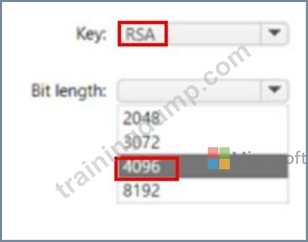
NEW QUESTION # 85
You have an Azure subscription that contains the storage accounts shown in the following table.
You plan to manage the data stored in the accounts by using lifecycle management rules.
To which storage accounts can you apply lifecycle management rules?
- A. storage1 and storage2 only
- B. storage1 only
- C. storage3 and storage4 only
- D. storage1, storage2, and storage3 only
- E. storage1, storage2, storage3, and storage4
Answer: D
Explanation:
Reference:
https://docs.microsoft.com/en-us/azure/storage/blobs/storage-lifecycle-management-concepts?tabs=azure-portal
NEW QUESTION # 86
You have an Azure subscription named Subscription1. Subscription1 contains a virtual machine named VM1.
You install and configure a web server and a DNS server on VM1.
VM1 has the effective network security rules shown in the following exhibit.
Use the drop-down menus to select the answer choice that completes each statement based on the information presented in the graphic.
NOTE: Each correct selection is worth one point.
Answer:
Explanation:
Explanation
Box 1:
Rule2 blocks ports 50-60, which includes port 53, the DNS port. Internet users can reach the Web server, since it uses port 80.
Box 2:
If Rule2 is removed internet users can reach the DNS server as well.
Note: Rules are processed in priority order, with lower numbers processed before higher numbers, because lower numbers have higher priority. Once traffic matches a rule, processing stops. As a result, any rules that exist with lower priorities (higher numbers) that have the same attributes as rules with higher priorities are not processed.
References:
https://docs.microsoft.com/en-us/azure/virtual-network/security-overview
NEW QUESTION # 87
You plan to deploy three Azure virtual machines named VM1, VM2, and VM3. The virtual machines will host a web app named App1.
You need to ensure that at least two virtual machines are available if a single Azure datacenter becomes unavailable.
What should you deploy?
- A. all virtual machines in a single Availability Set
- B. all three virtual machines in a single Availability Zone
- C. each virtual machine in a separate Availability Set
- D. each virtual machine in a separate Availability Zone
Answer: A
Explanation:
Availability sets are a datacenter configuration to provide VM redundancy and availability. This configuration within a datacenter ensures that during either a planned or unplanned maintenance event, at least one virtual machine is available.
Reference:
https://docs.microsoft.com/en-us/azure/virtual-machines/windows/manage-availability
https://docs.microsoft.com/en-us/azure/virtual-machines/windows/tutorial-availability-sets
NEW QUESTION # 88
You have 100 Azure subscriptions. All the subscriptions are associated to the same Azure Active Directory (Azure AD) tenant named contoso.com.
You are a global administrator.
You plan to create a report that lists all the resources across all the subscriptions.
You need to ensure that you can view all the resources in all the subscriptions.
What should you do?
- A. From the Azure portal, modify the properties of the Azure AD tenant.
- B. From the Azure portal, modify the profile settings of your account.
- C. From Windows PowerShell, run the New-AzureADUserAppRoleAssignment cmdlet.
- D. From Windows PowerShell, run the Add-AzureADAdministrativeUnitMember cmdlet.
Answer: C
Explanation:
The New-AzureADUserAppRoleAssignment cmdlet assigns a user to an application role in Azure Active Directory (AD). Use it for the application report.
NEW QUESTION # 89
You have an Azure subscription named Subscription1 that contains the storage accounts shown in the following table:
You plan to use the Azure Import/Export service to export data from Subscription1.
Which account can be used to export the data.
What should you identify?
- A. storage4
- B. storage2
- C. storage1
- D. storage3
Answer: A
Explanation:
Azure Import/Export service supports the following of storage accounts:
* Standard General Purpose v2 storage accounts (recommended for most scenarios)
*Blob Storage accounts
* General Purpose v1 storage accounts (both Classic or Azure Resource Manager deployments), Azure Import/Export service supports the following storage types:
*Import supports Azure Blob storage and Azure File storage
* Export supports Azure Blob storage. Azure Files not supported.
Only storage4 can be exported.
Reference:
https://docs.microsoft.com/en-us/azure/storage/common/storage-import-export-requirements
NEW QUESTION # 90
You manage an on-premises infrastructure based on VMware vSphere 6.0 with 250 virtual machines (VMs). You are evaluating the possibility of moving those VMs to Azure.
You decide to use the Azure Migrate service to help you with the assessment of your on- premises infrastructure.
You configure the default data collection level for your VMware vCenter server.
After performing the initial assessment, you find that there is some missing information in the assessment.
You need to make needed configurations so Azure Migrate service can collect all of the available information.
What should you do?
- A. Configure the collector VM with a user account with read-only privileges.
- B. Configure the data collector level in VMware vCenter to level 2.
- C. Configure the collector VM with a user account with administrative privileges.
- D. Configure the data collector level in VMware vCenter to level 3.
Answer: D
NEW QUESTION # 91
You have an Azure subscription that contains an Azure Storage account.
You plan to copy an on-premises virtual machine image to a container named vmimages.
You need to create the container for the planned image.
Which command should you run? To answer, select the appropriate options in the answer area.
NOTE: Each correct selection is worth one point.
Answer:
Explanation:
Reference:
https://adamtheautomator.com/azcopy-copy-files/
NEW QUESTION # 92
You have an Azure subscription that contains an Azure Service Bus named Bus1.
Your company plans to deploy two Azure web apps named App1 and App2. The web apps will create messages that have the following requirements:
Each message created by App1 must be consumed by only a single consumer Each message created by App2 will be consumed by multiple consumers.
Which resource should you create for each web app? To answer, drag the appropriate resources to the correct web apps. Each resource may be used once, more than once, or not at all. You may need to drag the split bar between panes or scroll to view content.
NOTE: Each correct selection is worth one point.
Answer:
Explanation:
Reference:
https://docs.microsoft.com/en-us/azure/service-bus-messaging/service-bus-queues-topics-subscriptions
NEW QUESTION # 93
You have two Azure virtual machines named VM1 and VM2. VM1 has a single data disk named Disk1. You need to attach Disk1 to VM2. The solution must minimize downtime for both virtual machines.
Which four actions should you perform in sequence? To answer, move the appropriate actions from the list of actions to the answer area and arrange them in the correct order.
Answer:
Explanation:
1 - Stop VM1.
2 - Detach Disk1 from VM1.
3 - Start VM1.
4 - Attach Disk1 to VM2.
Reference:
https://docs.microsoft.com/en-us/azure/virtual-machines/windows/detach-disk
https://docs.microsoft.com/en-us/azure/lab-services/devtest-lab-attach-detach-data-disk
NEW QUESTION # 94
You have an Azure subscription named Subscription1 that contains the following resource group:
Name: RG1
Region: West US
Tag: "tag1": "value1"
You assign an Azure policy named Policy1 to Subscription1 by using the following configurations:
Exclusions: None
Policy definition: Append tag and its default value
Assignment name: Policy1
Parameters:
- Tag name: Tag2
- Tag value: Value2
After Policy1 is assigned, you create a storage account that has the following configurations:
Name: storage1
Location: West US
Resource group: RG1
Tags: "tag3": "value3"
You need to identify which tags are assigned to each resource.
What should you identify? To answer, select the appropriate options in the answer area.
NOTE: Each correct selection is worth one point.
Answer:
Explanation:
Reference:
https://docs.microsoft.com/en-us/azure/azure-resource-manager/resource-group-using-tags
NEW QUESTION # 95
You have an Azure virtual machine named VM1.
The network interface for VM1 is configured as shown in the exhibit. (Click the Exhibit tab.)
You deploy a web server on VM1, and then create a secure website that is accessible by using the HTTPS protocol. VM1 is used as a web server only.
You need to ensure that users can connect to the website from the Internet.
What should you do?
- A. Create a new inbound rule that allows TCP protocol 443 and configure the rule to have a priority of 501.
- B. For Rule5, change the Action to Allow and change the priority to 401
- C. Delete Rule1
- D. Modify the protocol of Rule4
Answer: B
Explanation:
HTTPS uses port 443.
Rule2, with priority 500, denies HTTPS traffic.
Rule5, with priority changed from 2000 to 401, would allow HTTPS traffic.
Note: Priority is a number between 100 and 4096. Rules are processed in priority order, with lower numbers processed before higher numbers, because lower numbers have higher priority. Once traffic matches a rule, processing stops. As a result, any rules that exist with lower priorities (higher numbers) that have the same attributes as rules with higher priorities are not processed.
Note:
There are several versions of this question in the exam. The question has two possible correct answers:
1. Change the priority of Rule3 to 450.
2. For Rule5, change the Action to Allow and change the priority to 401.
Other incorrect answer options you may see on the exam include the following:
* Modify the action of Rule1.
* Change the priority of Rule6 to 100.
* For Rule4, change the protocol from UDP to Any.
Reference:
https://docs.microsoft.com/en-us/azure/virtual-network/network-security-groups-overview
NEW QUESTION # 96
You have a sync group named Sync1 that has a cloud endpoint. The cloud endpoint includes a file named File1.txt.
You on-premises network contains servers that run Windows Server 2016. The servers are configured as shown in the following table.
You add Share1 as an endpoint for Sync1. One hour later, you add Share2 as an endpoint for Sync1.
For each of the following statements, select Yes if the statement is true. Otherwise, select No.
NOTE: Each correct selection is worth one point.
Answer:
Explanation:
Reference:
https://docs.microsoft.com/en-us/azure/storage/files/storage-sync-files-planning
http://techgenix.com/azure-file-sync-replicating-data/
NEW QUESTION # 97
Note: The question is included in a number of questions that depicts the identical set-up.
However, every question has a distinctive result. Establish if the solution satisfies the requirements.
Your company has a Microsoft SQL Server Always On availability group configured on their Azure virtual machines (VMs).
You need to configure an Azure internal load balancer as a listener for the availability group.
Solution: You create an HTTP health probe on port 1433.
Does the solution meet the goal?
- A. No
- B. Yes
Answer: A
Explanation:
You need to configure a load-balancing rule to allow/route traffic to the SQL Server instances.
Health probe - is for monitoring the health status of the backend servers or instances.
Reference:
https://docs.microsoft.com/en-us/azure/azure-sql/virtual-machines/windows/availability-group- load-balancer-portal-configure#step-4-set-the-load-balancing-rules
NEW QUESTION # 98
DRAG DROP
You onboard 10 Azure virtual machines to Azure Automation State Configuration.
You need to use Azure Automation State Configuration to manage the ongoing consistency of the virtual machine configurations.
Which three actions should you perform in sequence? To answer, move the appropriate actions from the list of actions to the answer area and arrange them in the correct order.
NOTE: More than one order of answer choices is correct. You will receive credit for any of the correct orders you select.
Select and Place:
Answer:
Explanation:
Section: [none]
Explanation:
Step 1: Upload a configuration to Azure Automation State Configuration.
Import the configuration into the Automation account.
Step 2: Compile a configuration into a node configuration.
A DSC configuration defining that state must be compiled into one or more node configurations (MOF document), and placed on the Automation DSC Pull Server.
Step 3: Assign the node configuration
Then: Check the compliance status of the node
Each time Azure Automation State Configuration performs a consistency check on a managed node, the node sends a status report back to the pull server. You can view these reports on the page for that node.
On the blade for an individual report, you can see the following status information for the corresponding consistency check:
The report status - whether the node is "Compliant", the configuration "Failed", or the node is "Not Compliant" Reference:
https://docs.microsoft.com/en-us/azure/automation/automation-dsc-getting-started
NEW QUESTION # 99
You have an Azure subscription named Subscription1 that contains the storage accounts shown in the following table:
You plan to use the Azure Import/Export service to export data from Subscription1.
Which account can be used to export the data.
What should you identify?
- A. storage4
- B. storage2
- C. storage1
- D. storage3
Answer: A
Explanation:
Azure Import/Export service supports the following of storage accounts:
Standard General Purpose v2 storage accounts (recommended for most scenarios) Blob Storage accounts General Purpose v1 storage accounts (both Classic or Azure Resource Manager deployments), Azure Import/Export service supports the following storage types:
Import supports Azure Blob storage and Azure File storage
Export supports Azure Blob storage. Azure Files not supported.
Only storage4 can be exported.
Reference:
https://docs.microsoft.com/en-us/azure/storage/common/storage-import-export-requirements
NEW QUESTION # 100
Your company has offices in New York and Los Angeles.
You have an Azure subscription that contains an Azure virtual network named VNet1. Each office has a site-to-site VPN connection to VNet1.
Each network uses the address spaces shown in the following table.
You need to ensure that all Internet-bound traffic from VNet1 is routed through the New York office.
What should you do? To answer, select the appropriate options in the answer area.
NOTE: Each correct selection is worth one point.
Answer:
Explanation:
Explanation:
Box 1 : Set-AzureRmVirtualNetworkGatewayDefaultSite
The Set-AzureRmVirtualNetworkGatewayDefaultSite cmdlet assigns a forced tunneling default site to a virtual network gateway. Forced tunneling provides a way for you to redirect Internet-bound traffic from Azure virtual machines to your on-premises network; this enables you to inspect and audit traffic before releasing it. Forced tunneling is carried out by using a virtual private network (VPN) tunnel; this tunnel requires a default site, a local gateway where all the Azure Internet-bound traffic is redirected. Set-AzureRmVirtualNetworkGatewayDefaultSite provides a way to change the default site assigned to a gateway.
Box 2 : 0.0.0.0/0
Forced tunneling must be associated with a VNet that has a route-based VPN gateway. You need to set a "default site" among the cross-premises local sites connected to the virtual network. Also, the on-premises VPN device must be configured using 0.0.0.0/0 as traffic selectors.
Forced Tunneling:
The following diagram illustrates how forced tunneling works
Reference:
https://docs.microsoft.com/en-us/powershell/module/azurerm.network/set-azurermvirtualnetworkgatewaydefaultsite?view=azurermps-6.13.0
https://docs.microsoft.com/en-us/azure/vpn-gateway/vpn-gateway-forced-tunneling-rm
NEW QUESTION # 101
......
Download Free Microsoft AZ-104 Real Exam Questions: https://www.trainingdump.com/Microsoft/AZ-104-practice-exam-dumps.html
AZ-104 Exam Dumps, AZ-104 Practice Test Questions: https://drive.google.com/open?id=1RGSXCFwbK9Bes9gThdsULbEtwymzramB