

[UPDATED 2022] Microsoft AZ-304 Questions Prepare with Free Demo of PDF
NEW 2022 Certification Sample Questions AZ-304 Dumps & Practice Exam
For more info read reference:
microsoft learning site AZ-304 Skills measured
Introduction to AZ-304: Microsoft Azure Architect Design Exam
Candidates for AZ-304 Exam are seeking to prove fundamental knowledge and skills in Azure Architect Technologies domain. Before taking this exam, aspirants ought to have a solid fundamental information of the concepts shared in preparation guide as well as basic understanding of Azure administration, Azure development, and DevOpss would give an added edge.
It is suggested that professionals accustomed to the ideas and also the technologies represented here by taking relevant training courses. Candidates are expected to have some hands-on experience on multi factor authentication, hybrid identity including Azure AD Connect and Azure AD connect Health, solution for B2B integration.
After passing this exam, candidates get a certificate from Microsoft that helps them to demonstrate their proficiency to their clients and employers.
This exam is replaced with previous exam named as Microsoft Azure Architect Technologies Exam AZ-301.Microsoft Azure Architect Technologies Exam AZ-301 will be retired from 30.09.2020. To earn the Azure solutions architect expert certifications you can mix the old and new exams.
Az-301 and Az-304 = Azure solutions architect expert
NEW QUESTION 20
You are designing a network connectivity strategy for a new Azure subscription. You identify the following requirements:
The Azure virtual machines on a subnet named Subnet1 must be accessible only from the computers in your London office.
Engineers require access to the Azure virtual machine on a subnet named Subnet2 over the Internet on a specific TCP/IP management port.
The Azure virtual machines in the West Europe Azure region must be able to communicate on all ports to the Azure virtual machines in the North Europe Azure region.
You need to recommend which components must be used to meet the requirements. The solution must minimize costs and administrative effort whenever possible.
What should you include in the recommendation? To answer, drag the appropriate components to the correct requirements. Each component may be used once, more than once, or not at all. You may need to drag the split bar between panes or scroll to view content.
NOTE: Each correct selection is worth one point.
Answer:
Explanation:
NEW QUESTION 21
You need to design a resource governance solution for an Azure subscription. The solution must meet the following requirements:
* Ensure that all ExpressRoute resources are created in a resource group named RG1.
* Delegate the creation of the ExpressRoute resources to an Azure Active Directory (Azure AD) group named Networking.
* Use the principle of least privilege.
What should you include in the solution? To answer, select the appropriate options in the answer area.
NOTE: Each correct selection is worth one point.
Answer:
Explanation:
Explanation
Box 1: An Azure policy assignment at the subscription level that has an exclusion Box 2: A custom RBAC role assignment at the level of RG1 Azure role-based access control (Azure RBAC) is the authorization system you use to manage access to Azure resources. To grant access, you assign roles to users, groups, service principals, or managed identities at a particular scope.
Reference:
https://docs.microsoft.com/en-us/azure/governance/policy/tutorials/create-and-manage
NEW QUESTION 22
Your company develops a web service that is deployed to at, Azure virtual machine named VM1 the web service allows an API to access real- time data from VM1. The current virtual machine deployment is shown in the Deployment exhibit. (Click the Deployment tab).
The chief technology officer (CTO) sends you the following email message: "Our developers have deployed the web service to a virtual machine named WL Testing has shown that the API is accessible from VM1 and VM? Our partners must be able to connect to the API over the Internet Partners will me this data in applications that they develop:
You deploy an Azure API Management service. The relevant API Management configuration is shown in the API ambit. (Click the API tab).
For each of the following statements, select. Yes, if the statement is true. Otherwise. select No.
NOTE: Each correct selection is worth one point.
Answer:
Explanation:
NEW QUESTION 23
You are designing a cost-optimized solution that uses Azure Batch to run two types of jobs on Linux nodes.
The first job type will consist of short-running tasks for a development environment. The second jot type will consist of long-running Message Passing Interface (MPI) applications for a production environment that requires timely job completion.
You need to recommend the pool type and node type for each job type. The solution must minimize compute charges and leverage Azure Hybrid Benefit whenever possible.
What should you recommend? To answer, select the appropriate options in the answer area.
NOTE: Each correct selection is worth one point.
Answer:
Explanation:
Explanation
Box 1: User subscription and low-priority virtual machines
Azure Batch offers low-priority virtual machines (VMs) to reduce the cost of Batch workloads. Low-priority VMs make new types of Batch workloads possible by enabling a large amount of compute power to be used for a very low cost.
Some examples of batch processing use cases well suited to use low-priority VMs are:
* Development and testing: In particular, if large-scale solutions are being developed, significant savings can be realized. All types of testing can benefit, but large-scale load testing and regression testing are great uses.
* Supplementing on-demand capacity.
* Flexible job execution time.
Box 2: Batch service and dedicate virtual machines
Reference:
https://docs.microsoft.com/en-us/azure/batch/batch-low-pri-vms
NEW QUESTION 24
Your company plans to use a separate Azure subscription for each of its business units. You identify the following governance requirements:
* Each business unit will analyze costs for different workloads such as production, development, and testing.
* The company will analyze costs by business unit and workload.
What should you use to meet the governance requirements?
- A. tags and Azure Policy
- B. Azure Advisor alerts and Azure Logic Apps
- C. Microsoft Intune and compliance policies
- D. Azure management groups and RBAC
Answer: D
NEW QUESTION 25
You have an Azure subscription that contains 100 virtual machines.
You plan to design a data protection strategy to encrypt the virtual disks.
You need to recommend a solution to encrypt the disks by using Azure Disk Encryption. The solution must provide the ability to encrypt operating system disks and data disks.
What should you include in the recommendation?
- A. a secret
- B. a certificate
- C. a key
- D. a passphrase
Answer: C
Explanation:
Explanation
For enhanced virtual machine (VM) security and compliance, virtual disks in Azure can be encrypted. Disks are encrypted by using cryptographic keys that are secured in an Azure Key Vault. You control these cryptographic keys and can audit their use.
Reference:
https://docs.microsoft.com/en-us/azure/virtual-machines/windows/encrypt-disks
NEW QUESTION 26
You have an Azure subscription named Subscription1 that is linked to a hybrid Azure Active Directory (Azure AD) tenant.
You have an on-premises datacenter that does NOT have a VPN connection to Subscription1. The datacenter contains a computer named Server1 that has Microsoft SQL Server 2016 installed. Server1 is prevented from accessing the internet An Azure logic app named LogicApp1 requires write access to a database on Server1.
You need to recommend a solution to provide LogicApp1 with the ability to access Server1.
What should you recommend deploying on-premises and in Azure? To answer, select the appropriate options in the answer area.
NOTE: Each correct selection is worth one point.
Answer:
Explanation:
see the answer solution below.
Explanation
solution
NEW QUESTION 27
You have an Azure subscription.
Your on-premises network contains a file server named Server1. Server 1 stores 5 TB of company files that are accessed rarely.
You plan to copy the files to Azure Storage.
You need to implement a storage solution for the files that meets the following requirements:
* The files must be available within 24 hours of being requested.
* Storage costs must be minimized.
Which two possible storage solutions achieve this goal? Each correct answer presents a complete solution. NOTE: Each correct selection is worth one point.
- A. Create a general-purpose v2 storage account that is configured for the Cool default access tier. Create a file share in the storage account and copy the files to the file share.
- B. Create a general-purpose v1 storage account. Create a blob container and copy the files to the blob container.
- C. Create a general-purpose v1 storage account Create a file share in the storage account and copy the files to the file share.
- D. Create an Azure Blob storage account that is configured for the Cool default access tier. Create a blob container, copy the files to the blob container, and set each file to the Archive access tier.
- E. Create a general-purpose v2 storage account that is configured for the Hot default access tier Create a blob container, copy the files to the blob container, and set each file to the Archive access tier.
Answer: A,B
NEW QUESTION 28
You plan to create an Azure environment that will contain a root management group and 10 child management groups. Each child management group will contain five Azure subscriptions. You plan to have between 10 and 30 resource groups in each subscription.
You need to design an Azure governance solution. The solution must meet the following requirements:
* Use Azure Blueprints to control governance across all the subscriptions and resource groups.
* Ensure that Blueprints-based configurations are consistent across all the subscriptions and resource groups.
* Minimize the number of blueprint definitions and assignments.
What should you include in the solution? To answer, select the appropriate options in the answer are a. NOTE: Each correct selection is worth one point.
Answer:
Explanation:
Explanation:
Box 1: The root management group
When creating a blueprint definition, you'll define where the blueprint is saved. Blueprints can be saved to a management group or subscription that you have Contributor access to. If the location is a management group, the blueprint is available to assign to any child subscription of that management group.
Box 2: The root management group
Each directory is given a single top-level management group called the "Root" management group. This root management group is built into the hierarchy to have all management groups and subscriptions fold up to it. This root management group allows for global policies and Azure role assignments to be applied at the directory level.
Each Published Version of a blueprint can be assigned to an existing management group or subscription.
Reference:
https://docs.microsoft.com/en-us/azure/governance/blueprints/overview
https://docs.microsoft.com/en-us/azure/governance/management-groups/overview
NEW QUESTION 29
A company plans to implement an HTTP-based API to support a web app. The web app allows customers to check the status of their orders.
The API must meet the following requirements:
Implement Azure Functions
Provide public read-only operations
Do not allow write operations
You need to recommend configuration options.
What should you recommend? To answer, configure the appropriate options in the dialog box in the answer area.
NOTE: Each correct selection is worth one point.
Answer:
Explanation:
Explanation:
Allowed authentication methods: GET only
Authorization level: Anonymous
The option is Allow Anonymous requests. This option turns on authentication and authorization in App Service, but defers authorization decisions to your application code. For authenticated requests, App Service also passes along authentication information in the HTTP headers.
This option provides more flexibility in handling anonymous requests.
References:
https://docs.microsoft.com/en-us/azure/app-service/overview-authentication-authorization
NEW QUESTION 30
You plan to deploy a network-intensive application to several Azure virtual machines.
You need to recommend a solution that meets the following requirements:
* Minimizes the use of the virtual machine processors to transfer data
* Minimizes network latency
Which virtual machine size and feature should you use? To answer, select the appropriate options in the answer area.
NOTE: Each correct selection is worth one point.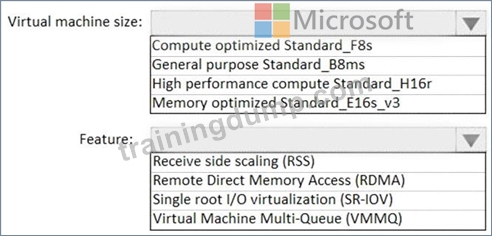
Answer:
Explanation:
Explanation
References:
https://docs.microsoft.com/en-us/azure/virtual-machines/windows/sizes-hpc#h-series
NEW QUESTION 31
You have an Azure Active Directory (Azure AD) tenant named contoso.com that has a security group named Group1. Group1 is configured for assigned membership. Group1 has 50 members, including 20 guest users.
You need to recommend a solution for evaluating the membership of Group1. The solution must meet the following requirements:
* The evaluation must be repeated automatically every three months.
* Every member must be able to report whether they need to be in Group1.
* Users who report that they do not need to be in Group1 must be removed from Group1 automatically.
* Users who do not report whether they need to be in Group1 must be removed from Group1 automatically.
What should you include in the recommendation?
- A. Change the Membership type of Group1 to Dynamic User.
- B. Implement Azure AD Privileged Identity Management.
- C. Implement Azure AD Identity Protection.
- D. Create an access review.
Answer: A
Explanation:
In Azure Active Directory (Azure AD), you can create complex attribute-based rules to enable dynamic memberships for groups. Dynamic group membership reduces the administrative overhead of adding and removing users.
When any attributes of a user or device change, the system evaluates all dynamic group rules in a directory to see if the change would trigger any group adds or removes. If a user or device satisfies a rule on a group, they are added as a member of that group. If they no longer satisfy the rule, they are removed.
Reference:
https://docs.microsoft.com/en-us/azure/active-directory/users-groups-roles/groups-dynamic-membership
NEW QUESTION 32
You have five .NET Core applications that run on 10 Azure virtual machines in the same subscription.
You need to recommend a solution to ensure that the applications can authenticate by using the same Azure Active Directory (Azure AD) identity. The solution must meet the following requirements:
* Ensure that the applications can authenticate only when running on the 10 virtual machines.
* Minimize administrative effort.
What should you include in the recommendation? To answer, select the appropriate options in the answer area.
NOTE: Each correct selection is worth one point.
Answer:
Explanation: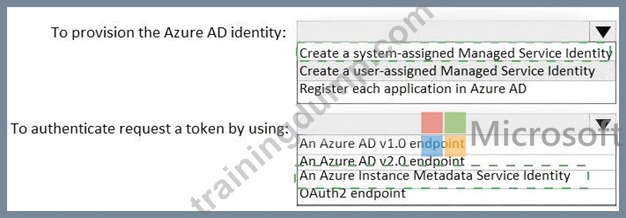
Explanation
NEW QUESTION 33
You are designing a virtual machine that will run Microsoft SQL Server and will contain two data disks. The first data disk will store log files, and the second data disk will store dat a. Both disks are P40 managed disks.
You need to recommend a caching policy for each disk. The policy must provide the best overall performance for the virtual machine.
Which caching policy should you recommend for each disk? To answer, drag the appropriate policies to the correct disks. Each policy may be used once, more than once, or not at all. You may need to drag the split bar between panes or scroll to view content.
NOTE: Each correct selection is worth one point.
Answer:
Explanation:
1 - None
2 - ReadOnly
Reference:
https://docs.microsoft.com/en-us/azure/virtual-machines/windows/sql/virtual-machines-windows-sql-performance
NEW QUESTION 34
Your company has users who work remotely from laptops.
You plan to move some of the applications accessed by the remote users to Azure virtual machines. The users will access the applications in Azure by using a point-to-site VPN connection. You will use certificates generated from an on-premises-based certification authority (CA).
You need to recommend which certificates are required for the deployment.
What should you include in the recommendation? To answer, drag the appropriate certificates to the correct targets. Each certificate may be used once, more than once, or not at all. You may need to drag the split bar between panes or scroll to view content.
NOTE: Each correct selection is worth one point.
Answer:
Explanation:
NEW QUESTION 35
You are designing a microservices architecture that will use Azure Kubernetes Service (AKS) to host pods that run containers. Each pod deployment will host a separate API Each API will be implemented as a separate service- You need to recommend a solution to make the APIs available to external users from Azure API Management.
The solution must meet the following requirements:
* Control access to the APIs by using mutual US authentication between API Management and the AKS-based APIs.
* Provide access to the APIs by using a single IP address.
What should you recommend to provide access to the APIs?
- A. custom network security groups (NSGs)
- B. the Ingress Controller in AKS
- C. the LoadBelancer service in AKS
Answer: A
NEW QUESTION 36
You have an on-premises file server that stores 2 TB of data files.
You plan to move the data files to Azure Blob storage in the Central Europe region.
You need to recommend a storage account type to store the data files and a replication solution for the storage account. The solution must meet the following requirements:
Be available if a single Azure datacenter fails.
Support storage tiers.
Minimize cost.
What should you recommend? To answer, select the appropriate options in the answer area.
NOTE: Each correct selection is worth one point.
Answer:
Explanation:
Explanation:
Box 1: Blob storage
Blob storage supports storage tiers
Note: Azure offers three storage tiers to store data in blob storage: Hot Access tier, Cool Access tier, and Archive tier. These tiers target data at different stages of its lifecycle and offer cost-effective storage options for different use cases.
Box 2: Zone-redundant storage (ZRS)
Data in an Azure Storage account is always replicated three times in the primary region. Azure Storage offers two options for how your data is replicated in the primary region:
Zone-redundant storage (ZRS) copies your data synchronously across three Azure availability zones in the primary region.
Locally redundant storage (LRS) copies your data synchronously three times within a single physical location in the primary region. LRS is the least expensive replication option, but is not recommended for applications requiring high availability.
References:
https://cloud.netapp.com/blog/storage-tiers-in-azure-blob-storage-find-the-best-for-your-data
NEW QUESTION 37
You plan to deploy the backup policy shown in the following exhibit.
Use the drop-down menus to select the answer choice that completes each statement based on the information presented in the graphic.
NOTE: Each correct selection is worth one point.
Answer:
Explanation:
NEW QUESTION 38
......
AZ-304 Deluxe Study Guide with Online Test Engine: https://www.trainingdump.com/Microsoft/AZ-304-practice-exam-dumps.html
AZ-304 Test Prep Training Practice Exam Questions Practice Tests: https://drive.google.com/open?id=1bbQpQNBt2HRKw49bMMSBsKSkcNoU8qS-