

Updated Oct 31, 2021 Test Engine to Practice Test for 5V0-21.20 Valid and Updated Dumps
Exam Questions for 5V0-21.20 Updated Versions With Test Engine
How to book the 5V0-21.20: VMware HCI Master Specialist Exam
These are the following steps for registering for the 5V0-21.20: VMware HCI Master Specialist exam.
- Step 1: Visit VMware Exam Registration
- Step 2: Sign up/log in to VMware account
- Step 3: Select a local center based on your country, date, time, and confirm with a payment method.
5V0-21.20: VMware HCI Master Specialist Exam Certified Professional salary
The average salary of a 5V0-21.20: VMware HCI Master Specialist Exam Certified Expert in:
- Europe - 70,500 EURO
- India. - 14,00,327 INR
- United State - 100,200 USD
- England - 75,000 POUND
NEW QUESTION 11
An architect has been asked to design a vSAN Stretched Cluster. The architect will configure Microsoft Active Directory to replicate between a server on Site A (preferred) and a server on Site B (non-preferred). The architect must minimize the amount of raw storage capacity used.
Which storage policy needs to be applied to the Active Directory server on site A?
- A. None - stretched cluster
- B. Dual site mirronng
- C. None - keep data on Preferred
- D. None - standard cluster
Answer: C
NEW QUESTION 12
Refer to the exhibit.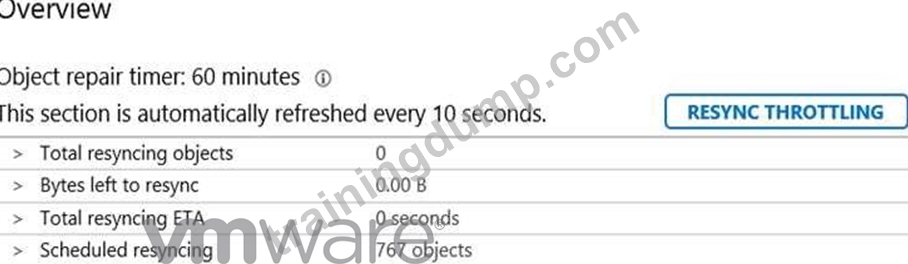
An administrator is managing a 4-node, hybrid vSAN cluster. One of the hosts in the cluster went offline.
Referencing the information displayed in the resyncing objects section of the vSAN UI, what is the current state of this cluster?
- A. Metadata resynchronization is scheduled to occur every 60 minutes.
- B. Objects will be resynchronized when the Object Repair Timer expires.
- C. Resync Throttling has caused data resynchronization scheduling.
- D. Offline host reconnected to the cluster and all objects are synchronized.
Answer: A
Explanation:
Explanation/Reference: https://core.vmware.com/resource/vsan-2-node-guide#sec11-sub3
NEW QUESTION 13
What is the key factor when sizing the Witness Host for a vSAN Stretched Cluster?
- A. size of the cache tier within the witness appliance
- B. number of maximum components supported
- C. size of the ESXi boot drive to account for metadata
- D. number of vCPUs within the Witness appliance
Answer: D
NEW QUESTION 14
An administrator receives an alert for vCenter being unavailable. With vCenter running on vSAN, the administrator wants to know if any other VMs are impacted. What command can an administrator run to determine the overall health of the vSAN objects?
- A. esxcli vsan health cluster list
- B. esxcli vsan errands timemachine get
- C. esxcli vsan cluster get
- D. esxcli vsan storage list
Answer: B
NEW QUESTION 15
Refer to the exhibit.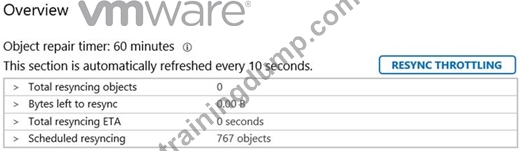
An administrator is managing a 4-node, hybrid vSAN cluster. One of the hosts in the cluster went offline.
Referencing the information displayed in the section of the vSAN UI, what is the current state of this cluster?
- A. Metadata resynchronization is scheduled to occur every 60 minutes.
- B. Objects will be resynchronized when the Object Repair Timer expires.
- C. Resync Throttling has caused data resynchronization scheduling.
- D. Offline host reconnected to the cluster and all objects are synchronized.
Answer: A
NEW QUESTION 16
Which two must be considered when creating a vSAN solution that will utilize VMware vSphere Replication?
(Choose two.)
- A. Deduplication and compression must be disabled for PIT snapshots,
- B. AES-NI must be enabled prior to using snapshots for replication,
- C. vSAN Encryption cannot be used with vSphere Replication.
- D. Additional read I/O will be generated by vSphere Replication.
- E. Point-in-time snapshots count towards component limit.
Answer: C,D
NEW QUESTION 17
Which two storage policy changes require a full rebuild of all components for an object? (Choose two.)
- A. Reduce the Primary Failures to Tolerate from 2 to 1 for an object using a failure tolerance method of RAID-1 (Mirroring).
- B. Increase the number of disk stripes for an object from 2 to 3.
- C. Change the failure tolerance method of an object from RAID-1 (Mirroring) to RAID-5 (Erasure Coding).
- D. Increase the IOPS limit for an object.
- E. Disable object checksum on an object.
Answer: A,B
NEW QUESTION 18
An infrastructure architect is submitting a proposal for a vSAN Cluster. These are the customer's requirements:
*Maximize the amount of usable capacity.
*Deduplication and compression will be enabled to help maximize usable capacity.
Which disk group configuration should the architect include in their design?
- A. One disk group with one flash device for cache and six magnetic devices for capacity.
- B. Five disk groups with one flash device for cache and one magnetic device for capacity per disk group.
- C. Three disk groups with one flash device for cache and two flash devices for capacity per disk group.
- D. One disk group with one flash device for cache and six flash devices for capacity.
Answer: C
NEW QUESTION 19
Which two statements regarding networking are true for a vSAN Stretched Cluster? (Choose two.)
- A. PIM is required for stretched vSAN clusters.
- B. The vSAN data network must communicate with the vSAN witness host.
- C. A Stretched Layer 2 network is required at the vSAN data sites and at the witness site.
- D. A Stretched Cluster can use Layer 2 or Layer 3 communication for the vSAN network.
- E. A 5ms RTT or less is required between the data sites.
Answer: D,E
NEW QUESTION 20
A vSAN administrator wants to implement end-to-end prioritization of vSAN traffic across the network in a shared network infrastructure that is using vSphere Distributed Switches (VDS).
Which two can help achieve this objective? (Choose two.)
- A. Configure multiple vSAN VMkernel interfaces to load balance across multiple uplinks.
- B. Enable Network I/O Control and allocate higher shares for vSAN traffic.
- C. Enable network resource pool at the VDS level to prioritize vSAN traffic
- D. Enable jumbo frames for vSAN VMkernel ports and configure LACP for optimal load balancing.
- E. Configure CoS or DSCP with high priority tag at the VDS and equivalent in the physical network.
Answer: B,D
NEW QUESTION 21
A 3-node All-Flash vSAN cluster has this configuration:
* One disk group per host
* All disk groups have identical make & model disks of an 800GB NVMe SSD cache and 2x 4TB SAS SSDs each An administrator has been tasked with expanding storage capacity by adding one additional disk group with this configuration:
1.6TB SAS SSD cache and 1x 4TB SAS SSDs
Assuming all the disks are compliant with the vSAN HCL, which is true?
- A. The additional disk group would make this cluster an unsupported configuration.
- B. The additional disk group would work and be fully supported by VMware support.
- C. The additional disk group will generate an 'Advanced vSAN Configuration in sync' health check warning.
- D. The additional disk group would not be possible as vSAN would not allow it.
Answer: A
NEW QUESTION 22
An administrator receives an alert for vCenter being unavailable. With vCenter running on vSAN, the administrator wants to know if any other VMs are impacted.
What command can an administrator run to determine the overall health of the vSAN objects?
- A. esxcli vsan cluster get
- B. esxcli vsan health cluster list
- C. esxcli vsan cmmds timemachine get
- D. esxcli vsan storage list
Answer: A
Explanation:
Explanation/Reference: https://www.vmware.com/content/dam/digitalmarketing/vmware/en/pdf/products/vsan/vmware- virtual-san-health-check-guide-6.1.pdf (66)
NEW QUESTION 23
A vSAN all-flash environment with these host specifications has reported high network latency, write latency, and faces degraded performance:
* One 1Gbps (vSAN, vMotion Traffic)
* One 1Gbps (Management, Fault Tolerance traffic)
Based on the specifications of each host, what is recommended to resolve the issue?
- A. change MTU to 9000
- B. change stripe width to 12
- C. collapse all traffic shared under two 10Gbps NICs
- D. collapse all traffic into one 1Gbps NIC
Answer: C
NEW QUESTION 24
When designing a vSAN Cluster, which three should be considered when sizing a vSAN datastore? (Choose three.) D18912E1457D5D1DDCBD40AB3BF70D5D
- A. cache disks with 10% of the Disk Group
- B. capacity device queue depth
- C. On-Disk Format overheard
- D. Storage Policy or Policies to be used
- E. vSAN Slack Space
- F. endurance level of capacity disk used
Answer: B,D,E
NEW QUESTION 25
Which should be verified before enabling de duplication and compression?
- A. All hosts are in maintenance mode.
- B. Ensure disk groups are balanced.
- C. Autoclaim mode is enabled.
- D. Adequate space is available.
Answer: C
NEW QUESTION 26
Which two statements are true about enabling deduplication and compression on an All-Flash vSAN cluster with data? (Choose two.)
- A. Move one host at a time to maintenance mode and enable deduplication and compression.
- B. On-disk format version 3.0 or later is required to support deduplication and compression.
- C. This can be enabled through storage policies and does not require any data migration.
- D. This requires data evacuation and disk format upgrade of all the disk groups.
- E. Deduplication and Compression cannot be enabled on an existing vSAN datastore with data.
Answer: B,D
Explanation:
Explanation/Reference: https://docs.vmware.com/en/VMware-vSphere/6.7/com.vmware.vsphere.virtualsan.doc/GUID- BD30E413-F870-4C25-9507-123F59D0A4B8.html
NEW QUESTION 27
During planned maintenance of a four-node vSAN cluster, an outsourced IT contractor accidentally removed a
2.5" SSD cache disk from one of the vSAN nodes. The storage policy has been configured with FTT=1 RAID 1, and the disk management UI marked the disk group as absent.
Which remediation steps should the administrator select to ensure VMs become compliant with the storage policy as soon as possible?
- A. enter host in maintenance > remove from disk group > shutdown host > replace disk > power on host
- B. replace the SSD cache disk > rescan > add disk back in disk group
- C. remove disk group > enter host in maintenance > fully evacuate all data > exit maintenance
- D. vSAN Health Check > retest > object health > repair objects immediately
Answer: B
Explanation:
Explanation/Reference:
NEW QUESTION 28
Which step can be avoided when replacing a capacity tier device on a controller with passthrough mode and support for hot-plug?
- A. Replace the physical drive.
- B. Remove the disk from the disk group.
- C. Shut down the host.
- D. Add the new disk to the disk group.
Answer: A
NEW QUESTION 29
Which two statements are true about a vSAN Cluster when the vCenter Server managing it is offline? (Choose two.)
- A. Manage and view vSAN health information using RVC commands.
- B. Use a Web browser to monitor vSAN through the vSphere Host Client.
- C. vSAN continues to operate, but vSAN performance metrics will be lost.
- D. vSAN continues to operate and all VMs inherit the default vSAN storage policy.
- E. vSAN health information is available through esxcli commands.
Answer: B,E
NEW QUESTION 30
Which two are requirements for Kubernetes cluster virtual machines when leveraging vSphere Cloud Native Storage (CNS)? (Choose two.)
- A. Set the Disk Mode to Independent
- B. virtual machine hardware version 15 or higher
- C. set the disk.EnableUUID advanced setting to
- D. minimum of 4 vCPUs per node
- E. configure UEFI firmware
Answer: B,C
NEW QUESTION 31
An administrator receives an alert for vCenter being unavailable. With vCenter running on vSAN, the administrator wants to know if any other VMs are impacted. What command can an administrator run to determine the overall health of the vSAN objects?
- A. esxcli vsan cluster get
- B. esxcli vsan health cluster list
- C. esxcli vsan errands timemachine get
- D. esxcli vsan storage list
Answer: A
NEW QUESTION 32
A hardware 10 controller manufacturer has released a new version of firmware which brings performance improvements to the controller that the vSAN disk group is currently using. The administrator would like to upgrade to the new firmware version.
Which action should the administrator perform?
- A. Check against the vSAN Compatibility Guide that this new firmware version Is certified and Install it with any certified driver.
- B. Install the latest version of vSphere before upgrading to the newest version of firmware.
- C. Install the new firmware as soon as possible after testing in his/her lab to take advantage of the performance improvements.
- D. Check against the vSAN Compatibility Guide for the correct certified firmware and driver combination and upgrade both firmware and driver.
Answer: C
NEW QUESTION 33
A vSAN administrator wants to implement end-to-end prioritization of vSAN traffic across the network in a shared network infrastructure that is using vSphere Distributed Switches (VDS).
Which two can help achieve this objective. (Choose two.)
- A. Configure CoS or DSCP with high priority tag at the VDS and equivalent in the physical network.
- B. Enable network resource pool at the VDS level to prioritize vSAN traffic.
- C. Configure multiple vSAN VMkernel interfaces to load balance across multiple uplinks.
- D. Enable jumbo frames for vSAN VMkernel ports and configure LACP for optimal load balancing.
- E. Enable Network I/O Control and allocate higher shares for vSAN traffic.
Answer: A,C
NEW QUESTION 34
......
VMware 5V0-21.20 Exam Syllabus Topics:
| Topic | Details |
|---|---|
| Topic 1 |
|
| Topic 2 |
|
| Topic 3 |
|
| Topic 4 |
|
| Topic 5 |
|
| Topic 6 |
|
| Topic 7 |
|
| Topic 8 |
|
| Topic 9 |
|
| Topic 10 |
|
5V0-21.20 Exam Dumps - Free Demo & 365 Day Updates: https://www.trainingdump.com/VMware/5V0-21.20-practice-exam-dumps.html