

Databricks-Certified-Data-Engineer-Professional exam questions for practice in 2026 Updated 250 Questions
Updated Jul-2026 Premium Databricks-Certified-Data-Engineer-Professional Exam Engine pdf - Download Free Updated 250 Questions
NEW QUESTION # 87
The Databricks CLI is use to trigger a run of an existing job by passing the job_id parameter. The response that the job run request has been submitted successfully includes a filed run_id.
Which statement describes what the number alongside this field represents?
- A. The number of times the job definition has been run in the workspace.
- B. The job_id is returned in this field.
- C. The globally unique ID of the newly triggered run.
- D. The total number of jobs that have been run in the workspace.
- E. The job_id and number of times the job has been are concatenated and returned.
Answer: C
Explanation:
When triggering a job run using the Databricks CLI, the run_id field in the response represents a globally unique identifier for that particular run of the job. This run_id is distinct from the job_id.
While the job_id identifies the job definition and is constant across all runs of that job, the run_id is unique to each execution and is used to track and query the status of that specific job run within the Databricks environment. This distinction allows users to manage and reference individual executions of a job directly.
NEW QUESTION # 88
A data engineer wants to refactor the following DLT code, which includes multiple table definitions with very similar code.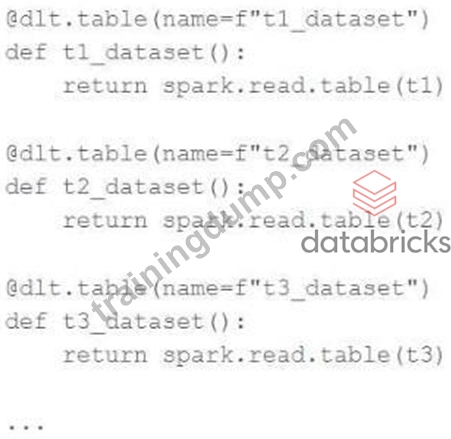
In an attempt to programmatically create these tables using a parameterized table definition, the data engineer writes the following code.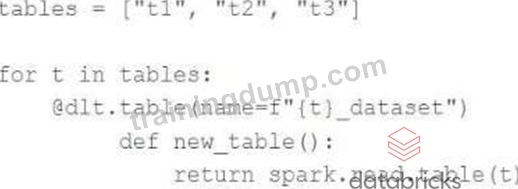
The pipeline runs an update with this refactored code, but generates a different DAG showing incorrect configuration values for these tables.
How can the data engineer fix this?
- A. Convert the list of configuration values to a dictionary of table settings, using table names as keys.
- B. Convert the list of configuration values to a dictionary of table settings, using different input the for loop.
- C. Load the configuration values for these tables from a separate file, located at a path provided by a pipeline parameter.
- D. Wrap the loop inside another table definition, using generalized names and properties to replace with those from the inner table
Answer: A
Explanation:
The issue with the refactored code is that it tries to use string interpolation to dynamically create table names within the dlc.table decorator, which will not correctly interpret the table names.
Instead, by using a dictionary with table names as keys and their configurations as values, the data engineer can iterate over the dictionary items and use the keys (table names) to properly configure the table settings. This way, the decorator can correctly recognize each table name, and the corresponding configuration settings can be applied appropriately.
NEW QUESTION # 89
The data engineering team is migrating an enterprise system with thousands of tables and views into the Lakehouse. They plan to implement the target architecture using a series of bronze, silver, and gold tables. Bronze tables will almost exclusively be used by production data engineering workloads, while silver tables will be used to support both data engineering and machine learning workloads. Gold tables will largely serve business intelligence and reporting purposes. While personal identifying information (PII) exists in all tiers of data, pseudonymization and anonymization rules are in place for all data at the silver and gold levels.
The organization is interested in reducing security concerns while maximizing the ability to collaborate across diverse teams.
Which statement exemplifies best practices for implementing this system?
- A. Because databases on Databricks are merely a logical construct, choices around database organization do not impact security or discoverability in the Lakehouse.
- B. Because all tables must live in the same storage containers used for the database they're created in, organizations should be prepared to create between dozens and thousands of databases depending on their data isolation requirements.
- C. Working in the default Databricks database provides the greatest security when working with managed tables, as these will be created in the DBFS root.
- D. Isolating tables in separate databases based on data quality tiers allows for easy permissions management through database ACLs and allows physical separation of default storage locations for managed tables.
- E. Storinq all production tables in a single database provides a unified view of all data assets available throughout the Lakehouse, simplifying discoverability by granting all users view privileges on this database.
Answer: D
Explanation:
This is the correct answer because it exemplifies best practices for implementing this system. By isolating tables in separate databases based on data quality tiers, such as bronze, silver, and gold, the data engineering team can achieve several benefits. First, they can easily manage permissions for different users and groups through database ACLs, which allow granting or revoking access to databases, tables, or views. Second, they can physically separate the default storage locations for managed tables in each database, which can improve performance and reduce costs. Third, they can provide a clear and consistent naming convention for the tables in each database, which can improve discoverability and usability.
NEW QUESTION # 90
A nightly batch job is configured to ingest all data files from a cloud object storage container where records are stored in a nested directory structure YYYY/MM/DD. The data for each date represents all records that were processed by the source system on that date, noting that some records may be delayed as they await moderator approval. Each entry represents a user review of a product and has the following schema:
user_id STRING, review_id BIGINT, product_id BIGINT, review_timestamp TIMESTAMP, review_text STRING The ingestion job is configured to append all data for the previous date to a target table reviews_raw with an identical schema to the source system. The next step in the pipeline is a batch write to propagate all new records inserted into reviews_raw to a table where data is fully deduplicated, validated, and enriched.
Which solution minimizes the compute costs to propagate this batch of data?
- A. Use Delta Lake version history to get the difference between the latest version of reviews_raw and one version prior, then write these records to the next table.
- B. Reprocess all records in reviews_raw and overwrite the next table in the pipeline.
- C. Filter all records in the reviews_raw table based on the review_timestamp; batch append those records produced in the last 48 hours.
- D. Perform a batch read on the reviews_raw table and perform an insert-only merge using the natural composite key user_id, review_id, product_id, review_timestamp.
- E. Configure a Structured Streaming read against the reviews_raw table using the trigger once execution mode to process new records as a batch job.
Answer: E
Explanation:
https://www.databricks.com/blog/2017/05/22/running-streaming-jobs-day-10x-cost-savings.html
NEW QUESTION # 91
A data engineer wants to create a cluster using the Databricks CLI for a big ETL pipeline. The cluster should have five workers, one driver of type i3.xlarge, and should use the '14.3.x- scala2.12' runtime. Which command should the data engineer use?
- A. databricks clusters add 14.3.x-scala2.12 --num-workers 5 --node-type-id i3.xlarge --cluster-name Data Engineer_cluster
- B. databricks compute create 14.3.x-scala2.12 --num-workers 5 --node-type-id i3.xlarge --cluster- name Data Engineer_cluster
- C. databricks compute add 14.3.x-scala2.12 --num-workers 5 --node-type-id i3.xlarge --cluster-name Data Engineer_cluster
- D. databricks clusters create 14.3.x-scala2.12 --num-workers 5 --node-type-id i3.xlarge --cluster- name DataEngineer_cluster
Answer: D
Explanation:
The correct Databricks CLI command to create a new cluster is databricks clusters create. You specify the runtime with --spark-version (here '14.3.x-scala2.12'), the number of workers with -- num-workers, the node type with --node-type-id, and the cluster name with --cluster-name. This command properly initializes the cluster with the desired configuration.
NEW QUESTION # 92
The data architect has mandated that all tables in the Lakehouse should be configured as external Delta Lake tables.
Which approach will ensure that this requirement is met?
- A. When the workspace is being configured, make sure that external cloud object storage has been mounted.
- B. Whenever a database is being created, make sure that the location keyword is used Get Latest & Actual Certified-Data-Engineer-Professional Exam's Question and Answers from
- C. When tables are created, make sure that the external keyword is used in the create table statement.
- D. When configuring an external data warehouse for all table storage. leverage Databricks for all ELT.
- E. Whenever a table is being created, make sure that the location keyword is used.
Answer: E
Explanation:
This is the correct answer because it ensures that this requirement is met. The requirement is that all tables in the Lakehouse should be configured as external Delta Lake tables. An external table is a table that is stored outside of the default warehouse directory and whose metadata is not managed by Databricks. An external table can be created by using the location keyword to specify the path to an existing directory in a cloud storage system, such as DBFS or S3. By creating external tables, the data engineering team can avoid losing data if they drop or overwrite the table, as well as leverage existing data without moving or copying it.
NEW QUESTION # 93
A data engineer is configuring a pipeline that will potentially see late-arriving, duplicate records.
In addition to de-duplicating records within the batch, which of the following approaches allows the data engineer to deduplicate data against previously processed records as it is inserted into a Delta table?
- A. VACUUM the Delta table after each batch completes.
- B. Rely on Delta Lake schema enforcement to prevent duplicate records.
- C. Perform an insert-only merge with a matching condition on a unique key.
- D. Set the configuration delta.deduplicate = true.
- E. Perform a full outer join on a unique key and overwrite existing data.
Answer: C
Explanation:
To deduplicate data against previously processed records as it is inserted into a Delta table, you can use the merge operation with an insert-only clause. This allows you to insert new records that do not match any existing records based on a unique key, while ignoring duplicate records that match existing records. For example, you can use the following syntax:
MERGE INTO target_table USING source_table ON target_table.unique_key = source_table.unique_key WHEN NOT MATCHED THEN INSERT * This will insert only the records from the source table that have a unique key that is not present in the target table, and skip the records that have a matching key. This way, you can avoid inserting duplicate records into the Delta table.
NEW QUESTION # 94
A data engineer is implementing liquid clustering on a Delta Lale table and needs to understand how it affects data management operations. The table will be updated frequently with new data.
The table is an external table and not managed by Unity Catalog. How does liquid clustering in Delta Lake handle new data that is inserted after the initial table creation?
- A. New data remains unclustered until the next OPTIMIZE operation.
- B. New data is automatically clustered during write operations.
- C. New data is rejected if it doesn't match the clustering pattern.
- D. New data is written to a staging area and clustered during scheduled maintenance.
Answer: A
Explanation:
With liquid clustering, newly inserted data is written without being immediately reclustered. The clustering layout is applied incrementally during subsequent OPTIMIZE operations, which reorganize both existing and newly added data to maintain an efficient data layout as the table evolves.
NEW QUESTION # 95
A data engineer, User A, has promoted a new pipeline to production by using the REST API to programmatically create several jobs. A DevOps engineer, User B, has configured an external orchestration tool to trigger job runs through the REST API. Both users authorized the REST API calls using their personal access tokens.
Which statement describes the contents of the workspace audit logs concerning these events?
- A. Because the REST API was used for job creation and triggering runs, user identity will not be captured in the audit logs.
- B. Because User B last configured the jobs, their identity will be associated with both the job creation events and the job run events.
- C. Because these events are managed separately, User A will have their identity associated with the job creation events and User B will have their identity associated with the job run events.
- D. Because User A created the jobs, their identity will be associated with both the job creation events and the job run events.
- E. Because the REST API was used for job creation and triggering runs, a Service Principal will be automatically used to identity these events.
Answer: C
Explanation:
The events are that a data engineer, User A, has promoted a new pipeline to production by using the REST API to programmatically create several jobs, and a DevOps engineer, User B, has configured an external orchestration tool to trigger job runs through the REST API. Both users authorized the REST API calls using their personal access tokens. The workspace audit logs are logs that record user activities in a Databricks workspace, such as creating, updating, or deleting objects like clusters, jobs, notebooks, or tables. The workspace audit logs also capture the identity of the user who performed each activity, as well as the time and details of the activity.
Because these events are managed separately, User A will have their identity associated with the job creation events and User B will have their identity associated with the job run events in the workspace audit logs.
NEW QUESTION # 96
A Delta Lake table in the Lakehouse named customer_parsams is used in churn prediction by the machine learning team. The table contains information about customers derived from a number of upstream sources. Currently, the data engineering team populates this table nightly by overwriting the table with the current valid values derived from upstream data sources.
Immediately after each update succeeds, the data engineer team would like to determine the difference between the new version and the previous of the table. Given the current implementation, which method can be used?
Get Latest & Actual Certified-Data-Engineer-Professional Exam's Question and Answers from
- A. Parse the Delta Lake transaction log to identify all newly written data files.
- B. Execute DESCRIBE HISTORY customer_churn_params to obtain the full operation metrics for the update, including a log of all records that have been added or modified.
- C. Execute a query to calculate the difference between the new version and the previous version using Delta Lake's built-in versioning and time travel functionality.
- D. Parse the Spark event logs to identify those rows that were updated, inserted, or deleted.
Answer: C
Explanation:
Delta Lake provides built-in versioning and time travel capabilities, allowing users to query previous snapshots of a table. This feature is particularly useful for understanding changes between different versions of the table. In this scenario, where the table is overwritten nightly, you can use Delta Lake's time travel feature to execute a query comparing the latest version of the table (the current state) with its previous version. This approach effectively identifies the differences (such as new, updated, or deleted records) between the two versions. The other options do not provide a straightforward or efficient way to directly compare different versions of a Delta Lake table.
NEW QUESTION # 97
A data engineer needs to capture pipeline settings from an existing in the workspace, and use them to create and version a JSON file to create a new pipeline. Which command should the data engineer enter in a web terminal configured with the Databricks CLI?
- A. Use the get command to capture the settings for the existing pipeline; remove the pipeline_id and rename the pipeline; use this in a create command
- B. Stop the existing pipeline; use the returned settings in a reset command
- C. Use list pipelines to get the specs for all pipelines; get the pipeline spec from the return results parse and use this to create a pipeline
- D. Use the alone command to create a copy of an existing pipeline; use the get JSON command to get the pipeline definition; save this to git
Answer: A
Explanation:
The Databricks CLI provides a way to automate interactions with Databricks services. When dealing with pipelines, you can use the databricks pipelines get --pipeline-id command to capture the settings of an existing pipeline in JSON format. This JSON can then be modified by removing the pipeline_id to prevent conflicts and renaming the pipeline to create a new pipeline. The modified JSON file can then be used with the databricks pipelines create command to create a new pipeline with those settings.
NEW QUESTION # 98
The following table consists of items found in user carts within an e-commerce website.
The following MERGE statement is used to update this table using an updates view, with schema evolution enabled on this table.
How would the following update be handled?
- A. The new nested field is added to the target schema, and files underlying existing records are updated to include NULL values for the new field.
- B. The update is moved to separate ''restored'' column because it is missing a column expected in the target schema.
- C. The update throws an error because changes to existing columns in the target schema are not supported.
- D. The new restored field is added to the target schema, and dynamically read as NULL for existing unmatched records.
Answer: A
Explanation:
With schema evolution enabled in Databricks Delta tables, when a new field is added to a record through a MERGE operation, Databricks automatically modifies the table schema to include the new field. In existing records where this new field is not present, Databricks will insert NULL values for that field. This ensures that the schema remains consistent across all records in the table, with the new field being present in every record, even if it is NULL for records that did not originally include it.
NEW QUESTION # 99
A data engineering team is migrating off its legacy Hadoop platform. As part of the process, they are evaluating storage formats for performance comparison. The legacy platform uses ORC and RCFile formats. After converting a subset of data to Delta Lake, they noticed significantly better query performance. Upon investigation, they discovered that queries reading from Delta tables leveraged a Shuffle Hash Join, whereas queries on legacy formats used Sort Merge Joins. The queries reading Delta Lake data also scanned less data. Which reason could be attributed to the difference in query performance?
- A. Delta Lake enables data skipping and file pruning using a vectorized Parquet reader.
- B. The queries against the ORC tables leveraged the dynamic data skipping optimization but not the dynamic file pruning optimization.
- C. The queries against the Delta Lake tables were able to leverage the dynamic file pruning optimization.
- D. Shuffle Hash Joins are always more efficient than Sort Merge Joins.
Answer: A
Explanation:
Delta Lake outperforms legacy Hadoop formats because it leverages Parquet-based storage, data skipping, and file pruning. According to Databricks documentation, Delta Lake automatically stores detailed statistics (min/max values and file-level metadata) in the transaction log. During query planning, the engine uses these statistics to skip entire files that do not match query filters, a process called data skipping and file pruning. Additionally, Delta uses a vectorized Parquet reader, which reduces I/O and CPU overhead. Together, these optimizations allow Delta to scan significantly less data and produce more efficient physical query plans (e.g., Shuffle Hash Join instead of Sort Merge Join). The performance gain is due to efficient data skipping, not the inherent superiority of join type.
NEW QUESTION # 100
The data architect has mandated that all tables in the Lakehouse should be configured as external Delta Lake tables.
Which approach will ensure that this requirement is met?
- A. When the workspace is being configured, make sure that external cloud object storage has been mounted.
- B. When tables are created, make sure that the external keyword is used in the create table statement.
- C. When configuring an external data warehouse for all table storage. leverage Databricks for all ELT.
- D. Whenever a database is being created, make sure that the location keyword is used
- E. Whenever a table is being created, make sure that the location keyword is used.
Answer: E
Explanation:
This is the correct answer because it ensures that this requirement is met. The requirement is that all tables in the Lakehouse should be configured as external Delta Lake tables. An external table is a table that is stored outside of the default warehouse directory and whose metadata is not managed by Databricks. An external table can be created by using the location keyword to specify the path to an existing directory in a cloud storage system, such as DBFS or S3. By creating external tables, the data engineering team can avoid losing data if they drop or overwrite the table, as well as leverage existing data without moving or copying it.
NEW QUESTION # 101
A view is registered with the following code: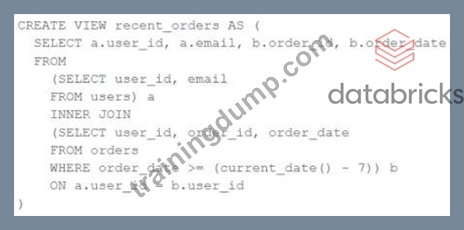
Both users and orders are Delta Lake tables.
Which statement describes the results of querying recent_orders?
- A. All logic will execute when the view is defined and store the result of joining tables to the DBFS; this stored data will be returned when the view is queried.
- B. All logic will execute at query time and return the result of joining the valid versions of the source tables at the time the query finishes.
- C. Results will be computed and cached when the view is defined; these cached results will incrementally update as new records are inserted into source tables.
- D. All logic will execute at query time and return the result of joining the valid versions of the source tables at the time the query began.
Answer: D
NEW QUESTION # 102
The data engineering team has configured a Databricks SQL query and alert to monitor the values in a Delta Lake table. The recent_sensor_recordings table contains an identifying sensor_id alongside the timestamp and temperature for the most recent 5 minutes of recordings.
The below query is used to create the alert:
The query is set to refresh each minute and always completes in less than 10 seconds. The alert is set to trigger when mean (temperature) > 120. Notifications are triggered to be sent at most Get Latest & Actual Certified-Data-Engineer-Professional Exam's Question and Answers from every 1 minute.
If this alert raises notifications for 3 consecutive minutes and then stops, which statement must be true?
- A. The source query failed to update properly for three consecutive minutes and then restarted
- B. The maximum temperature recording for at least one sensor exceeded 120 on three consecutive executions of the query
- C. The average temperature recordings for at least one sensor exceeded 120 on three consecutive executions of the query
- D. The total average temperature across all sensors exceeded 120 on three consecutive executions of the query
- E. The recent_sensor_recordingstable was unresponsive for three consecutive runs of the query
Answer: C
Explanation:
This is the correct answer because the query is using a GROUP BY clause on the sensor_id column, which means it will calculate the mean temperature for each sensor separately. The alert will trigger when the mean temperature for any sensor is greater than 120, which means at least one sensor had an average temperature above 120 for three consecutive minutes. The alert will stop when the mean temperature for all sensors drops below 120.
NEW QUESTION # 103
An upstream source writes Parquet data as hourly batches to directories named with the current date. A nightly batch job runs the following code to ingest all data from the previous day as indicated by the date variable:
Get Latest & Actual Certified-Data-Engineer-Professional Exam's Question and Answers from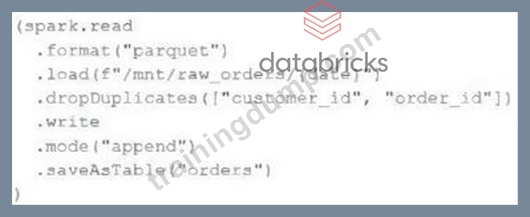
Assume that the fields customer_id and order_id serve as a composite key to uniquely identify each order.
If the upstream system is known to occasionally produce duplicate entries for a single order hours apart, which statement is correct?
- A. Each write to the orders table will only contain unique records, and only those records without duplicates in the target table will be written.
- B. Each write to the orders table will only contain unique records; if existing records with the same key are present in the target table, the operation will tail.
- C. Each write to the orders table will only contain unique records; if existing records with the same key are present in the target table, these records will be overwritten.
- D. Each write to the orders table will run deduplication over the union of new and existing records, ensuring no duplicate records are present.
- E. Each write to the orders table will only contain unique records, but newly written records may have duplicates already present in the target table.
Answer: E
Explanation:
This is the correct answer because the code uses the dropDuplicates method to remove any duplicate records within each batch of data before writing to the orders table. However, this method does not check for duplicates across different batches or in the target table, so it is possible that newly written records may have duplicates already present in the target table. To avoid this, a better approach would be to use Delta Lake and perform an upsert operation using mergeInto.
NEW QUESTION # 104
Which configuration parameter directly affects the size of a spark-partition upon ingestion of data into Spark?
- A. spark.sql.autoBroadcastJoinThreshold
- B. spark.sql.adaptive.coalescePartitions.minPartitionNum
- C. spark.sql.files.openCostInBytes
- D. spark.sql.adaptive.advisoryPartitionSizeInBytes
- E. spark.sql.files.maxPartitionBytes
Answer: E
Explanation:
Get Latest & Actual Certified-Data-Engineer-Professional Exam's Question and Answers from This is the correct answer because spark.sql.files.maxPartitionBytes is a configuration parameter that directly affects the size of a spark-partition upon ingestion of data into Spark. This parameter configures the maximum number of bytes to pack into a single partition when reading files from file- based sources such as Parquet, JSON and ORC. The default value is 128 MB, which means each partition will be roughly 128 MB in size, unless there are too many small files or only one large file.
NEW QUESTION # 105
A data engineer is using Lakeflow Declarative Pipelines Expectations feature to track the data quality of their incoming sensor data. Periodically, sensors send bad readings that are out of range, and they are currently flagging those rows with a warning and writing them to the silver table along with the good data. They've been given a new requirement ?the bad rows need to be quarantined in a separate quarantine table and no longer included in the silver table.
This is the existing code for their silver table:
@dlt.table
@dlt.expect("valid_sensor_reading", "reading < 120")
def silver_sensor_readings():
return spark.readStream.table("bronze_sensor_readings")
What code will satisfy the requirements?
- A. @dlt.table
@dlt.expect_or_drop("valid_sensor_reading", "reading < 120")
def silver_sensor_readings():
return spark.readStream.table("bronze_sensor_readings")
@dlt.table
@dlt.expect("invalid_sensor_reading", "reading < 120")
def quarantine_sensor_readings():
return spark.readStream.table("bronze_sensor_readings") - B. @dlt.table
@dlt.expect("valid_sensor_reading", "reading < 120")
def silver_sensor_readings():
return spark.readStream.table("bronze_sensor_readings")
@dlt.table
@dlt.expect("invalid_sensor_reading", "reading >= 120")
def quarantine_sensor_readings():
return spark.readStream.table("bronze_sensor_readings") - C. @dlt.table
@dlt.expect_or_drop("valid_sensor_reading", "reading < 120")
def silver_sensor_readings():
return spark.readStream.table("bronze_sensor_readings")
@dlt.table
@dlt.expect("invalid_sensor_reading", "reading >= 120")
def quarantine_sensor_readings():
return spark.readStream.table("bronze_sensor_readings") - D. @dlt.table
@dlt.expect_or_drop("valid_sensor_reading", "reading < 120")
def silver_sensor_readings():
return spark.readStream.table("bronze_sensor_readings")
@dlt.table
@dlt.expect_or_drop("invalid_sensor_reading", "reading >= 120")
def quarantine_sensor_readings():
return spark.readStream.table("bronze_sensor_readings")
Answer: B
Explanation:
Lakeflow Declarative Pipelines (DLT) supports data quality enforcement using @dlt.expect,
@dlt.expect_or_drop, and @dlt.expect_all.
@dlt.expect applies a rule and records whether rows pass or fail the condition but does not drop failing rows. Instead, failing rows can be written to a quarantine table.
@dlt.expect_or_drop enforces that only rows passing the condition flow downstream, dropping bad records automatically.
In this case, the requirement is:
Good rows (reading < 120) go to the silver table.
Bad rows (reading >= 120) go to a quarantine table.
Bad rows should not be included in silver.
The correct implementation is Option A, where:
The silver table uses @dlt.expect to validate reading < 120. These rows flow normally.
The quarantine table applies an expectation for reading >= 120, ensuring bad records are captured separately.
Other options are incorrect:
Option B/D: These either use expect_or_drop incorrectly or apply wrong conditions, leading to dropped rows without quarantining properly.
Option C: Uses expect_or_drop for both tables, which would discard bad rows instead of persisting them into a quarantine table.
Thus, Option A meets the business requirement to split good and bad data streams while ensuring both are captured for auditing and processing.
NEW QUESTION # 106
The data science team has requested assistance in accelerating queries on free form text from user reviews. The data is currently stored in Parquet with the below schema:
item_id INT, user_id INT, review_id INT, rating FLOAT, review STRING
The review column contains the full text of the review left by the user. Specifically, the data science team is looking to identify if any of 30 key words exist in this field.
A junior data engineer suggests converting this data to Delta Lake will improve query performance.
Which response to the junior data engineer's suggestion is correct?
- A. ZORDER ON review will need to be run to see performance gains.
- B. The Delta log creates a term matrix for free text fields to support selective filtering.
- C. Delta Lake statistics are not optimized for free text fields with high cardinality.
- D. Text data cannot be stored with Delta Lake.
- E. Delta Lake statistics are only collected on the first 4 columns in a table.
Answer: C
Explanation:
Converting the data to Delta Lake may not improve query performance on free text fields with high cardinality, such as the review column. This is because Delta Lake collects statistics on the minimum and maximum values of each column, which are not very useful for filtering or skipping data on free text fields. Moreover, Delta Lake collects statistics on the first 32 columns by default, which may not include the review column if the table has more columns. Therefore, the junior data engineer's suggestion is not correct. A better approach would be to use a full-text search engine, such as Elasticsearch, to index and query the review column. Alternatively, you can use natural language processing techniques, such as tokenization, stemming, and lemmatization, to preprocess the review column and create a new column with normalized terms that can be used for filtering or skipping data.
NEW QUESTION # 107
Assuming that the Databricks CLI has been installed and configured correctly, which Databricks CLI command can be used to upload a custom Python Wheel to object storage mounted with the DBFS for use with a production job?
- A. fs
- B. workspace
- C. configure
- D. jobs
- E. libraries
Answer: A
Explanation:
https://docs.databricks.com/en/archive/dev-tools/cli/dbfs-cli.html
NEW QUESTION # 108
A Data Engineer is building a fraud detection pipeline that calls out to Open AI, via a Python library, and needs to include an access token when using the API. Which Databricks CLI command should the Data Engineer use to create the secret?
- A. databricks secrets put-secret SCOPE KEY; dbutils.secrets.get (SCOPE, KEY)
- B. databricks tokens put-token KEY SCOPE; dbutils.secrets.get (KEY, SCOPE)
- C. databricks tokens put-token SCOPE KEY; dbutils.tokens.get (SCOPE, KEY)
- D. databricks secrets put-secret KEY SCOPE; dbutils.secrets.get (KEY, SCOPE)
Answer: A
Explanation:
The Databricks CLI command databricks secrets put-secret <scope> <key> is used to securely store sensitive values such as API access tokens in a secret scope. The secret can then be retrieved at runtime using dbutils.secrets.get(scope, key), ensuring credentials are not hard- coded and remain protected.
NEW QUESTION # 109
......
Authentic Databricks-Certified-Data-Engineer-Professional Dumps With 100% Passing Rate Practice Tests Dumps: https://www.trainingdump.com/Databricks/Databricks-Certified-Data-Engineer-Professional-practice-exam-dumps.html