

Latest 2025 Realistic Verified Databricks-Certified-Data-Engineer-Professional Dumps - 100% Free Databricks-Certified-Data-Engineer-Professional Exam Dumps
Get 2025 Updated Free Databricks Databricks-Certified-Data-Engineer-Professional Exam Questions and Answer
NEW QUESTION # 45
A Databricks job has been configured with 3 tasks, each of which is a Databricks notebook. Task A does not depend on other tasks. Tasks B and C run in parallel, with each having a serial dependency on Task A.
If task A fails during a scheduled run, which statement describes the results of this run?
- A. Tasks B and C will be skipped; task A will not commit any changes because of stage failure.
- B. Tasks B and C will attempt to run as configured; any changes made in task A will be rolled back due to task failure.
- C. Tasks B and C will be skipped; some logic expressed in task A may have been committed before task failure.
- D. Unless all tasks complete successfully, no changes will be committed to the Lakehouse; because task A failed, all commits will be rolled back automatically.
- E. Because all tasks are managed as a dependency graph, no changes will be committed to the Lakehouse until all tasks have successfully been completed.
Answer: C
Explanation:
When a Databricks job runs multiple tasks with dependencies, the tasks are executed in a dependency graph. If a task fails, the downstream tasks that depend on it are skipped and marked as Upstream failed. However, the failed task may have already committed some changes to the Lakehouse before the failure occurred, and those changes are not rolled back automatically. Therefore, the job run may result in a partial update of the Lakehouse. To avoid this, you can use the transactional writes feature of Delta Lake to ensure that the changes are only committed when the entire job run succeeds. Alternatively, you can use the Run if condition to configure tasks to run even when some or all of their dependencies have failed, allowing your job to recover from failures and continue running.
NEW QUESTION # 46
When evaluating the Ganglia Metrics for a given cluster with 3 executor nodes, which indicator would signal proper utilization of the VM's resources?
- A. Network I/O never spikes
- B. Bytes Received never exceeds 80 million bytes per second
- C. Total Disk Space remains constant
- D. The five Minute Load Average remains consistent/flat
- E. CPU Utilization is around 75% Get Latest & Actual Certified-Data-Engineer-Professional Exam's Question and Answers from
Answer: E
Explanation:
In the context of cluster performance and resource utilization, a CPU utilization rate of around
75% is generally considered a good indicator of efficient resource usage. This level of CPU utilization suggests that the cluster is being effectively used without being overburdened or underutilized. A consistent 75% CPU utilization indicates that the cluster's processing power is being effectively employed while leaving some headroom to handle spikes in workload or additional tasks without maxing out the CPU, which could lead to performance degradation. A five Minute Load Average that remains consistent/flat (Option A) might indicate underutilization or a bottleneck elsewhere.
Monitoring network I/O (Options B and C) is important, but these metrics alone don't provide a complete picture of resource utilization efficiency.
Total Disk Space (Option D) remaining constant is not necessarily an indicator of proper resource utilization, as it's more related to storage rather than computational efficiency.
NEW QUESTION # 47
The DevOps team has configured a production workload as a collection of notebooks scheduled to run daily using the Jobs Ul. A new data engineering hire is onboarding to the team and has requested access to one of these notebooks to review the production logic. What are the maximum notebook permissions that can be granted to the user without allowing accidental changes to production code or data?
- A. Can run
- B. Can Read
- C. Can manage
- D. Can edit
Answer: B
Explanation:
Granting a user 'Can Read' permissions on a notebook within Databricks allows them to view the notebook's content without the ability to execute or edit it. This level of permission ensures that the new team member can review the production logic for learning or auditing purposes without the risk of altering the notebook's code or affecting production data and workflows. This approach aligns with best practices for maintaining security and integrity in production environments, where strict access controls are essential to prevent unintended modifications.
NEW QUESTION # 48
What statement is true regarding the retention of job run history?
- A. It is retained until you export or delete job run logs
- B. t is retained for 60 days, during which you can export notebook run results to HTML
- C. It is retained for 90 days or until the run-id is re-used through custom run configuration
- D. It is retained for 60 days, after which logs are archived
- E. It is retained for 30 days, during which time you can deliver job run logs to DBFS or S3
Answer: B
Explanation:
https://docs.databricks.com/en/workflows/jobs/monitor-job-runs.html
NEW QUESTION # 49
A CHECK constraint has been successfully added to the Delta table named activity_details using the following logic: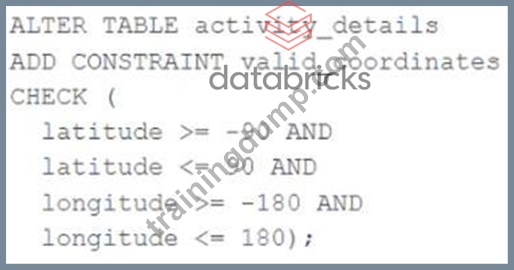
A batch job is attempting to insert new records to the table, including a record where latitude =
45.50 and longitude = 212.67.
Which statement describes the outcome of this batch insert?
- A. The write will include all records in the target table; any violations will be indicated in the boolean column named valid_coordinates.
- B. The write will insert all records except those that violate the table constraints; the violating records will be recorded to a quarantine table.
- C. The write will fail completely because of the constraint violation and no records will be inserted into the target table.
- D. The write will fail when the violating record is reached; any records previously processed will be recorded to the target table.
- E. The write will insert all records except those that violate the table constraints; the violating records will be reported in a warning log.
Answer: C
Explanation:
The CHECK constraint is used to ensure that the data inserted into the table meets the specified conditions. In this case, the CHECK constraint is used to ensure that the latitude and longitude values are within the specified range. If the data does not meet the specified conditions, the write operation will fail completely and no records will be inserted into the target table. This is because Delta Lake supports ACID transactions, which means that either all the data is written or none of it is written. Therefore, the batch insert will fail when it encounters a record that violates the Get Latest & Actual Certified-Data-Engineer-Professional Exam's Question and Answers from constraint, and the target table will not be updated.
NEW QUESTION # 50
A data pipeline uses Structured Streaming to ingest data from kafka to Delta Lake. Data is being stored in a bronze table, and includes the Kafka_generated timesamp, key, and value. Three months after the pipeline is deployed the data engineering team has noticed some latency issued during certain times of the day.
A senior data engineer updates the Delta Table's schema and ingestion logic to include the current timestamp (as recoded by Apache Spark) as well the Kafka topic and partition. The team plans to use the additional metadata fields to diagnose the transient processing delays.
Which limitation will the team face while diagnosing this problem?
- A. New fields not be computed for historic records.
- B. Updating the table schema requires a default value provided for each file added.
Get Latest & Actual Certified-Data-Engineer-Professional Exam's Question and Answers from - C. Updating the table schema will invalidate the Delta transaction log metadata.
- D. New fields cannot be added to a production Delta table.
- E. Spark cannot capture the topic partition fields from the kafka source.
Answer: A
Explanation:
When adding new fields to a Delta table's schema, these fields will not be retrospectively applied to historical records that were ingested before the schema change. Consequently, while the team can use the new metadata fields to investigate transient processing delays moving forward, they will be unable to apply this diagnostic approach to past data that lacks these fields.
NEW QUESTION # 51
Which statement describes the default execution mode for Databricks Auto Loader?
- A. Webhook trigger Databricks job to run anytime new data arrives in a source directory; new data automatically merged into target tables using rules inferred from the data.
- B. Cloud vendor-specific queue storage and notification services are configured to track newly arriving files; the target table is materialized by directly querying all valid files in the source directory.
- C. New files are identified by listing the input directory; new files are incrementally and idempotently loaded into the target Delta Lake table.
- D. Cloud vendor-specific queue storage and notification services are configured to track newly arriving files; new files are incrementally and impotently into the target Delta Lake table.
- E. New files are identified by listing the input directory; the target table is materialized by directory querying all valid files in the source directory.
Answer: C
Explanation:
Get Latest & Actual Certified-Data-Engineer-Professional Exam's Question and Answers from Explanation:
Databricks Auto Loader simplifies and automates the process of loading data into Delta Lake.
The default execution mode of the Auto Loader identifies new files by listing the input directory. It incrementally and idempotently loads these new files into the target Delta Lake table. This approach ensures that files are not missed and are processed exactly once, avoiding data duplication. The other options describe different mechanisms or integrations that are not part of the default behavior of the Auto Loader.
NEW QUESTION # 52
The DevOps team has configured a production workload as a collection of notebooks scheduled to run daily using the Jobs UI. A new data engineering hire is onboarding to the team and has requested access to one of these notebooks to review the production logic.
What are the maximum notebook permissions that can be granted to the user without allowing accidental changes to production code or data?
- A. No permissions
- B. Can Run
- C. Can Edit
- D. Can Read
- E. Can Manage
Answer: D
NEW QUESTION # 53
A table named user_ltv is being used to create a view that will be used by data analysts on various teams. Users in the workspace are configured into groups, which are used for setting up data access using ACLs.
The user_ltv table has the following schema:
email STRING, age INT, ltv INT
The following view definition is executed: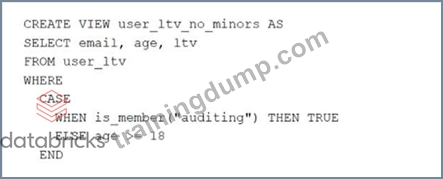
An analyst who is not a member of the auditing group executes the following query:
SELECT * FROM user_ltv_no_minors
Which statement describes the results returned by this query?
- A. All age values less than 18 will be returned as null values all other columns will be returned with the values in user_ltv.
- B. All columns will be displayed normally for those records that have an age greater than 17; records not meeting this condition will be omitted.
- C. All values for the age column will be returned as null values, all other columns will be returned with the values in user_ltv.
- D. All columns will be displayed normally for those records that have an age greater than 18; records not meeting this condition will be omitted.
- E. All records from all columns will be displayed with the values in user_ltv.
Answer: D
Explanation:
Get Latest & Actual Certified-Data-Engineer-Professional Exam's Question and Answers from Explanation:
Given the CASE statement in the view definition, the result set for a user not in the auditing group would be constrained by the ELSE condition, which filters out records based on age. Therefore, the view will return all columns normally for records with an age greater than 18, as users who are not in the auditing group will not satisfy the is_member('auditing') condition. Records not meeting the age > 18 condition will not be displayed.
NEW QUESTION # 54
A Delta Lake table representing metadata about content from user has the following schema:
Based on the above schema, which column is a good candidate for partitioning the Delta Table?
- A. Post_id
- B. latitude
- C. Date
- D. User_id
- E. Post_time
Answer: C
Explanation:
Partitioning a Delta Lake table improves query performance by organizing data into partitions based on the values of a column. In the given schema, the date column is a good candidate for partitioning for several reasons:
Time-Based Queries: If queries frequently filter or group by date, partitioning by the date column can significantly improve performance by limiting the amount of data scanned. Granularity: The date column likely has a granularity that leads to a reasonable number of partitions (not too many and not too few). This balance is important for optimizing both read and write performance.
Data Skew: Other columns like post_id or user_id might lead to uneven partition sizes (data skew), which can negatively impact performance.
Get Latest & Actual Certified-Data-Engineer-Professional Exam's Question and Answers from Partitioning by post_time could also be considered, but typically date is preferred due to its more manageable granularity.
NEW QUESTION # 55
Which statement regarding spark configuration on the Databricks platform is true?
- A. When the same spar configuration property is set for an interactive to the same interactive cluster.
Get Latest & Actual Certified-Data-Engineer-Professional Exam's Question and Answers from - B. The Databricks REST API can be used to modify the Spark configuration properties for an interactive cluster without interrupting jobs.
- C. Spark configuration properties can only be set for an interactive cluster by creating a global init script.
- D. Spark configuration properties set for an interactive cluster with the Clusters UI will impact all notebooks attached to that cluster.
- E. Spark configuration set within an notebook will affect all SparkSession attached to the same interactive cluster
Answer: D
Explanation:
When Spark configuration properties are set for an interactive cluster using the Clusters UI in Databricks, those configurations are applied at the cluster level. This means that all notebooks attached to that cluster will inherit and be affected by these configurations. This approach ensures consistency across all executions within that cluster, as the Spark configuration properties dictate aspects such as memory allocation, number of executors, and other vital execution parameters. This centralized configuration management helps maintain standardized execution environments across different notebooks, aiding in debugging and performance optimization.
NEW QUESTION # 56
A new data engineer notices that a critical field was omitted from an application that writes its Kafka source to Delta Lake. This happened even though the critical field was in the Kafka source.
That field was further missing from data written to dependent, long-term storage. The retention threshold on the Kafka service is seven days. The pipeline has been in production for three months.
Which describes how Delta Lake can help to avoid data loss of this nature in the future?
- A. Delta Lake schema evolution can retroactively calculate the correct value for newly added fields, as long as the data was in the original source.
- B. Ingestine all raw data and metadata from Kafka to a bronze Delta table creates a permanent, replayable history of the data state.Get Latest & Actual Certified-Data-Engineer-Professional Exam's Question and Answers from
- C. Data can never be permanently dropped or deleted from Delta Lake, so data loss is not possible under any circumstance.
- D. The Delta log and Structured Streaming checkpoints record the full history of the Kafka producer.
- E. Delta Lake automatically checks that all fields present in the source data are included in the ingestion layer.
Answer: B
Explanation:
This is the correct answer because it describes how Delta Lake can help to avoid data loss of this nature in the future. By ingesting all raw data and metadata from Kafka to a bronze Delta table, Delta Lake creates a permanent, replayable history of the data state that can be used for recovery or reprocessing in case of errors or omissions in downstream applications or pipelines.
Delta Lake also supports schema evolution, which allows adding new columns to existing tables without affecting existing queries or pipelines. Therefore, if a critical field was omitted from an application that writes its Kafka source to Delta Lake, it can be easily added later and the data can be reprocessed from the bronze table without losing any information.
NEW QUESTION # 57
A junior data engineer has configured a workload that posts the following JSON to the Databricks REST API endpoint 2.0/jobs/create.
Assuming that all configurations and referenced resources are available, which statement describes the result of executing this workload three times?
- A. The logic defined in the referenced notebook will be executed three times on new clusters with the configurations of the provided cluster ID.
- B. One new job named "Ingest new data" will be defined in the workspace, but it will not be executed.
- C. The logic defined in the referenced notebook will be executed three times on the referenced existing all purpose cluster.
- D. Three new jobs named "Ingest new data" will be defined in the workspace, but no jobs will be executed.
- E. Three new jobs named "Ingest new data" will be defined in the workspace, and they will each run once daily.
Answer: D
Explanation:
Databricks jobs create will create a new job with the same name each time it is run.
In order to overwrite the extsting job you need to run databricks jobs reset
NEW QUESTION # 58
The data engineering team has configured a job to process customer requests to be forgotten (have their data deleted). All user data that needs to be deleted is stored in Delta Lake tables using default table settings.
The team has decided to process all deletions from the previous week as a batch job at 1am each Sunday. The total duration of this job is less than one hour. Every Monday at 3am, a batch job executes a series of VACUUM commands on all Delta Lake tables throughout the organization.
The compliance officer has recently learned about Delta Lake's time travel functionality. They are concerned that this might allow continued access to deleted data.
Assuming all delete logic is correctly implemented, which statement correctly addresses this concern?
- A. Because the default data retention threshold is 24 hours, data files containing deleted records will be retained until the vacuum job is run the following day.
- B. Because the default data retention threshold is 7 days, data files containing deleted records will be retained until the vacuum job is run 8 days later.Get Latest & Actual Certified-Data-Engineer-Professional Exam's Question and Answers from
- C. Because Delta Lake's delete statements have ACID guarantees, deleted records will be permanently purged from all storage systems as soon as a delete job completes.
- D. Because the vacuum command permanently deletes all files containing deleted records, deleted records may be accessible with time travel for around 24 hours.
- E. Because Delta Lake time travel provides full access to the entire history of a table, deleted records can always be recreated by users with full admin privileges.
Answer: B
Explanation:
https://learn.microsoft.com/en-us/azure/databricks/delta/vacuum
NEW QUESTION # 59
Which statement describes Delta Lake optimized writes?
- A. Before a job cluster terminates, OPTIMIZE is executed on all tables modified during the most recent job.
- B. A shuffle occurs prior to writing to try to group data together resulting in fewer files instead of each executor writing multiple files based on directory partitions.
- C. Optimized writes logical partitions instead of directory partitions partition boundaries are only Get Latest & Actual Certified-Data-Engineer-Professional Exam's Question and Answers from represented in metadata fewer small files are written.
- D. An asynchronous job runs after the write completes to detect if files could be further compacted; yes, an OPTIMIZE job is executed toward a default of 1 GB.
Answer: B
Explanation:
Delta Lake optimized writes involve a shuffle operation before writing out data to the Delta table.
The shuffle operation groups data by partition keys, which can lead to a reduction in the number of output files and potentially larger files, instead of multiple smaller files. This approach can significantly reduce the total number of files in the table, improve read performance by reducing the metadata overhead, and optimize the table storage layout, especially for workloads with many small files.
NEW QUESTION # 60
Which of the following technologies can be used to identify key areas of text when parsing Spark Driver log4j output?
- A. pyspsark.ml.feature
- B. Julia
- C. Scala Datasets
- D. C++
- E. Regex
Answer: E
Explanation:
Regex, or regular expressions, are a powerful way of matching patterns in text. They can be used Get Latest & Actual Certified-Data-Engineer-Professional Exam's Question and Answers from to identify key areas of text when parsing Spark Driver log4j output, such as the log level, the timestamp, the thread name, the class name, the method name, and the message. Regex can be applied in various languages and frameworks, such as Scala, Python, Java, Spark SQL, and Databricks notebooks.
NEW QUESTION # 61
A data engineer is testing a collection of mathematical functions, one of which calculates the area under a curve as described by another function.
Which kind of the test does the above line exemplify?
- A. Unit
- B. End-to-end
- C. Integration
- D. functional
- E. Manual
Answer: A
Explanation:
A unit test is designed to verify the correctness of a small, isolated piece of code, typically a single function. Testing a mathematical function that calculates the area under a curve is an example of a unit test because it is testing a specific, individual function to ensure it operates as expected.
NEW QUESTION # 62
Assuming that the Databricks CLI has been installed and configured correctly, which Databricks CLI command can be used to upload a custom Python Wheel to object storage mounted with the DBFS for use with a production job?
- A. jobs
- B. configure
- C. workspace
- D. fs
- E. libraries
Answer: D
Explanation:
https://docs.databricks.com/en/archive/dev-tools/cli/dbfs-cli.html
NEW QUESTION # 63
The data engineer is using Spark's MEMORY_ONLY storage level. Which indicators should the data engineer look for in the spark UI's Storage tab to signal that a cached table is not performing optimally?
- A. Size on Disk is < Size in Memory
- B. The RDD Block Name included the '' annotation signaling failure to cache
- C. The number of Cached Partitions> the number of Spark Partitions
- D. Size on Disk is> 0
- E. On Heap Memory Usage is within 75% of off Heap Memory usage
Answer: D
Explanation:
When using Spark's MEMORY_ONLY storage level, the ideal scenario is that the data is fully cached in memory, and the Size on Disk should be 0 (indicating that the data is not spilled to disk). If the Size on Disk is greater than 0, it suggests that some data has been spilled to disk, which can lead to degraded performance as reading from disk is slower than reading from memory.
NEW QUESTION # 64
A table is registered with the following code:
Get Latest & Actual Certified-Data-Engineer-Professional Exam's Question and Answers from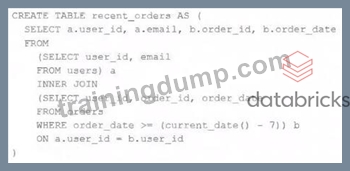
Both users and orders are Delta Lake tables. Which statement describes the results of querying recent_orders?
- A. The versions of each source table will be stored in the table transaction log; query results will be saved to DBFS with each query.
- B. Results will be computed and cached when the table is defined; these cached results will incrementally update as new records are inserted into source tables.
- C. All logic will execute when the table is defined and store the result of joining tables to the DBFS; this stored data will be returned when the table is queried.
- D. All logic will execute at query time and return the result of joining the valid versions of the source tables at the time the query finishes.
- E. All logic will execute at query time and return the result of joining the valid versions of the source tables at the time the query began.
Answer: C
Explanation:
Table is created and data of join will be stored on DBFS and it will be returned on query time.
NEW QUESTION # 65
A data architect has heard about lake's built-in versioning and time travel capabilities. For auditing purposes they have a requirement to maintain a full of all valid street addresses as they appear in the customers table.
The architect is interested in implementing a Type 1 table, overwriting existing records with new values and relying on Delta Lake time travel to support long-term auditing. A data engineer on the project feels that a Type 2 table will provide better performance and scalability. Which piece of Get Latest & Actual Certified-Data-Engineer-Professional Exam's Question and Answers from information is critical to this decision?
- A. Delta Lake time travel cannot be used to query previous versions of these tables because Type 1 changes modify data files in place.
- B. Shallow clones can be combined with Type 1 tables to accelerate historic queries for long-term versioning.
- C. Delta Lake only supports Type 0 tables; once records are inserted to a Delta Lake table, they cannot be modified.
- D. Data corruption can occur if a query fails in a partially completed state because Type 2 tables requires setting multiple fields in a single update.
- E. Delta Lake time travel does not scale well in cost or latency to provide a long-term versioning solution.
Answer: E
Explanation:
Delta Lake's time travel feature allows users to access previous versions of a table, providing a powerful tool for auditing and versioning. However, using time travel as a long-term versioning solution for auditing purposes can be less optimal in terms of cost and performance, especially as the volume of data and the number of versions grow. For maintaining a full history of valid street addresses as they appear in a customers table, using a Type 2 table (where each update creates a new record with versioning) might provide better scalability and performance by avoiding the overhead associated with accessing older versions of a large table. While Type 1 tables, where existing records are overwritten with new values, seem simpler and can leverage time travel for auditing, the critical piece of information is that time travel might not scale well in cost or latency for long-term versioning needs, making a Type 2 approach more viable for performance and scalability.
NEW QUESTION # 66
What is the first of a Databricks Python notebook when viewed in a text editor?
- A. -- Databricks notebook source
- B. // Databricks notebook source
- C. # MAGIC %python
- D. %python
- E. # Databricks notebook source
Answer: E
Explanation:
https://docs.databricks.com/en/notebooks/notebook-export-import.html#import-a-file-and-convert- it-to-a-notebook
NEW QUESTION # 67
......
Databricks-Certified-Data-Engineer-Professional Dumps PDF and Test Engine Exam Questions: https://www.trainingdump.com/Databricks/Databricks-Certified-Data-Engineer-Professional-practice-exam-dumps.html