

[Dec-2023] AZ-600 PDF Dumps Are Helpful To produce Your Dreams Correct QA's
New AZ-600 exam Free Sample Questions to Practice
NEW QUESTION # 49
You have an Azure Stack Hub integrated system.
You install the Azure Gallery Packager (.azpkg) tool on a management workstation.
You need to define a custom Azure Stack Hub Marketplace item that will provision a virtual machine from a base image.
Which file should you configure for each requirement? To answer, drag the appropriate files to the correct requirements. Each file may be used once, more than once, or not at all. You may need to drag the split bar between panes or scroll to view content.
Answer:
Explanation:
Explanation
NEW QUESTION # 50
You start the update of an Azure Stack Hub integrated system. The Update run details are shown in the following exhibit.
Use the drop-down menus to select the answer choice that completes each statement based on the information presented in the graphic.
NOTE: Each correct selection is worth one point.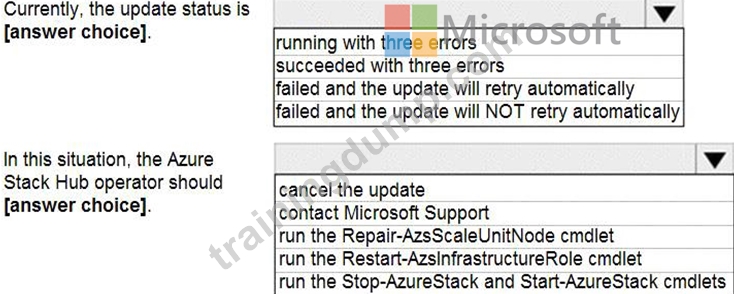
Answer:
Explanation:
Explanation
Reference:
https://docs.microsoft.com/en-us/azure-stack/operator/azure-stack-apply-updates?view=azs-2008
NEW QUESTION # 51
You have an Azure Stack Hub integrated system that is enabled for multitenancy and uses an Azure Active Directory (Azure AD) tenant named fabrikam.com as an identity provider.
The integrated system has the following guest directory tenants onboarded and enabled for multitenancy:
* com
* onmicrosoft.com
* onmicrosoft.com
You need to verify whether all the guest directory tenants are registered properly.
How should you complete the PowerShell script? To answer, drag the appropriate cmdlet to the correct targets.
Each cmdlet may be used once, more than once, or not at all. You may need to drag the split bar between panes or scroll to view content.
NOTE: Each correct selection is worth one point.
Answer:
Explanation:
Explanation
Reference:
https://docs.microsoft.com/en-us/azure-stack/operator/azure-stack-enable-multitenancy?view=azs-2008
NEW QUESTION # 52
You have an Azure Stack Hub integrated system that uses an Azure Active Directory (Azure AD) identity provider.
You have a group named AppGroup1.
You need to provide an application with the ability to access Azure Stack Hub resources by using AppGroup1.
Which four actions should you perform in sequence? To answer, move the appropriate actions from the list of actions to the answer area and arrange them in the correct order.
Answer:
Explanation:
Explanation
Reference:
https://docs.microsoft.com/en-us/azure-stack/operator/azure-stack-create-service-principals?view=azs-2008&tab
NEW QUESTION # 53
You have an Azure Stack Hub integrated system that uses an Active Directory (Azure AD) tenant named contoso.com.
An Azure Stack Hub operator named Operator1 receives the alert shown in the following exhibit.
Use the drop-down menus to select the answer choice that completes each statement based on the information presented in the graphic.
NOTE: Each correct selection is worth one point.
Answer:
Explanation:
Explanation
Box 1: 30 days
We cannot tell for sure without the exhibit. It would likely be either 30 or 90 days.
The Azure Stack Hub root certificate is provisioned during deployment with an expiration of five years.
Starting with 2108, internal secret rotation also rotates the root certificate. The standard secret expiration alert identifies the expiry of the root certificate and generates alerts at both 90 (warning) and 30 (critical) days.
Note: Manual remediation
If the Repair option is not supported, be sure to follow the complete set of remediation instructions provided in the alert. As an example, the internal certificate expiration remediation steps will guide you through the process of secret rotation:
Graphical user interface, text, application Description automatically generated
Box 2: running the Start-SecreatRotation -Internal PowerShell cmdlet from the priveged endpoint (PEP) session Start-SecretRotation cmdlet rotates the infrastructure secrets of an Azure Stack Hub system. This cmdlet can only be executed against the Azure Stack Hub privileged endpoint, by using an Invoke-Command script block passing the PEP session in the -Session parameter. By default, it rotates only the certificates of all external network infrastructure endpoints.
Reference:
https://learn.microsoft.com/en-us/azure-stack/operator/azure-stack-rotate-secrets
https://learn.microsoft.com/en-us/azure-stack/operator/azure-stack-monitor-health
NEW QUESTION # 54
You have an Azure Stack Hub integrated system that is enabled for multitenancy.
The Directories list for the integrated system is shown in the following exhibit.
Use the drop-down menus to select the answer choice that completes each statement based on the information presented in the graphic.
NOTE: Each correct selection is worth one point.
Answer:
Explanation:
Explanation
Box 1: 3
3 registered, and one in need of an update.
Note: Update the Azure Stack Hub directories
When an Azure Stack Hub directory update is required, a status of Update Required is shown. For example:
Graphical user interface, application Description automatically generated
To update the directory, select the Directory name checkbox, and then select Update.
Box 2: global administrator of ITHCSubAS2021.onmicrosoft.com
The guest directory ITHCSubAS2021.onmicrosoft.com needs an update.
Update the guest directory
An Azure Stack Hub operator should also inform the guest directory owner that they need to update their directory by using the URL shared for registration.
Reference:
https://learn.microsoft.com/en-us/azure-stack/operator/enable-multitenancy
NEW QUESTION # 55
You are troubleshooting the chargeback issues of the dev1 region.
You need to query the usage for each tenant subscription.
What should you do? To answer, select the appropriate options in the answer area.
NOTE: Each correct selection is worth one point.
Answer:
Explanation:
Explanation
Box 1: Administrator management endpoint
Note: The developers report high chargeback costs for the dev1 region.
Two integrated systems that are dedicated to application development and have the following configurations:
* The integrated systems are disconnected from the Internet. The workloads in the user subscriptions have Internet access.
* One integrated system has a region name of dev1, and the other has a region name of dev2.
* Both regions are used only by developers at Northwind Traders.
The request gets consumption details for the requested subscriptions and for the requested time frame. There is no request body.
This usage API is a provider API, so the caller must be assigned an Owner, Contributor, or Reader role in the provider's subscription.
Method, Request URI
GET
https://{armendpoint}/subscriptions/{subId}/providers/Microsoft.Commerce.Admin/subscriberUsageAggregates Arguments
* armendpoint
Azure Resource Manager endpoint of your Azure Stack Hub environment. The Azure Stack Hub convention is that the name of the Azure Resource Manager endpoint is in the format
https://adminmanagement.{domain-name}. For example, for the Azure Stack Development Kit (ASDK), if the domain name is local.azurestack.external, then the Resource Manager endpoint is
https://adminmanagement.local.azurestack.external.
* subId
Subscription ID of the user who makes the call.
* Etc.
Box 2: Get-AzsSubscriberUsage
Retrieve usage information
PowerShell
To generate the usage data, you should have resources that are running and actively using the system; for example, an active virtual machine (VM), or a storage account containing some data. If you're not sure whether you have any resources running in the Azure Stack Hub Marketplace, deploy a VM, and verify the VM monitoring blade to make sure it's running. Use the following PowerShell cmdlets to view the usage data:
* Install PowerShell for Azure Stack Hub.
* Configure the Azure Stack Hub user or the Azure Stack Hub operator PowerShell environment.
* To retrieve the usage data, call the Get-AzsSubscriberUsage PowerShell cmdlet:
Get-AzsSubscriberUsage -ReportedStartTime "2017-09-06T00:00:00Z"
Reference: https://learn.microsoft.com/en-us/azure-stack/operator/azure-stack-provider-resource-api
NEW QUESTION # 56
You have an Azure Stack Hub integrated system.
The Volumes list for the integrated system is shown in the following exhibit.
Use the drop-down menus to select the answer choice that completes each statement based on the information presented in the graphic.
NOTE: Each correct selection is worth one point.
Answer:
Explanation:
Explanation
NEW QUESTION # 57
You have an Azure Stack Hub integrated system that uses an Azure Active Directory (Azure AD) identity provider.
You have a group named AppGroup1.
You need to provide an application with the ability to access Azure Stack Hub resources by using AppGroup1.
Which four actions should you perform in sequence? To answer, move the appropriate actions from the list of actions to the answer area and arrange them in the correct order.
Answer:
Explanation:
1 - Sign in to the Azure portal
2 - Create an app resgistration
3 - Generate a client secret
4 - Add the app to a group
Reference:
https://docs.microsoft.com/en-us/azure-stack/operator/azure-stack-create-service-principals?view=azs-2008&tabs=az1%2Caz2&pivots=state-connected
NEW QUESTION # 58
Note: This question is part of a series of questions that present the same scenario. Each question in the series contains a unique solution that might meet the stated goals. Some question sets might have more than one correct solution, while others might not have a correct solution.
After you answer a question in this section, you will NOT be able to return to it. As a result, these questions will not appear in the review screen.
You have an Azure Stack Hub integrated system that connects to the Internet. The integrated system uses an Enterprise Agreement (EA) for licensing.
You are creating an Azure Resource Manager template to generate a marketplace item for a virtual machine that runs Windows Server 2019 Datacenter and a custom application.
You need to ensure that Windows Server is licensed by using the bring-your-own-license model.
Solution: You add licenseType: None to the Azure Resource Manager template.
Does this meet the goal?
- A. No
- B. Yes
Answer: A
NEW QUESTION # 59
You need to implement the App Service infrastructure to address the current issues and support the planned changes for Azure Functions in Boston.
What should you do? To answer, select the appropriate options in the answer area.
NOTE: Each correct selection is worth one point.
Answer:
Explanation:
Explanation
Table Description automatically generated
Reference:
https://docs.microsoft.com/en-us/azure-stack/operator/azure-stack-app-service-capacity-planning?view=azs-2008
NEW QUESTION # 60
You have an Azure Stack Hub integrated system that is disconnected from the Internet. The integrated system is registered to an Azure Active Directory (Azure AD) tenant named contoso.com.
You need to download the latest Ubuntu image for Azure Stack Hub Marketplace.
How should you complete the PowerShell script? To answer, drag the appropriate cmdlets to the correct targets. Each cmdlet may be used once, more than once, or not at all. You may need to drag and split the bar between panes to scroll to view content.
NOTE: Each correct selection is worth one point.
Answer:
Explanation:
Explanation
Reference:
https://docs.microsoft.com/en-us/azure-stack/operator/azure-stack-download-azure-marketplace-item?view=azs-
NEW QUESTION # 61
You need to change the int1 region to use the capacity model. The solution must meet the technical requirements.
Which three actions should you perform in sequence? To answer, move the appropriate actions from the list of actions to the answer area and arrange them in the correct order.
Answer:
Explanation:
Explanation
NEW QUESTION # 62
You have an Azure Stack Hub integrated system that uses an Azure Active Directory (Azure AD) tenant named fabrikam.com as an identity provider. The integrated system region name is region1, and the external domain name is fabrikam.com.
The integrated system has the following domains enabled for multitenancy:
fabrikam.onmicrosoft.com
contoso.onmicrosoft.com
fabrikam.com
contoso.com
You need to disable multitenancy for contoso.com.
How should you complete the PowerShell script? To answer, select the appropriate options in the answer area.
NOTE: Each correct selection is worth one point.
Answer:
Explanation:
Explanation
Graphical user interface, application Description automatically generated
Reference:
https://docs.microsoft.com/en-us/azure-stack/operator/azure-stack-enable-multitenancy?view=azs-2008
NEW QUESTION # 63
You need to configure the log forwarding. The solution must meet the Azure Stack Hub requirements.
What should you do?
- A. Connect to 192.168.100.224 and run the Set-SyslogServer and Set-SyslogClient cmdlets.
- B. Connect to 192.168.101.101 and run the Set-EventLogLevel and Add-AzLogProfile cmdlets.
- C. Connect to 192.168.100.224 and run the Set-EventLogLevel and Add-AzLogProfile cmdlets.
- D. Connect to 192.168.101.101 and run the Set-SyslogServer and Set-SyslogClient cmdlets.
Answer: D
Explanation:
Explanation
Integrate Azure Stack Hub with monitoring solutions using syslog forwarding The syslog channel exposes audits, alerts, and security logs from all the components of the Azure Stack Hub infrastructure. Use syslog forwarding to integrate with security monitoring solutions and to retrieve all audits, alerts, and security logs to store them for retention.
Cmdlets to configure syslog forwarding
Configuring syslog forwarding requires access to the privileged endpoint (PEP). Two PowerShell cmdlets have been added to the PEP to configure the syslog forwarding:
### cmdlet to pass the syslog server information to the client and to configure the transport protocol, the encryption and the authentication between the client and the server Set-SyslogServer [-ServerName <String>] [-ServerPort <UInt16>] [-NoEncryption] [-SkipCertificateCheck]
[-SkipCNCheck] [-UseUDP] [-Remove]
### cmdlet to configure the certificate for the syslog client to authenticate with the server Set-SyslogClient [-pfxBinary <Byte[]>] [-CertPassword <SecureString>] Reference:
https://learn.microsoft.com/en-us/azure-stack/operator/azure-stack-integrate-security
NEW QUESTION # 64
You plan to deploy a disconnected Azure Stack Hub integrated system named eastus.azurestack.contoso.com.
Azure Stack Hub clients will be isolated from the internet.
You need to identify which certificates and certificate type to use for the deployment.
What should you identify? To answer, select the appropriate options in the answer area.
NOTE: Each correct selection is worth one point.
Answer:
Explanation:
Explanation
D:\mudassar\Untitled.jpg
NEW QUESTION # 65
......
The AZ-600 certification exam covers a range of topics, including configuring and managing Azure Stack Hub infrastructure, deploying and managing Azure Stack Hub Marketplace items, implementing Azure Stack Hub security and monitoring, and deploying and managing Azure Stack Hub hybrid cloud solutions. Candidates will also be tested on their ability to troubleshoot Azure Stack Hub issues, configure networking, and manage storage solutions.
Cover AZ-600 Exam Questions Make Sure You 100% Pass: https://www.trainingdump.com/Microsoft/AZ-600-practice-exam-dumps.html
AZ-600 dumps Accurate Questions and Answers with Free: https://drive.google.com/open?id=1mlhA1jOaHBfARqtCY15C5MSciNoyHlSB