

Go to C_ABAPD_2309 Questions - Try C_ABAPD_2309 dumps pdf
Dumps Practice Exam Questions Study Guide for the C_ABAPD_2309 Exam
NEW QUESTION # 46 
To adhere to the most recent ABAP SQL syntax conventions from SAP, on which line must you insert the
"INTO TABLE @gt flights" clause to complete the SQL statement?
- A. #6
- B. #4
- C. #15
- D. #8
Answer: B
Explanation:
Explanation
To adhere to the most recent ABAP SQL syntax conventions from SAP, you must insert the "INTO TABLE
@gt flights" clause on line #4 to complete the SQL statement. This is because the INTO or APPENDING clause should be specified immediately after the SELECT clause, according to the ABAP SQL syntax conventions1. The INTO or APPENDING clause defines the data object to which the results set of the SELECT statement is assigned. The data object can be an internal table, a work area, or an inline declaration.
In this case, the data object is an internal table named gt_flights, which is created using the inline declaration operator @DATA. The inline declaration operator allows you to declare and create a data object in the same statement where it is used, without the need for a separate DATA statement2.
The other lines are not suitable for inserting the "INTO TABLE @gt flights" clause, as they would violate the ABAP SQL syntax conventions or cause syntax errors. These lines are:
#6: This line is not suitable for inserting the "INTO TABLE @gt flights" clause, as it would cause a syntax error. This is because the FROM clause must be specified before the INTO or APPENDING clause, according to the ABAP SQL syntax conventions1. The FROM clause defines the data sources from which the data is read, such as database tables, CDS view entities, or CDS DDIC-based views. In this case, the data source is the database table flights.
#8: This line is not suitable for inserting the "INTO TABLE @gt flights" clause, as it would cause a syntax error. This is because the ORDER BY clause must be specified after the INTO or APPENDING clause, according to the ABAP SQL syntax conventions1. The ORDER BY clause defines the sort order of the results set of the SELECT statement. In this case, the results set is sorted by the fields carrid, connid, and fltime.
#15: This line is not suitable for inserting the "INTO TABLE @gt flights" clause, as it would violate the ABAP SQL syntax conventions. This is because the INTO or APPENDING clause should be specified as close as possible to the SELECT clause, according to the ABAP SQL syntax conventions1. The INTO or APPENDING clause should not be separated from the SELECT clause by other clauses, such as the WHERE clause, the GROUP BY clause, the HAVING clause, the UNION clause, or the ORDER BY clause. This is to improve the readability and maintainability of the ABAP SQL statement.
References: SELECT - ABAP Keyword Documentation, Inline Declarations - ABAP Keyword Documentation
NEW QUESTION # 47
Image:
In the following ABAP SQL code, what are valid case distinctions? Note: There are 2 correct answers to this question.
- A.

- B.

- C.

- D.

Answer: A,C
NEW QUESTION # 48
For the assignment, gv_target = gv_source.
which of the following data declarations will always work without truncation or rounding? Note: There are 2 correct answers to this question.
- A. DATA gv_source TYPE p LENGTH 8 DECIMALS 3. to DATA gv_target TYPE p LENGTH 16 DECIMALS 2.
- B. DATA gv_source TYPE string, to DATA gv_target TYPE c.
- C. DATA gv_source TYPE d. to DATA gv_target TYPE string.
- D. DATA gv_source TYPE c. to DATA gv_target TYPE string.
Answer: C,D
Explanation:
Explanation
The data declarations that will always work without truncation or rounding for the assignment gv_target = gv_source are B and C. This is because the target data type string is a variable-length character type that can hold any character string, including those of data types c (fixed-length character) and d (date). The assignment of a character or date value to a string variable will not cause any loss of information or precision, as the string variable will adjust its length to match the source value12.
You cannot do any of the following:
A: DATA gv_source TYPE string, to DATA gv_target TYPE c.: This data declaration may cause truncation for the assignment gv_target = gv_source. This is because the target data type c is a fixed-length character type that has a predefined length. If the source value of type string is longer than the target length of type c, the source value will be truncated on the right to fit the target length12.
D: DATA gv_source TYPE p LENGTH 8 DECIMALS 3. to DATA gv_target TYPE p LENGTH 16 DECIMALS 2.: This data declaration may cause rounding for the assignment gv_target = gv_source.
This is because the target data type p is a packed decimal type that has a predefined length and number of decimal places. If the source value of type p has more decimal places than the target type p, the source value will be rounded to the target number of decimal places12.
References: 1: ABAP Data Types - ABAP Keyword Documentation - SAP Online Help 2: ABAP Assignment Rules - ABAP Keyword Documentation - SAP Online Help
NEW QUESTION # 49
Image:
In the following ABAP SQL code, what are valid case distinctions? Note: There are 2 correct answers to this question.
- A.

- B.

- C.

- D.

Answer: A,B
NEW QUESTION # 50
Which of the following integration frameworks have been released for ABAP cloud development? Note:
There are 3 correct answers to this question.
- A. Business Add-ins (BAdls)
- B. OData services
- C. Business Events
- D. SOAP consumption
- E. CDS Views
Answer: B,C,D
Explanation:
Explanation
The following are the integration frameworks that have been released for ABAP cloud development:
SOAP consumption: This framework allows you to consume SOAP web services from ABAP cloud applications. You can use the ABAP Development Tools in Eclipse to create a service consumption model based on a WSDL file or URL. The service consumption model generates the required ABAP artifacts, such as proxy classes, data types, and constants, to access the web service. You can then use the proxy classes to call the web service operations from your ABAP code1 Business Events: This framework allows you to publish and subscribe to business events from ABAP cloud applications. Business events are messages that represent a change in the state of a business object or process. You can use the ABAP Development Tools in Eclipse to create a business event definition based on a CDS view entity or a projection view. The business event definition specifies the event key, the event payload, and the event metadata. You can then use the ABAP Messaging Channel (AMC) framework to publish and subscribe to business events using the AMC API2 OData services: This framework allows you to expose and consume OData services from ABAP cloud applications. OData is a standardized protocol for creating and consuming RESTful APIs. You can use the ABAP RESTful Application Programming Model (RAP) to create OData services based on CDS view entities or projection views. The RAP framework generates the required OData metadata and runtime artifacts, such as service definitions, service bindings, and service implementations. You can then use the SAP Gateway framework to register and activate your OData services. You can also use the ABAP Development Tools in Eclipse to consume OData services from other sources using the service consumption model3 The other integration frameworks are not released for ABAP cloud development, as they are either not supported or not recommended for cloud scenarios. These frameworks are:
CDS Views: CDS views are not an integration framework, but a data modeling framework. CDS views are used to define data models based on database tables or other CDS view entities. CDS views can have associations, aggregations, filters, parameters, and annotations. CDS views can also be used as the basis for other integration frameworks, such as OData services or business events4 Business Add-ins (BAdls): BAdls are not supported for ABAP cloud development, as they are part of the classic ABAP enhancement framework. BAdls are used to implement custom logic in predefined enhancement spots in the standard SAP code. BAdls are not compatible with the cloud strategy and the clean core paradigm, as they modify the SAP code and can cause upgrade and maintenance issues. For ABAP cloud development, SAP recommends using the key user extensibility tools or the side-by-side extensibility approach instead of BAdls.
References: Consuming SOAP Services - ABAP Keyword Documentation, Business Events - ABAP Keyword Documentation, OData Services - ABAP Keyword Documentation, CDS Data Model Views - ABAP Keyword Documentation, [Business Add-Ins (BAdIs) - ABAP Keyword Documentation]
NEW QUESTION # 51
Exhibit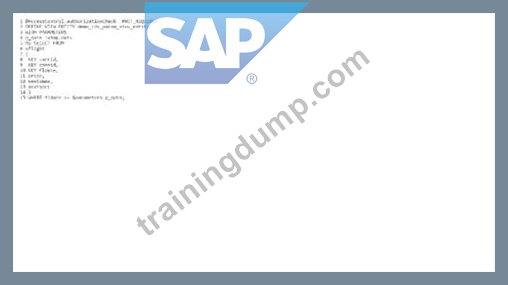
Which of the following ABAP SQL snippets are syntactically correct ways to provide a value for the parameter on line #4? Note: There are 2 correct answers to this question
- A. ...SELECT * FROM demo_cds_param_view entity (p_date: $session.system_date)...
- B. ...SELECT * FROM demo_cds_param_view_entity (p_date: 20238181')... )
- C. ...SELECT * FROM deno_cds_param_view_entity (p_date = @
(cl_abap_context_info->get_system_date ())... - D. ...SELECT * FROM deno_cds_param_view_entity (p_date - '20230101')... )
Answer: C,D
NEW QUESTION # 52
In RESTful Application Programming, which EML statement retrieves an object?
- A. Find entity
- B. Select entity
- C. Get entity
- D. Read entity
Answer: C
Explanation:
Explanation
In RESTful Application Programming, the EML statement that retrieves an object is GET entity. The GET entity statement is used to read data of an entity instance from the database or the transaction buffer. The GET entity statement can specify the entity name, the entity key, and the entity elements to be retrieved. The GET entity statement can also use the IN LOCAL MODE addition to bypass the access control, authorization control, and feature control checks. The GET entity statement returns a single entity instance or raises an exception if no instance is found or multiple instances match the key.
The other EML statements are not used to retrieve an object, but have different purposes and effects. These statements are:
FIND entity: This statement is used to search for entity instances that match a given condition. The FIND entity statement can specify the entity name, the entity elements to be returned, and the condition to be applied. The FIND entity statement can also use the IN LOCAL MODE addition to bypass the access control, authorization control, and feature control checks. The FIND entity statement returns a table of entity instances or an empty table if no instances match the condition.
SELECT entity: This statement is used to query data of entity instances from the database or the transaction buffer. The SELECT entity statement can specify the entity name, the entity elements to be returned, and the filter, order, and aggregation options to be applied. The SELECT entity statement can also use the IN LOCAL MODE addition to bypass the access control, authorization control, and feature control checks. The SELECT entity statement returns a table of entity instances or an empty table if no instances match the query.
READ entity: This statement is not a valid EML statement, but an ABAP statement. The READ statement is used to access a single row of an internal table using the table index or the table key. The READ statement can also use the TRANSPORTING addition to specify which fields should be returned, and the INTO addition to specify the target variable. The READ statement returns a single row of the internal table or raises an exception if no row is found or multiple rows match the key.
References: GET ENTITY - ABAP Keyword Documentation, FIND ENTITY, ENTITIES - ABAP Keyword Documentation, SELECT ENTITY, ENTITIES - ABAP Keyword Documentation, READ - ABAP Keyword Documentation
NEW QUESTION # 53
Exhibit:
What are valid statements? Note: There are 3 correct answers to this question.
- A. Instead of go_cll = NEW #() you could use go_iff - NEW #(...).
- B. Instead of go ell = NEW #(...) you could use go ifl = NEW cll(. ... ).
- C. go_ifl may call method m2 with go if->m2(...).
- D. go_if 1 may call method ml with go_ift->ml().
- E. go_cll may call method ml with go_dl->ifl-ml().
Answer: B,C,D
Explanation:
Explanation
The following are the explanations for each statement:
A: This statement is valid. go_ifl may call method ml with go_ifl->ml(). This is because go_ifl is a data object of type REF TO ifl, which is a reference to the interface ifl. The interface ifl defines a method ml, which can be called using the reference variable go_ifl. The class cll implements the interface ifl, which means that it provides an implementation of the method ml. The data object go_ifl is assigned to a new instance of the class cll using the NEW operator and the inline declaration operator @DATA. Therefore, when go_ifl->ml() is called, the implementation of the method ml in the class cll is executed123 B: This statement is valid. Instead of go_cll = NEW #(...) you could use go_ifl = NEW cll(...). This is because go_ifl is a data object of type REF TO ifl, which is a reference to the interface ifl. The class cll implements the interface ifl, which means that it is compatible with the interface ifl. Therefore, go_ifl can be assigned to a new instance of the class cll using the NEW operator and the class name cll. The inline declaration operator @DATA is optional in this case, as go_ifl is already declared. The parentheses after the class name cll can be used to pass parameters to the constructor of the class cll, if any123 E: This statement is valid. go_ifl may call method m2 with go_ifl->m2(...). This is because go_ifl is a data object of type REF TO ifl, which is a reference to the interface ifl. The class cll implements the interface ifl, which means that it inherits all the components of the interface ifl. The class cll also defines a method m2, which is a public method of the class cll. Therefore, go_ifl can call the method m2 using the reference variable go_ifl. The method m2 is not defined in the interface ifl, but it is accessible through the interface ifl, as the interface ifl is implemented by the class cll. The parentheses after the method name m2 can be used to pass parameters to the method m2, if any123 The other statements are not valid, as they have syntax errors or logical errors. These statements are:
C: This statement is not valid. go_cll may call method ml with go_cll->ifl~ml(). This is because go_cll is a data object of type REF TO cll, which is a reference to the class cll. The class cll implements the interface ifl, which means that it inherits all the components of the interface ifl. The interface ifl defines a method ml, which can be called using the reference variable go_cll. However, the syntax for calling an interface method using a class reference is go_cll->ml(), not go_cll->ifl~ml(). The interface component selector ~ is only used when calling an interface method using an interface reference, such as go_ifl->ifl~ml(). Using the interface component selector ~ with a class reference will cause a syntax error123 D: This statement is not valid. Instead of go_cll = NEW #() you could use go_ifl = NEW #(...). This is because go_ifl is a data object of type REF TO ifl, which is a reference to the interface ifl. The interface ifl cannot be instantiated, as it does not have an implementation. Therefore, go_ifl cannot be assigned to a new instance of the interface ifl using the NEW operator and the inline declaration operator @DATA.
This will cause a syntax error or a runtime error. To instantiate an interface, you need to use a class that implements the interface, such as the class cll123 References: INTERFACES - ABAP Keyword Documentation, CLASS - ABAP Keyword Documentation, NEW - ABAP Keyword Documentation
NEW QUESTION # 54
Given the following code in an SAP S/4HANA Cloud private edition tenant:
The class zcl_demo_class is in a software component with the language version set to "ABAP Cloud". The function module ZF1' is in a different software component with the language version set to "Standard ABAP".
Both the class and function module are customer created.
Regarding line #6, which of the following are valid statements? Note: There are 2 correct answers to this question.
- A. ZF1" can be called if a wrapper is created for it but the wrapper itself is not released for cloud development.
- B. 'ZF1' can be called if a wrapper is created for it and the wrapper itself is released for cloud development.
- C. "ZF1" can be called whether it is released or not for cloud development
- D. ZF1' can be called only if it is released for cloud development.
Answer: B,D
Explanation:
Explanation
The ABAP Cloud Development Model requires that only public SAP APIs and extension points are used to access SAP functionality and data. These APIs and extension points are released by SAP and documented in the SAP API BusinessHub1. Customer-created function modules are not part of the public SAP APIs and are not released for cloud development. Therefore, calling a function module directly from an ABAP Cloud class is not allowed and will result in a syntax error. However, there are two possible ways to call a function module indirectly from an ABAP Cloud class:
Create a wrapper class or interface for the function module and release it for cloud development. A wrapper is a class or interface that encapsulates the function module and exposes its functionality through public methods or attributes. The wrapper must be created in a software component with the language version set to "Standard ABAP" and must be marked as released for cloud development using the annotation @EndUserText.label. The wrapper can then be called from an ABAP Cloud class using the public methods or attributes2.
Use the ABAP Cloud Connector to call the function module as a remote function call (RFC) from an ABAP Cloud class. The ABAP Cloud Connector is a service that enables the secure and reliable communication between SAP BTP, ABAP environment and on-premise systems. The function module must be exposed as an RFC-enabled function module in the on-premise system and must be registered in the ABAP Cloud Connector. The ABAP Cloud class can then use the class cl_rfc_destination_service to get the destination name and the class cl_abap_system to create a proxy object for the function module. The proxy object can then be used to call the function module3.
References: 1: SAP API Business Hub 2: Creating an ABAP Cloud Project | SAP Help Portal 3: Calling Remote Function Modules | SAP Help Portal
NEW QUESTION # 55
Exhibit:
With Icl_super being superclass for Icl_subl and Icl_sub2 and with methods subl_methl and sub2_methl being subclass-specific methods of Id_subl or Icl_sub2, respectivel. What will happen when executing these casts?
Note:
There are 2 correct answers to this question
- A. go subl = CAST # go super), will not work
- B. go_sub2 = CAST #(go_super). will not work. ] go sub2->sub2 meth 1(...). will work
- C. go_sub2 = CAST # go super), will work. go_subl CAST #go_super), will work
- D. go_subl->subl_meth !(...)* w'll work.
Answer: A,D
Explanation:
Explanation
The following are the explanations for each statement:
A: This statement is correct. go_subl = CAST #(go_super) will not work. This is because go_subl is a data object of type REF TO cl_subl, which is a reference to the subclass cl_subl. go_super is a data object of type REF TO cl_super, which is a reference to the superclass cl_super. The CAST operator is used to perform a downcast or an upcast of a reference variable to another reference variable of a compatible type. A downcast is a conversion from a more general type to a more specific type, while an upcast is a conversion from a more specific type to a more general type. In this case, the CAST operator is trying to perform a downcast from go_super to go_subl, but this is not possible, as go_super is not pointing to an instance of cl_subl, but to an instance of cl_super. Therefore, the CAST operator will raise an exception CX_SY_MOVE_CAST_ERROR at runtime12 B: This statement is incorrect. go_sub2 = CAST #(go_super) will work. go_subl = CAST #(go_super) will not work. This is because go_sub2 is a data object of type REF TO cl_sub2, which is a reference to the subclass cl_sub2. go_super is a data object of type REF TO cl_super, which is a reference to the superclass cl_super. The CAST operator is used to perform a downcast or an upcast of a reference variable to another reference variable of a compatible type. A downcast is a conversion from a more general type to a more specific type, while an upcast is a conversion from a more specific type to a more general type. In this case, the CAST operator is trying to perform a downcast from go_super to go_sub2, and this is possible, as go_super is pointing to an instance of cl_sub2, which is a subclass of cl_super.
Therefore, the CAST operator will assign the reference of go_super to go_sub2 without raising an exception. However, the CAST operator will not work for go_subl, as explained in statement A12 C: This statement is incorrect. go_sub2 = CAST #(go_super) will work. go_sub2->sub2_meth1(...) will not work. This is because go_sub2 is a data object of type REF TO cl_sub2, which is a reference to the subclass cl_sub2. go_super is a data object of type REF TO cl_super, which is a reference to the superclass cl_super. The CAST operator is used to perform a downcast or an upcast of a reference variable to another reference variable of a compatible type. A downcast is a conversion from a more general type to a more specific type, while an upcast is a conversion from a more specific type to a more general type. In this case, the CAST operator is trying to perform a downcast from go_super to go_sub2, and this is possible, as go_super is pointing to an instance of cl_sub2, which is a subclass of cl_super.
Therefore, the CAST operator will assign the reference of go_super to go_sub2 without raising an exception. However, the method call go_sub2->sub2_meth1(...) will not work, as sub2_meth1 is a subclass-specific method of cl_sub2, which is not inherited by cl_super. Therefore, the method call will raise an exception CX_SY_DYN_CALL_ILLEGAL_METHOD at runtime123 D: This statement is correct. go_subl->subl_meth1(...) will work. This is because go_subl is a data object of type REF TO cl_subl, which is a reference to the subclass cl_subl. subl_meth1 is a subclass-specific method of cl_subl, which is not inherited by cl_super. Therefore, the method call go_subl->subl_meth1(...) will work, as go_subl is pointing to an instance of cl_subl, which has the method subl_meth1123 References: NEW - ABAP Keyword Documentation, CAST - ABAP Keyword Documentation, Method Call - ABAP Keyword Documentation
NEW QUESTION # 56
What RESTful Application Programming object contains only the fields required for a particular app?
- A. Metadata extension
- B. Projection View
- C. Database view
- D. Data model view
Answer: B
Explanation:
Explanation
A projection view is a RESTful Application Programming object that contains only the fields required for a particular app. A projection view is a CDS view entity that defines a projection on an existing CDS view entity or CDS DDIC-based view. A projection view exposes a subset of the elements of the projected entity, which are relevant for a specific business service. A projection view can also define aliases, virtual elements, and annotations for the projected elements. A projection view is the top-most layer of a CDS data model and prepares data for a particular use case. A projection view can have different provider contracts depending on the type of service it supports, such as transactional query, analytical query, or transactional interface.
A database view is a CDS DDIC-based view that defines a join or union of database tables. A database view has an SQL view attached and can be accessed by Open SQL or native SQL. A database view can be used as a projected entity for a projection view, but it does not contain only the fields required for a particular app.
A metadata extension is a RESTful Application Programming object that defines additional annotations for a CDS view entity or a projection view. A metadata extension can be used to enhance the metadata of a CDS data model without changing the original definition. A metadata extension does not contain any fields, but only annotations.
A data model view is a CDS view entity that defines a data model based on database tables or other CDS view entities. A data model view can have associations, aggregations, filters, parameters, and annotations. A data model view can be used as a projected entity for a projection view, but it does not contain only the fields required for a particular app.
References: CDS Projection Views - ABAP Keyword Documentation, CDS Projection Views in ABAP CDS:
What's Your Flavor, Business Object Projection - ABAP Keyword Documentation
NEW QUESTION # 57
Which ABAP SQL clause allows the use of inline declarations?
- A. INTO
- B. INTO CORRESPONDING FIELDS OF
- C. FROM
- D. FIELDS
Answer: A
Explanation:
Explanation
The ABAP SQL clause that allows the use of inline declarations is the INTO clause. The INTO clause is used to specify the target variable or field symbol where the result of the SQL query is stored. The INTO clause can use inline declarations to declare the target variable or field symbol at the same position where it is used, without using a separate DATA or FIELD-SYMBOLS statement. The inline declaration is performed using the DATA or @DATA operators in the declaration expression12. For example:
The following code snippet uses the INTO clause with an inline declaration to declare a local variable itab and store the result of the SELECT query into it:
SELECT * FROM scarr INTO TABLE @DATA (itab).
The following code snippet uses the INTO clause with an inline declaration to declare a field symbol
<fs> and store the result of the SELECT query into it:
SELECT SINGLE * FROM scarr INTO @<fs>.
You cannot do any of the following:
FROM: The FROM clause is used to specify the data source of the SQL query, such as a table, a view, or a join expression. The FROM clause does not allow the use of inline declarations12.
INTO CORRESPONDING FIELDS OF: The INTO CORRESPONDING FIELDS OF clause is used to specify the target structure or table where the result of the SQL query is stored. The INTO CORRESPONDING FIELDS OF clause does not allow the use of inline declarations. The target structure or table must be declared beforehand using a DATA or FIELD-SYMBOLS statement12.
FIELDS: The FIELDS clause is used to specify the columns or expressions that are selected from the data source of the SQL query. The FIELDS clause does not allow the use of inline declarations. The FIELDS clause must be followed by an INTO clause that specifies the target variable or field symbol where the result is stored12.
References: 1: SELECT - ABAP Keyword Documentation - SAP Online Help 2: Inline Declarations - ABAP Keyword Documentation - SAP Online Help
NEW QUESTION # 58
What are valid statements? Note: There are 2 correct answers to this question.
- A. #EC_NEEDED is not checked by the syntax checker.
- B. The pseudo-comment is checked by the syntax checker
- C. ##NEEDED is checked by the syntax checker.
- D. The pragma is not checked by the syntax checker.
Answer: C,D
Explanation:
Explanation
Both statements are valid in ABAP, but they have different effects on the program.
##NEEDED is a pragma that can be used to hide warnings from the ABAP compiler syntax check. It tells the check tools that a variable or a parameter is needed for further processing, even if it is not used in the current statement. For example, if you declare a variable without assigning any value to it, you can use ##NEEDED to suppress the warning about unused variables12.
The pragma is not checked by the syntax checker means that you can use any pragma to hide any warning from the ABAP compiler syntax check, regardless of its effect on the program logic or performance. For example, if you use ##SHADOW to hide a warning about an obscured function, you can also use it to hide a warning about an invalid character in a string12.
You cannot do any of the following:
#EC_NEEDED is not checked by the syntax checker: This is not a valid statement in ABAP. There is no pseudo-comment with #EC_NEEDED in ABAP3.
The pseudo-comment is checked by the syntax checker: This is false. Pseudo-comments are obsolete and should no longer be used in ABAP. They were replaced by pragmas since SAP NW 7.0 EhP2 (Enhancement Package)4.
References: 1: Pragmas - ABAP Keyword Documentation - SAP Online Help 2: [What are pragmas and pseudo comments in ABAP? | SAP Blogs - SAP Community] 3: ABAP Keyword Documentation - SAP Online Help 4: What are PRAGMAS and Pseudo comments in SAP ABAP
NEW QUESTION # 59 
When accessing the subclass instance through go_super, what can you do? Note: There are 2 correct answers to this question.
- A. Call a subclass specific public method
- B. Call inherited public redefined methods.
- C. Access the inherited public components.
- D. Access the inherited private components.
Answer: C,D
Explanation:
Explanation
When accessing the subclass instance through go_super, you can do both of the following:
Access the inherited private components: A subclass inherits all the private attributes and methods of its superclass, unless they are explicitly overridden by the subclass. Therefore, you can access the inherited private componentsof the superclass through go_super, as long as they are not hidden by other attributes or methods in the subclass12.
Access the inherited public components: A subclass inherits all the public attributes and methods of its superclass, unless they are explicitly overridden by the subclass. Therefore, you can access the inherited public components of the superclass through go_super, as long as they are not hidden by other attributes or methods in the subclass12.
You cannot do any of the following:
Call a subclass specific public method: A subclass does not have any public methods that are not inherited from its superclass. Therefore, you cannot call a subclass specific public method through go_super12.
Call inherited public redefined methods: A subclass does not have any public methods that are redefined from its superclass. Therefore, you cannot call inherited public redefined methods through go_super12.
References: 1: Object Oriented - ABAP Development - Support Wiki 2: Inheritance and Instantiation - ABAP Keyword Documentation
NEW QUESTION # 60
Exhibit
Which of the following ABAP SQL snippets are syntactically correct ways to provide a value for the parameter on line #4? Note: There are 2 correct answers to this question
- A. ...SELECT * FROM demo_cds_param_view entity (p_date: $session.system_date)...
- B. ...SELECT * FROM demo_cds_param_view_entity (p_date: 20238181')... )
- C. ...SELECT * FROM deno_cds_param_view_entity (p_date = @
(cl_abap_context_info->get_system_date ())... - D. ...SELECT * FROM deno_cds_param_view_entity (p_date - '20230101')... )
Answer: C,D
NEW QUESTION # 61
You have two internal tables itab1 and itab2.What is true for using the expression itab1 = corresponding #( itab2 )? Note: There are 2 correct answers to this question.
- A. Fields with the same name and the same type will be copied from itab2 to itab1.
- B. itab1 and itab2 must have the same data type.
- C. Fields with the same name but with different types may be copied from itab2 to itab1.
- D. itab1 and itab2 must have at least one field name in common.
Answer: A,D
Explanation:
Explanation
The expression itab1 = corresponding #( itab2 ) is a constructor expression with the component operator CORRESPONDING that assigns the contents of the internal table itab2 to the internal table itab1. The following statements are true for using this expression:
B: itab1 and itab2 must have at least one field name in common. This is because the component operator CORRESPONDING assigns the identically named columns of itab2 to the identically named columns of itab1 by default, according to the rules of MOVE-CORRESPONDING for internal tables. If itab1 and itab2 do not have any field name in common, the expression will not assign any value to itab1 and it will remain initial or unchanged1 C: Fields with the same name and the same type will be copied from itab2 to itab1. This is because the component operator CORRESPONDING assigns the identically named columns of itab2 to the identically named columns of itab1 by default, according to the rules of MOVE-CORRESPONDING for internal tables. If the columns have the same name but different types, the assignment will try to perform a conversion between the types, which may result in a loss of precision, a truncation, or a runtime error, depending on the types involved1 The following statements are false for using this expression:
A: Fields with the same name but with different types may be copied from itab2 to itab1. This is not true, as explained in statement C. The assignment will try to perform a conversion between the types, which may result in a loss of precision, a truncation, or a runtime error, depending on the types involved1 D: itab1 and itab2 must have the same data type. This is not true, as the component operator CORRESPONDING can assign the contents of an internal table of one type to another internal table of a different type, as long as theyhave at least one field name in common. The target type of the expression is determined by the left-hand side of the assignment, which is itab1 in this case. The expression will create an internal table of the same type as itab1 and assign it to itab11 References: CORRESPONDING - Component Operator - ABAP Keyword Documentation
NEW QUESTION # 62
......
Free SAP Certified Associate C_ABAPD_2309 Exam Question: https://www.trainingdump.com/SAP/C_ABAPD_2309-practice-exam-dumps.html
C_ABAPD_2309 Dumps with Practice Exam Questions Answers: https://drive.google.com/open?id=1mhw08PtW8LSW8tPu4tcijHA5uyLOBjFl