

Latest [Dec 09, 2021] 1Z0-821 Exam Questions – Valid 1Z0-821 Dumps Pdf
1Z0-821 Practice Test Questions Answers Updated 245 Questions
Oracle 1Z0-821 Exam Syllabus Topics:
| Topic | Details |
|---|---|
| Topic 1 |
|
| Topic 2 |
|
| Topic 3 |
|
| Topic 4 |
|
| Topic 5 |
|
| Topic 6 |
|
| Topic 7 |
|
| Topic 8 |
|
NEW QUESTION 28
View the Exhibit and review the file system information displayed from a remote server.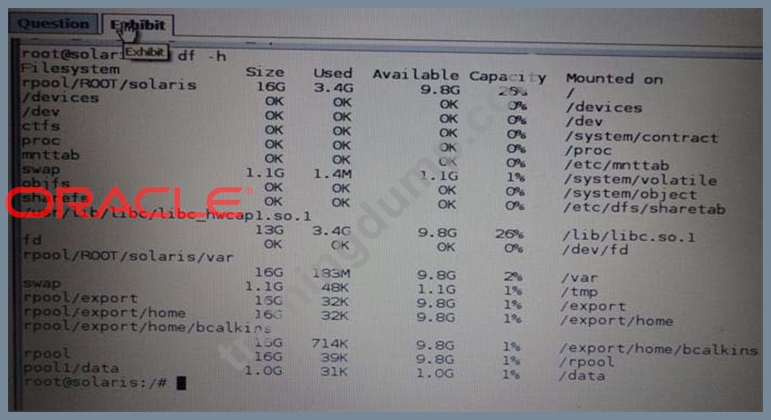
You are configuring a new server. This new server has the following storage pool configured:
This new server also has the following file systems configured: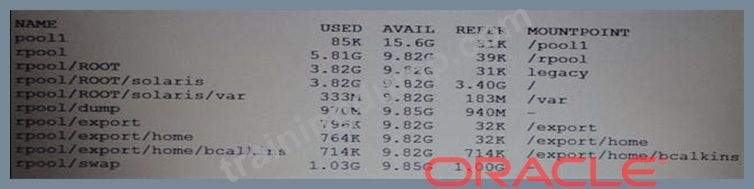
When you are finished building this new server, the pool1/data dataset must be an exact duplicate of note server. What is the correct procedure to create the pool1/data dataset on this new server?
- A. zfs create -o mountpoint=/data -o refquota=1gpool1/data
- B. zfs create quota=1g pool1/data
- C. zfs create mountpoint=/data pool1/data
- D. zfs set quota=1g pool1/data
- E. zfs set mountpoint=nonepool1zfs create pool1/data
- F. zfs set mountpoint=nonepool1zfs create -o mountpoint=/data -o quota=1gpool1/data
Answer: C
NEW QUESTION 29
On server A, you enter the following command to add a static route to serverA route -p add
-host 192.168.1.101 192.168.1.101 -static
What is the purpose of this command?
- A. to specify routing to an adjacent network when in.rdisc is not used
- B. to specify an IPMP target IP address to in.mpathd
- C. to specify routing to an adjacent network when in.routed is not used
- D. to ensure the IP address for serverB is not flushed from the ARP cache
- E. to temporarily bypass IP Filter rules
- F. to optimize link aggregation using a direct connection between two systems
Answer: B
Explanation:
Note: # route -p add -host destination-IP gateway-IP -static
where destination-IP and gateway-IP are IPv4 addresses of the host to be used as a target.
For example, you would type the following to specify the target system 192.168.10.137, which is on the same subnet as the interfaces in IPMP group itops0:
$ route -p add -host 192.168.10.137 192.168.10.137 -static
This new route will be automatically configured every time the system is restarted. If you want to define only a temporary route to a target system for probe-based failure detection, then do not use the -p option.
NEW QUESTION 30
Which two options describe how to override the default boot behavior of an Oracle Solaris 11 SPARC system to boot the system to the single-user milestone?
- A. From from the ok prompt, issue this command:boot -m milestone=s
- B. From the ok prompt, issue this command:boot -m milestone/single-user
- C. from the ok prompt, issue this command:boot -m milestone=single-user
- D. From the ok prompt. issue this command:boot -s
- E. From the ok prompt, issue this command:boot -milestone=single-user
Answer: C,D
Explanation:
By default, Solaris will boot to the pseudo milestone "all" and start all services. This behaviour can be changed at boot time using either "-s" to reach single-user, or the new SMF option "-m milestone=XXX" (see kernel(1M) for a list of the bootable milestones) to select an explicit milestone.
Note: boot -s is the same as: boot -m milestone=single-user
with the difference being that the former is a lot less to type and is what most SysAdmins will be familiar with.
NEW QUESTION 31
Solaris 11 includes a redesigned software packaging model: the Image Packaging system.
Which three describe advantages of the Image Packaging System over the previous Solaris 10 SVR4 packaging model?
- A. Allows for the installation of the OS without a local DVD or installation server
- B. Allows users to publish their own software package in a software repository
- C. Makes the patching process more efficient with less downtime
- D. Eliminates OS version upgrade
- E. Eliminates patching of the software package
- F. Allows the use of a repository mirror to speed up package operation
Answer: B,E,F
NEW QUESTION 32
The default publisher on your system is:
You want to update the Oracle Solaris 11 environment on your system, but you are not able to connect this system to the Internet to access the default Oracle repository. A repository has been created on your local network and is named http://server1.example.com.
Which command would you choose to connect your system to the local repository?
- A. pkgset-publisher to set the origin for the publisher
- B. pkg set-publisher to set the stickiness on the http://server1.example.com publisher and unset stickiness for http://pkg.oracle.com/solaris/release
- C. pkg add-publisher to add the new publisher
- D. pkg publisher to specify the new publisher
Answer: A
Explanation:
Solaris 11 Express makes it pretty easy to set up a local copy of the repository.
A common reason folks need access to a local repository is because their system is not connected
to the Internet.
Tthe pkg set-publisher command can be used to for example add a publisher or to enable or
disable a publisher.
Note: Example Adding a Publisher
Use the -g option to specify the publisher origin URI.
# pkg set-publisher -g http://pkg.example.com/release example.com
Example Specifying the Preferred Publisher
Use the -P option to specify a publisher as the preferred publisher. The specified publisher moves
to the top of the search order. You can specify the -P option when you add a publisher or you can
modify an existing publisher.
# pkg set-publisher -P example.com
Example Enabling or Disabling a Publisher
Use the -d option to disable a publisher. The preferred publisher cannot be disabled. A disabled
publisher is not used in package operations such as list and install. You can modify the properties
of a disabled publishers.
Use the -e option to enable a publisher.
# pkg set-publisher -d example2.com
Reference: Managing Package Publishers
NEW QUESTION 33
To confirm the IP address and netmask have been correctly configured on the network interfaces which command should you use?
- A. ipadm show-ifconfig
- B. ipdilm show-if
- C. ipadm show-nic
- D. ipadm show-addripadm show-mask
- E. ipadm show-addr
Answer: E
Explanation:
Explanation/Reference:
Explanation:
Show address information, either for the given addrobj or all the address objects configured on the specified interface, including the address objects that are only in the persistent configuration.
State can be: disabled, down, duplicate, inaccessible, ok, tentative
Example:
# ipadm show-addr
ADDROBJ TYPE STATE ADDR
lo0/v4 static ok 127.0.0.1/8
lo0/v6 static ok ::1/128
NEW QUESTION 34
You want to deploy Oracle Solaris 11 with the Automated Installer (AI). You need to make sure that your server and network meet the requirements for using AI.
Identify two requirements for using AI.
- A. The minimum requirement to operate as an AI install server is 1 GB of memory.
- B. You can create only one manifest per install service. If you need more than one manifest,you should create multiple install services.
- C. If two client machines have different architectures and need to be installed with the same version of the Oracle Solaris 11 OS,then you should create two AI manifests and a single install service.
- D. You should set up DHCP. The DHCP server and AI install server can be the same machine or two different machines.
Answer: C,D
Explanation:
A: An automated installation of a client over the network consists of the following high-level
steps:
Step 1. The client system boots over the network and gets its network configuration and the
location of the install server from the DHCP server.
Step 2: The install server provides a boot image to the client.
Etc.
D: If two client machines need to be installed with the same version of the Oracle Solaris
11 OS but
need to be installed differently in other ways,then create two AI manifests for the AI install
service. The different AI manifests can specify different packages to install or a different slice as the install target,for example.
NEW QUESTION 35
You display the IP interface information with ipmpstat -i.
Which two characteristics are indicated by characters that may be included in the FLAGS column?
- A. unusable due to being inactive
- B. IP forwarding enabled IS
- C. allocated to global zone
- D. default route
- E. nominated to send/receive IPv4 multicast for its IPMP group
Answer: A,E
Explanation:
FLAGS
Indicates the status of each underlying interface, which can be one or any combination of the following:
(D) d indicates that the interface is down and therefore unusable.
(E) M indicates that the interface is designated by the system to send and receive IPv6 multicast traffic for the IPMP group.
Note:
i indicates that the INACTIVE flag is set for the interface. Therefore, the interface is not used to send or receive data traffic.
s indicates that the interface is configured to be a standby interface.
m indicates that the interface is designated by the system to send and receive IPv4 multicast traffic for the IPMP group.
b indicates that the interface is designated by the system to receive broadcast traffic for the IPMP group.
h indicates that the interface shares a duplicate physical hardware address with another interface and has been taken offline. The h flag indicates that the interface is unusable.
NEW QUESTION 36
Which two capabilities are provided by the OpenBoot PROM?
- A. a command to safely shut down the system
- B. starting the GRUB loader
- C. booting from a disk or network
- D. hardware testing and initialization
Answer: C,D
Explanation:
OpenBoot firmware is executed immediately after you turn on your system. The primary tasks of OpenBoot firmware are to:
*Test and initialize the system hardware (B)
*Determine the hardware configuration
*Boot the operating system from either a mass storage device or from a network (C)
*Provide interactive debugging facilities for testing hardware and software
Reference: OpenBoot 4.x Command Reference Manual
NEW QUESTION 37
You need to connect two nonglobal zones using a private virtual network.
Identify the network resources required in the global zone to accomplish this.
- A. an etherstub and two virtual network interfaces
- B. two etherstubs
- C. a virtual bridge
- D. two virtual network interfaces.
Answer: A
NEW QUESTION 38
Which network protocol is responsible for routing packets from one network to another?
- A. IP
- B. ICMP
- C. TCP
- D. UDP
- E. Ethernet
Answer: A
Explanation:
The Internet Protocol (IP) is the principal communications protocol in the Internet protocol suite for relaying datagrams across network boundaries. Its routing function enables internetworking, and essentially establishes the Internet.
NEW QUESTION 39
On which is the open boot prom available?
- A. x86 only
- B. SPARC only
- C. x86 64-Bit only
- D. x86, x86 64-Bit and SPARC
- E. both x86 and x86 64-Bit
Answer: B
Explanation:
No OpenBoot Environment on the Intel Platform. The Intel environment has no OpenBoot PROM or NVRAM. On Intel systems, before the kernel is started, the system is controlled by the basic input/output system (BIOS), the firmware interface on a PC. Therefore, many features provided by OpenBoot are not available on Intel systems.
Note: The Open Boot PROM (OBP) bootloader only exists within SPARC. Before Solaris
10 01/06, the bootloader for Solaris x86 was a Sun customized bootstrap software. After Solaris 10 01/06, it uses GRUB, a well known bootloader that's commonly used in the Linux world.
With GRUB, it's much easier to make the system dual-boot Linux and Solaris. GRUB extends the capabilities of the bootloader that was not available previously such as the ability to boot from a USB DVD drive. Those who have used Linux will be quite familiar with GRUB and its options.
NEW QUESTION 40
View the Exhibit.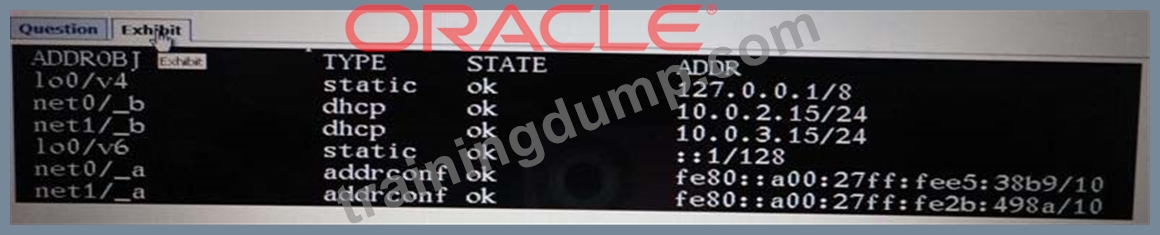
After Installing the OS, you need to verify the network interface information. Which command was used to display the network interface information in the exhibit?
- A. ifconfiq -a
- B. svcs -1 network/physical
- C. netstat -a
- D. ipadm show-addr
Answer: D
Explanation:
'ipadm show-addr' displays all the configured addresses on the system.
Example: # ipadm show-addr ADDROBJ TYPE STATE ADDR lo0/v4 static ok 127.0.0.1/8 lo0/v6 static ok ::1/128
NEW QUESTION 41
Review the non-global zone configuration displayed below: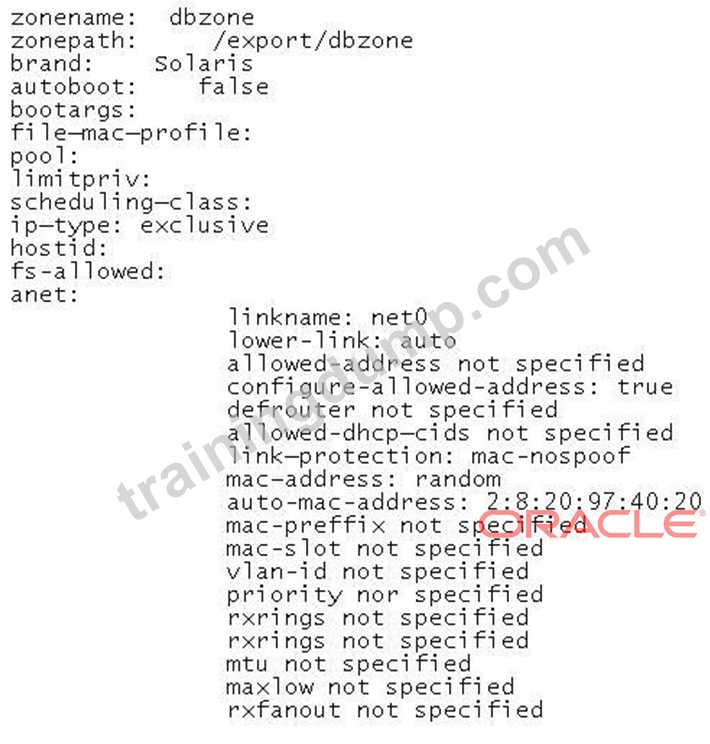
The global zone has 1024 MB of physical memory. You need to limit the non-global zone so that it uses no more than 500 MB of the global zone's physical memory. Which option would you choose?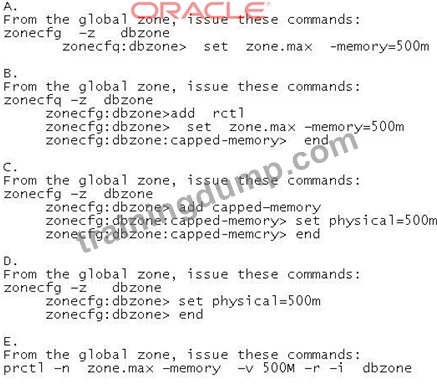
- A. Option C
- B. Option B
- C. Option D
- D. Option E
- E. Option A
Answer: A
Explanation:
Add a memory cap.
zonecfg:my-zone> add capped-memory
Set the memory cap.
zonecfg:my-zone:capped-memory> set physical=50m
End the memory cap specification.
zonecfg:my-zone:capped-memory> end
NEW QUESTION 42
To confirm the IP address and netmask have been correctly configured on the network interfaces which command should you use?
- A. ipadm show-ifconfig
- B. ipdilm show-if
- C. ipadm show-nic
- D. ipadm show-addripadm show-mask
- E. ipadm show-addr
Answer: E
Explanation:
Show address information, either for the given addrobj or all the address objects configured on the specified interface, including the address objects that are only in the persistent configuration.
State can be: disabled, down, duplicate, inaccessible, ok, tentative
Example:
# ipadm show-addr
ADDROBJ TYPE STATE ADDR
lo0/v4 static ok 127.0.0.1/8
lo0/v6 static ok ::1/128
NEW QUESTION 43
After installing the OS, you boot the system and notice that the syslogd daemon is not accepting messages from remote systems.
Which two options should you select to modify the syslogd daemon configuration so that it accepts messages from remote systems?
- A. Set the following parameter in the /etc/default/syslogd file:
LOG_FROM_REMOTE=YESRestart the syslogd daemon. - B. svccfg -s svc:/system/system -log setprop start/exec= "syslogd -t"Restart the syslogd daemon.
- C. svcadm enable svc:/system/system -log/config/log_from_remoteRestart the syslogd daemon.
- D. Set the following parameter in the /etc/syslogd.conf file: LOG_FROM_REMOTE= YESRestart the syslogd daemon.
- E. svccfg -s svc:/system/system-log setprop config/log_from_remote=trueRestart the syslogd daemon.
Answer: D,E
Explanation:
B: The /etc/default/syslogd file contains the following default parameter settings. See FILES.
LOG_FROM_REMOTE
Specifies whether remote messages are logged. LOG_FROM_REMOTE=NO is equivalent to the -t command-line option. The default value for LOG_FROM_REMOTE is YES.
NEW QUESTION 44
Select two correct statements about the authentication services available in Oracle Solaris
11.
- A. The Secure Shell can be configured to allow logins across a network to remote servers without transmitting passwords across the network.
- B. Simple Authentication and Security Layer (SASL) provides a mechanism to authenticate and encrypt access to local file system data.
- C. Pluggable Authentication Modules (PAM) is used to control the operation of services such console logins and ftp.
- D. Secure Remote Procedure Calls (Secure RPC) provides a mechanism to encrypt data on any IP Socket connection.
- E. Pluggable Authentication Modules (PAM) is used to implement the Secure Shell in Oracle Solaris 11.
Answer: B,C
Explanation:
A: Pluggable Authentication Modules (PAM) are an integral part of the authentication mechanism for the Solaris. PAM provides system administrators with the ability and flexibility to choose any authentication service available on a system to perform end-user authentication.
By using PAM, applications can perform authentication regardless of what authentication method is defined by the system administrator for the given client.
PAM enables system administrators to deploy the appropriate authentication mechanism for each service throughout the network. System administrators can also select one or multiple authentication technologies without modifying applications or utilities. PAM insulates application developers from evolutionary improvements to authentication technologies, while at the same time allowing deployed applications to use those improvements.
PAM employs run-time pluggable modules to provide authentication for system entry services.
E: The Simple Authentication and Security Layer (SASL) is a method for adding authentication support to connection-based protocols.
Simple Authentication and Security Layer (SASL) is a framework for authentication and data security in Internet protocols. It decouples authentication mechanisms from application protocols, in theory allowing any authentication mechanism supported by SASL to be used in any application protocol that uses SASL. Authentication mechanisms can also support proxy authorization, a facility allowing one user to assume the identity of another. They can also provide a data security layer offering data integrity and data confidentiality services.
DIGEST-MD5 provides an example of mechanisms which can provide a data-security layer. Application protocols that support SASL typically also support Transport Layer Security (TLS) to complement the services offered by SASL.
NEW QUESTION 45
......
1Z0-821 dumps Sure Practice with 245 Questions: https://www.trainingdump.com/Oracle/1Z0-821-practice-exam-dumps.html